
Location
CoLab, COM 100
Start Date
1-5-2025 8:30 AM
Document Type
Poster
Description
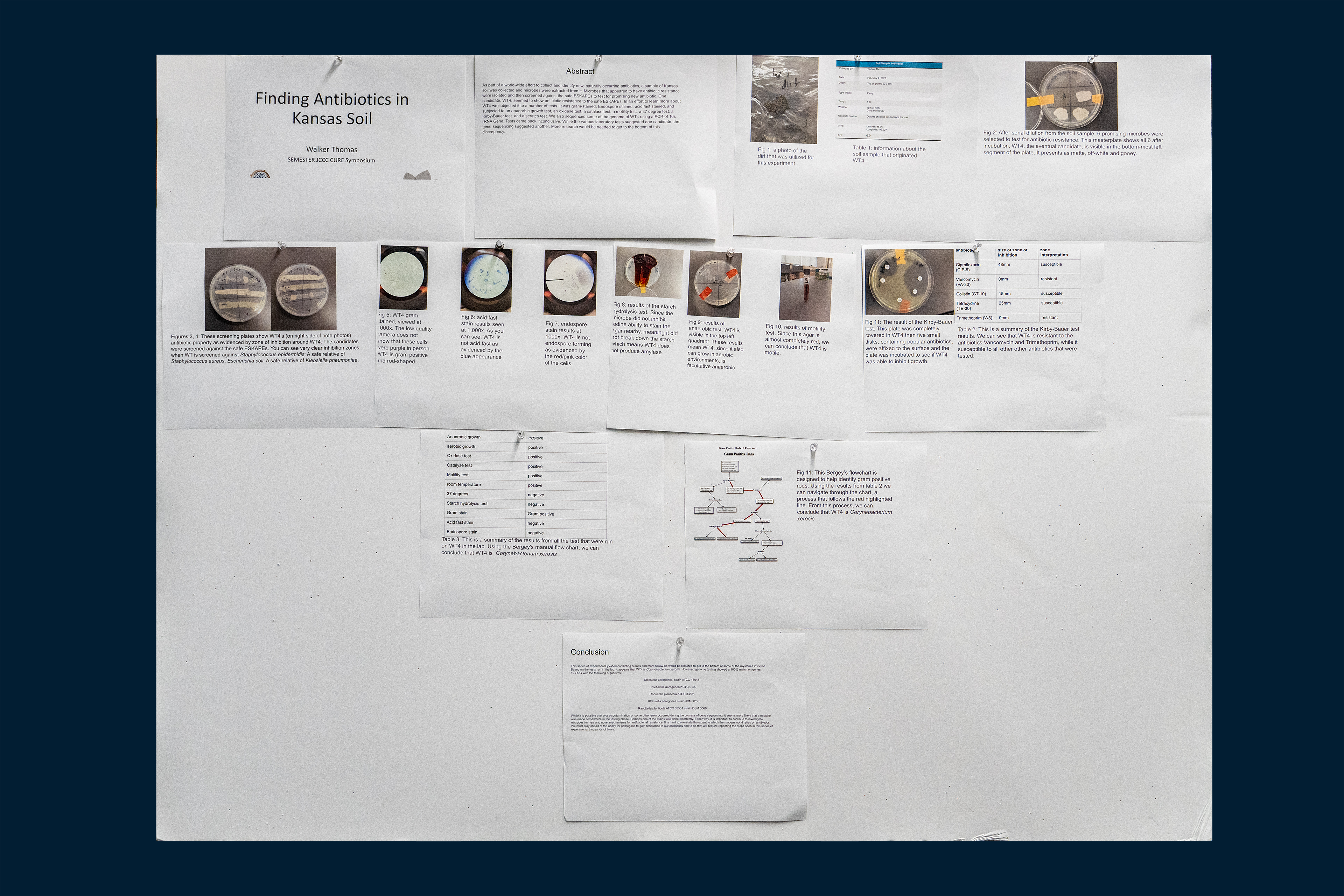
Since penicillin was discovered almost 100 years ago, we have been living in an age of antibiotics. The change that this brought to the world cannot be overstated, the number of people who lived through an infection that would have killed them before this time is hard to quantify. However, this miracle is not without its issues. Since the discovery of these drugs, they have been widely prescribed across the whole world. While this has saved lives it has caused bacteria to evolve into antibiotic resistant forms. The growing number of antibiotic resistant bacteria represents an existential threat to the world we have built. In order to develop new antibiotic drugs we can turn to bacteria itself. By finding and identifying new bacteria with natural antimicrobial qualities, we can help develop the next generation of antibiotics. This experiment used Kansas soil to source bacteria and then used a series of scientific techniques to isolate then test bacteria that seem to exhibit antibiotic properties. The bacteria were screened against the safe ESKAPEs and a collected bacteria (WT4, in this experiment) was especially resistant to Staphylococcus epidermidis, a safe relative of Staphylococcus aureus as well as to Enterococcus faecalis, a safe relative of Enterococcus faecium. Further experiments allowed us to learn more about this organism and how, exactly, it inhibits growth in other organisms. Hopefully, this research will allow us to continue to develop drugs and treatments that will keep us healthy and safe.
Image
Finding the Next Generation of Antibiotics
CoLab, COM 100
Since penicillin was discovered almost 100 years ago, we have been living in an age of antibiotics. The change that this brought to the world cannot be overstated, the number of people who lived through an infection that would have killed them before this time is hard to quantify. However, this miracle is not without its issues. Since the discovery of these drugs, they have been widely prescribed across the whole world. While this has saved lives it has caused bacteria to evolve into antibiotic resistant forms. The growing number of antibiotic resistant bacteria represents an existential threat to the world we have built. In order to develop new antibiotic drugs we can turn to bacteria itself. By finding and identifying new bacteria with natural antimicrobial qualities, we can help develop the next generation of antibiotics. This experiment used Kansas soil to source bacteria and then used a series of scientific techniques to isolate then test bacteria that seem to exhibit antibiotic properties. The bacteria were screened against the safe ESKAPEs and a collected bacteria (WT4, in this experiment) was especially resistant to Staphylococcus epidermidis, a safe relative of Staphylococcus aureus as well as to Enterococcus faecalis, a safe relative of Enterococcus faecium. Further experiments allowed us to learn more about this organism and how, exactly, it inhibits growth in other organisms. Hopefully, this research will allow us to continue to develop drugs and treatments that will keep us healthy and safe.
Comments
The faculty mentor for this project was Eulandria Biddle, Biology.