

Location
CoLab, COM 100
Start Date
1-5-2025 5:30 PM
Document Type
Poster
Description
The Tiny Earth Project is focused on researching soil for bacteria with the possible discovery of novel antibiotics. The purpose of this research is to combat the known pathogenic bacteria that are harming humans. Even with the current discovery of antibiotics, problems still exist in combating these bacteria due to the building up of resistance to the antibiotics. For that reason, the project aims to discover new antibiotics to fight against these resistances as well as the bacteria itself. During the research conducted, we were able to see the bacteria isolated from a soil collection inhibit the growth of some safe ESKAPEs (non-pathogenic relatives of the ESKAPE pathogen); the candidate bacteria was tested against E.faecalis, S.epidermis, E.coli, A.baylyi, P.putida, and E.aerogenes. This means that the bacteria used for research has a possibility of creating a new antibiotic that can fight the pathogenic bacteria or their resistance.
Image
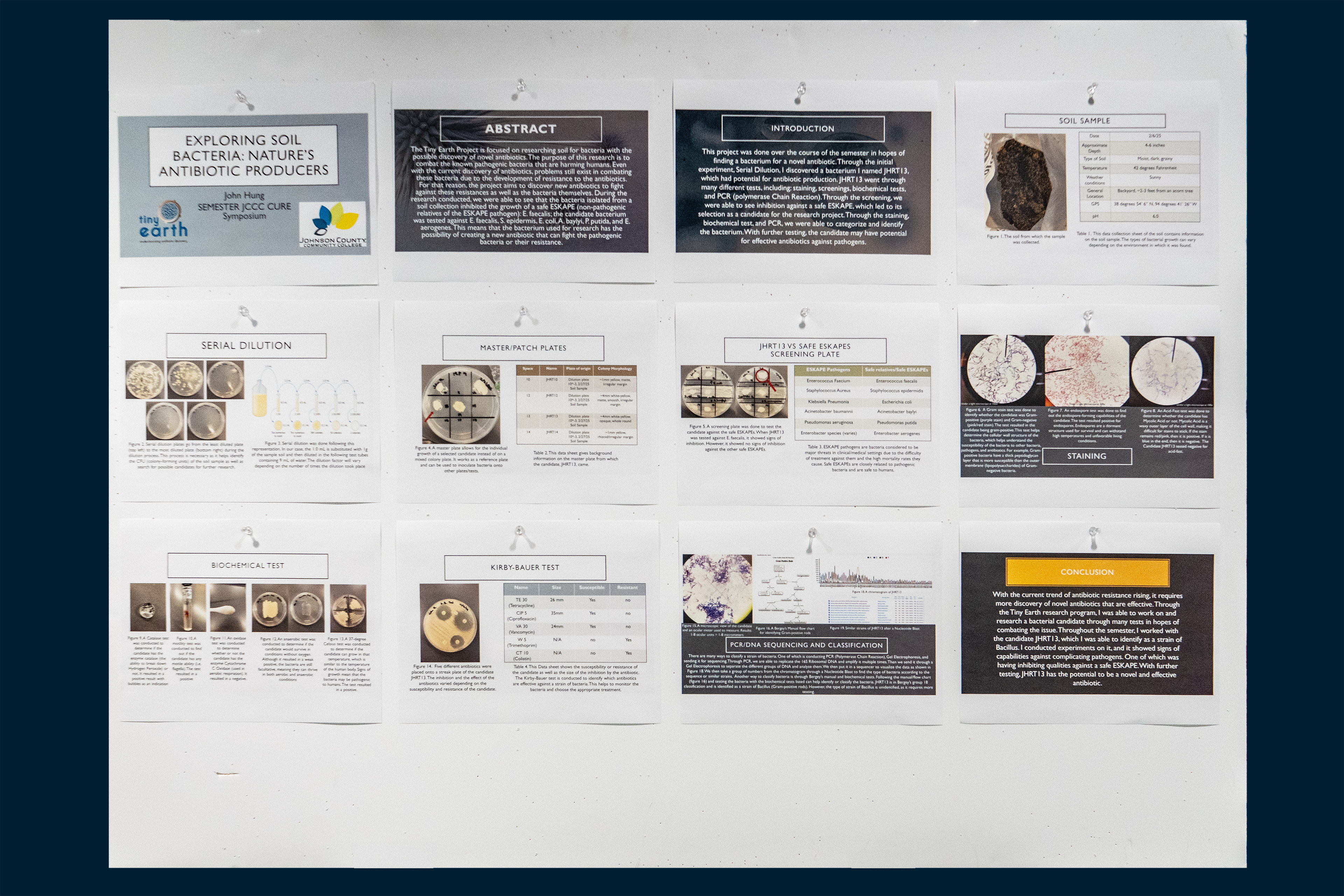
Exploring Soil Bacteria: Nature's Antibiotic Producers
CoLab, COM 100
The Tiny Earth Project is focused on researching soil for bacteria with the possible discovery of novel antibiotics. The purpose of this research is to combat the known pathogenic bacteria that are harming humans. Even with the current discovery of antibiotics, problems still exist in combating these bacteria due to the building up of resistance to the antibiotics. For that reason, the project aims to discover new antibiotics to fight against these resistances as well as the bacteria itself. During the research conducted, we were able to see the bacteria isolated from a soil collection inhibit the growth of some safe ESKAPEs (non-pathogenic relatives of the ESKAPE pathogen); the candidate bacteria was tested against E.faecalis, S.epidermis, E.coli, A.baylyi, P.putida, and E.aerogenes. This means that the bacteria used for research has a possibility of creating a new antibiotic that can fight the pathogenic bacteria or their resistance.
Comments
The faculty mentor for this project was Eulandria Biddle, Biology.