

Location
CoLab, COM 100
Start Date
1-5-2025 5:30 PM
Document Type
Poster
Description
This experiment utilized methods of thin layer chromatography and Gas Chromatography-Mass Spectrometry to analyze the chemical composition of an apple before and after freeze drying. Methylene chloride was used to prepare the apple for extraction and subsequent evaporation of the aqueous layer. The GC-MS was used on this sample to determine the composition of the apple before freeze-drying. Following evaporation, the apple was freeze-dried and then rehydrated, and another GC-MS test was performed to identify any potential changes caused by the freeze-drying process. Thin layer chromatography was also performed on both samples. Through analysis of data gathered with these methods, it was possible to determine the chemical makeup of the apple before and after freeze-drying. By comparing the two samples, before and after, it was possible to extrapolate conclusions on what effects freeze-drying may have on an object’s chemical composition.
Image
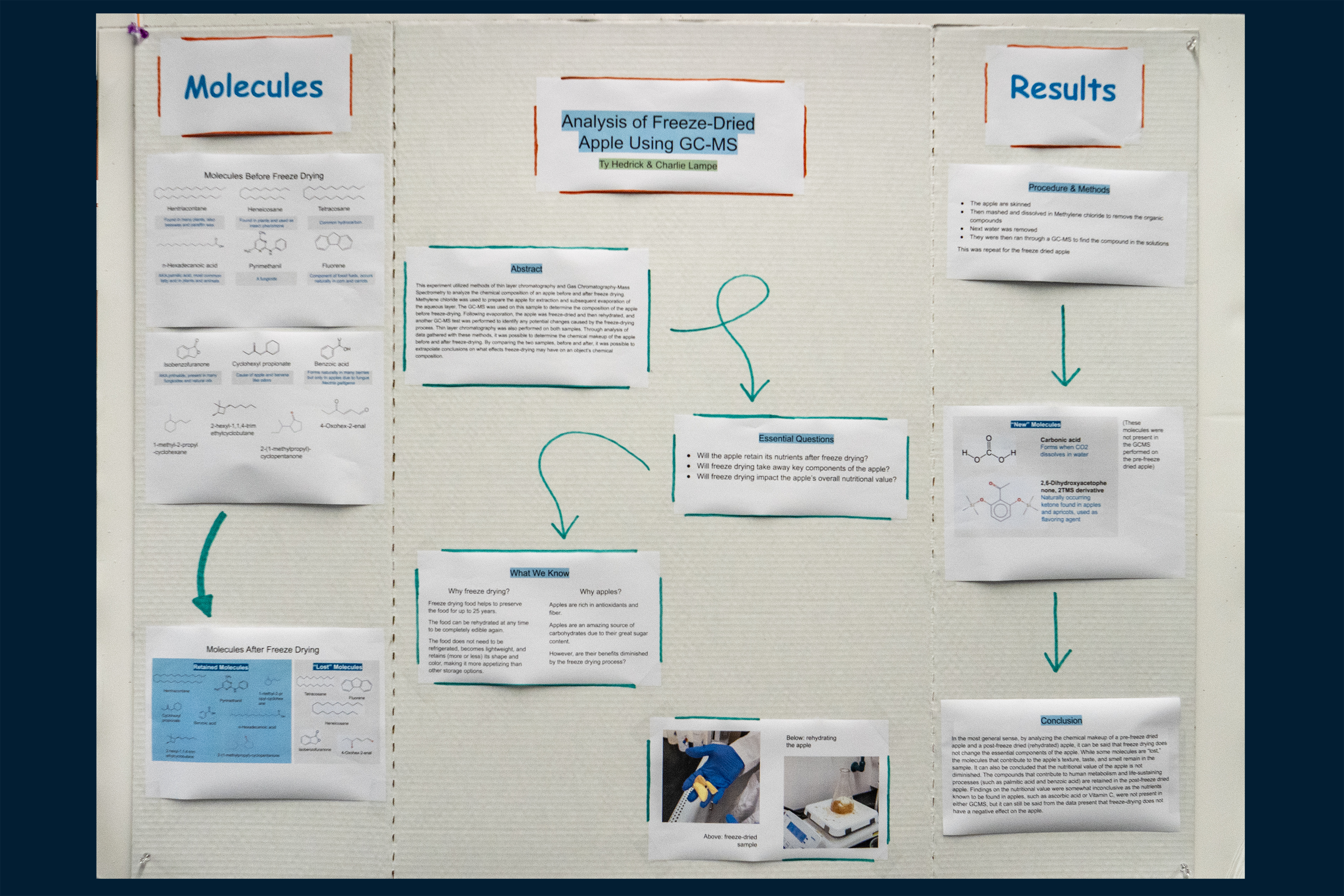
Analysis of Freeze-Dried Apple Using GC-MS
CoLab, COM 100
This experiment utilized methods of thin layer chromatography and Gas Chromatography-Mass Spectrometry to analyze the chemical composition of an apple before and after freeze drying. Methylene chloride was used to prepare the apple for extraction and subsequent evaporation of the aqueous layer. The GC-MS was used on this sample to determine the composition of the apple before freeze-drying. Following evaporation, the apple was freeze-dried and then rehydrated, and another GC-MS test was performed to identify any potential changes caused by the freeze-drying process. Thin layer chromatography was also performed on both samples. Through analysis of data gathered with these methods, it was possible to determine the chemical makeup of the apple before and after freeze-drying. By comparing the two samples, before and after, it was possible to extrapolate conclusions on what effects freeze-drying may have on an object’s chemical composition.
Comments
The faculty mentor for this project was Todd Watson, Chemistry.