

Location
CoLab, COM 100
Start Date
1-5-2025 5:30 PM
Document Type
Poster
Description
The objective of this project is to synthesize a tripeptide in liquid phase by using a coupling reagent to join an amino acid to a dipeptide. The resulting tripeptide will undergo antimicrobial activity testing and its effectiveness will be compared to other active peptides. Initially, the amino group of L-alanine will be protected using Boc-anhydride, forming Boc-L-alanine with a free carboxylic acid group. This protection step prevents undesired side reactions and ensures selective peptide bond formation. In the second step, a dipeptide with a protected carboxylic acid and a Boc-protected amine will undergo deprotection using trifluoroacetic acid (TFA) in DCM. The removal of the Boc group will free the amino terminus, making it available for subsequent coupling. The reaction will be monitored using thin-layer chromatography (TLC), and the product will be confirmed by 1H NMR analysis. The final step involves forming the peptide bond between the free amine of the deprotected dipeptide and the free carboxylic acid of Boc-L-alanine using the coupling reagent EDC. This reaction will also be monitored using TLC, and the purified tripeptide will be analyzed by 1H NMR to verify its structure and purity. Following successful synthesis, the antimicrobial activity of the tripeptide will be evaluated using a growth inhibition assay with optical density measurements at 600 nm. This project will contribute to understanding the relationship between peptide structure and antimicrobial activity, particularly regarding the role of hydrophobicity and positive charge in peptide-based therapeutics.
Image
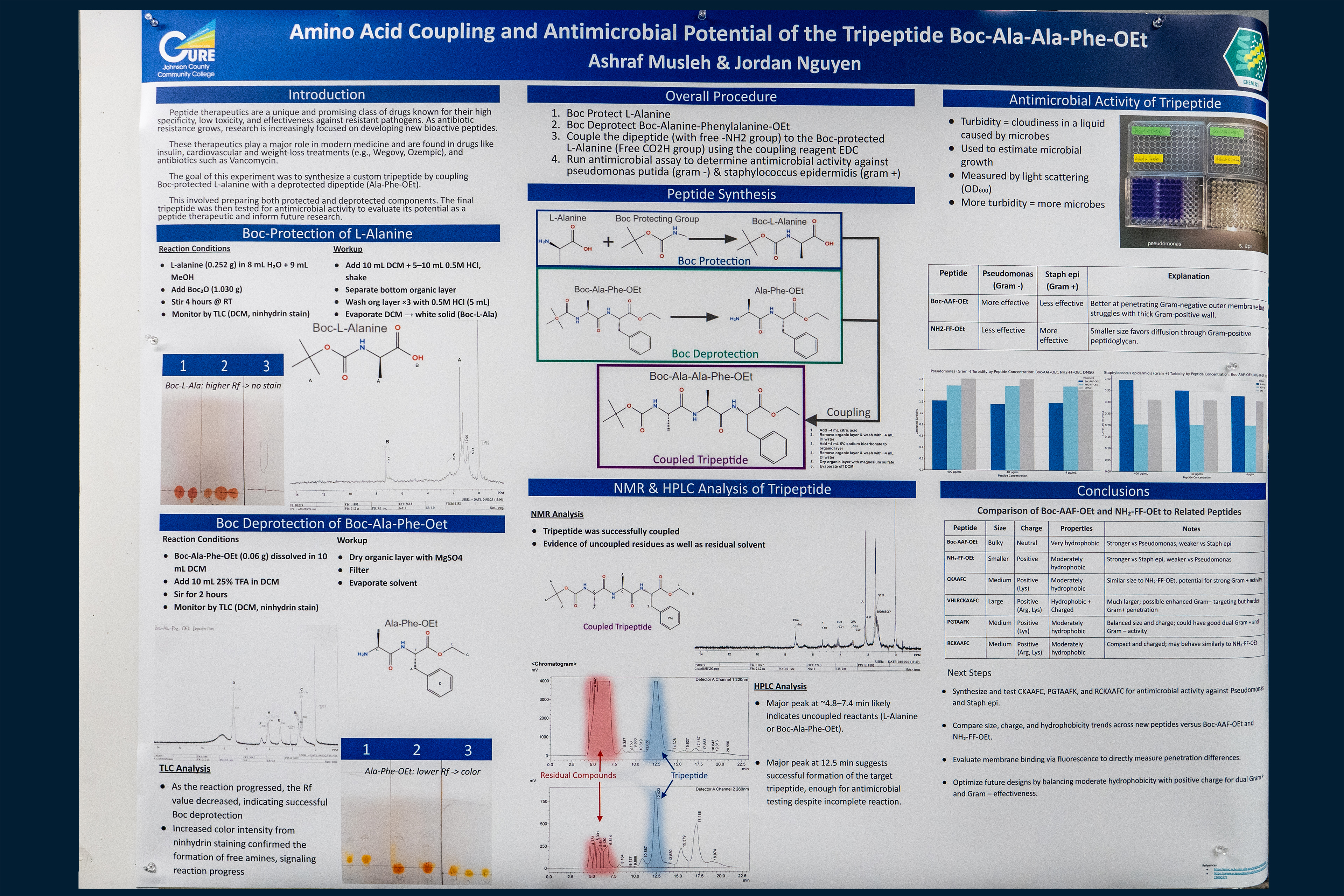
Amino Acid Coupling and Antimicrobial Potential of Tripeptides
CoLab, COM 100
The objective of this project is to synthesize a tripeptide in liquid phase by using a coupling reagent to join an amino acid to a dipeptide. The resulting tripeptide will undergo antimicrobial activity testing and its effectiveness will be compared to other active peptides. Initially, the amino group of L-alanine will be protected using Boc-anhydride, forming Boc-L-alanine with a free carboxylic acid group. This protection step prevents undesired side reactions and ensures selective peptide bond formation. In the second step, a dipeptide with a protected carboxylic acid and a Boc-protected amine will undergo deprotection using trifluoroacetic acid (TFA) in DCM. The removal of the Boc group will free the amino terminus, making it available for subsequent coupling. The reaction will be monitored using thin-layer chromatography (TLC), and the product will be confirmed by 1H NMR analysis. The final step involves forming the peptide bond between the free amine of the deprotected dipeptide and the free carboxylic acid of Boc-L-alanine using the coupling reagent EDC. This reaction will also be monitored using TLC, and the purified tripeptide will be analyzed by 1H NMR to verify its structure and purity. Following successful synthesis, the antimicrobial activity of the tripeptide will be evaluated using a growth inhibition assay with optical density measurements at 600 nm. This project will contribute to understanding the relationship between peptide structure and antimicrobial activity, particularly regarding the role of hydrophobicity and positive charge in peptide-based therapeutics.
Comments
The faculty mentor for this project was Meagan Weldele, Chemistry.