

Location
CoLab, COM 100
Start Date
1-5-2025 5:30 PM
Document Type
Poster
Description
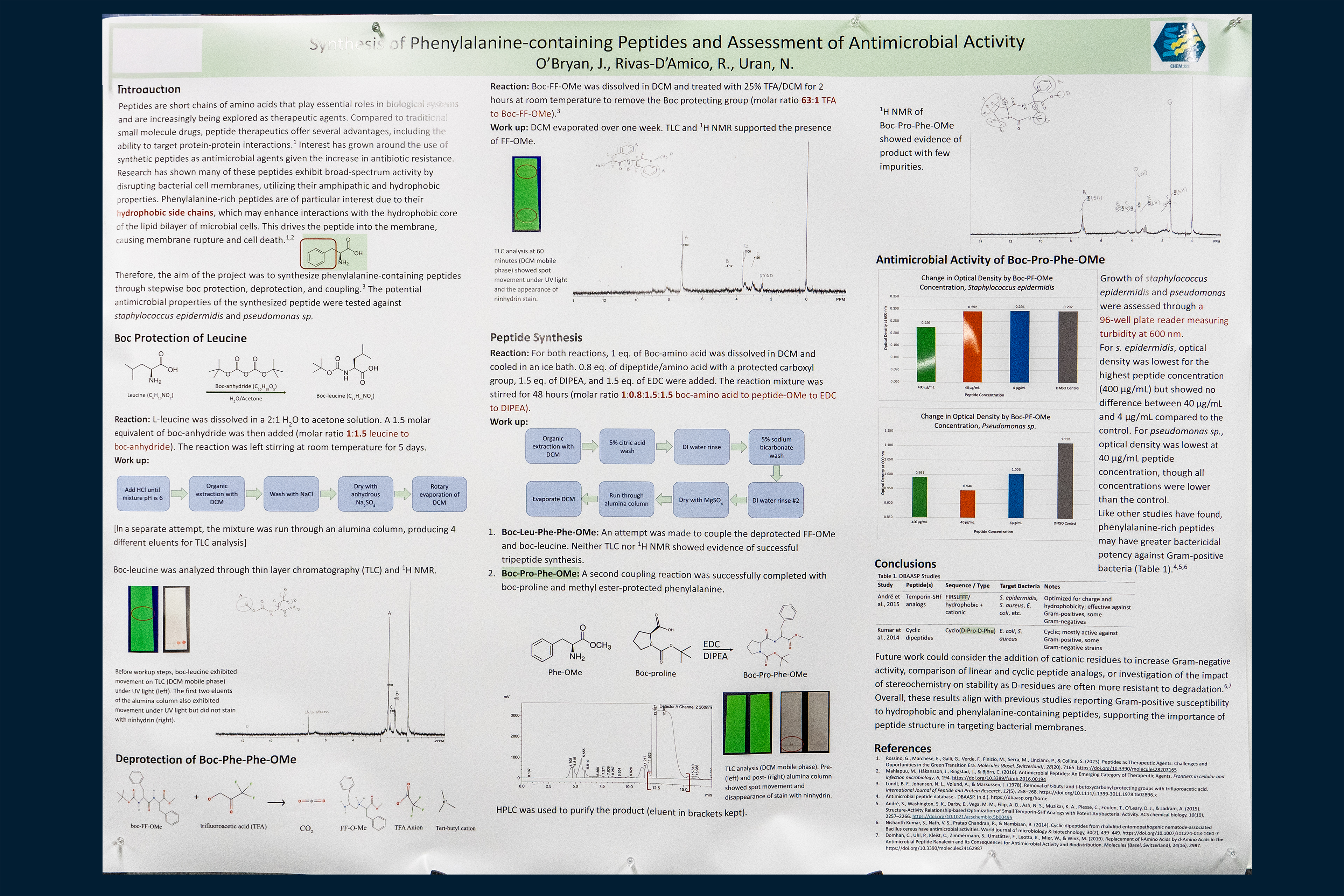
This research project aims to synthesize and evaluate a tripeptide for potential antimicrobial properties. Since current research suggests peptide hydrophobicity is linked to bacterial membrane disruption, a tripeptide composed of leucine and phenylalanine will be synthesized. This will be achieved through stepwise protection, deprotection, and coupling of amino acids. First, the amine group of the amino acid leucine will be Boc-protected, a strategy in peptide synthesis where a tert-butyloxycarbonyl (Boc) group shields reactive sites to control selectivity. Meanwhile, the Boc-protected dipeptide Boc-FF-OMe, which has a methyl ester-protected carboxyl group, will be deprotected using TFA to expose its free amine. The conditions and work-up steps for each reaction will be developed by this group. The progress of each reaction will be monitored by thin layer chromatography. Finally, the deprotected dipeptide will be coupled to Boc-Leu using EDC-mediated coupling, forming the protected final product, Boc-LFF-OMe. Structural characterization of the protected amino acid, deprotected dipeptide, and final product will be confirmed by ¹H NMR spectroscopy. The synthesized tripeptide will be evaluated for antimicrobial activity by growth inhibition assay. This project provides insight into peptide synthesis techniques and their potential applications in antimicrobial research.
Image
Tripeptide Synthesis and Antimicrobial Evaluation
CoLab, COM 100
This research project aims to synthesize and evaluate a tripeptide for potential antimicrobial properties. Since current research suggests peptide hydrophobicity is linked to bacterial membrane disruption, a tripeptide composed of leucine and phenylalanine will be synthesized. This will be achieved through stepwise protection, deprotection, and coupling of amino acids. First, the amine group of the amino acid leucine will be Boc-protected, a strategy in peptide synthesis where a tert-butyloxycarbonyl (Boc) group shields reactive sites to control selectivity. Meanwhile, the Boc-protected dipeptide Boc-FF-OMe, which has a methyl ester-protected carboxyl group, will be deprotected using TFA to expose its free amine. The conditions and work-up steps for each reaction will be developed by this group. The progress of each reaction will be monitored by thin layer chromatography. Finally, the deprotected dipeptide will be coupled to Boc-Leu using EDC-mediated coupling, forming the protected final product, Boc-LFF-OMe. Structural characterization of the protected amino acid, deprotected dipeptide, and final product will be confirmed by ¹H NMR spectroscopy. The synthesized tripeptide will be evaluated for antimicrobial activity by growth inhibition assay. This project provides insight into peptide synthesis techniques and their potential applications in antimicrobial research.
Comments
The faculty mentor for this project was Meagan Weldele, Chemistry.