

Location
CoLab, COM 100
Start Date
1-5-2025 2:45 PM
Document Type
Poster
Description
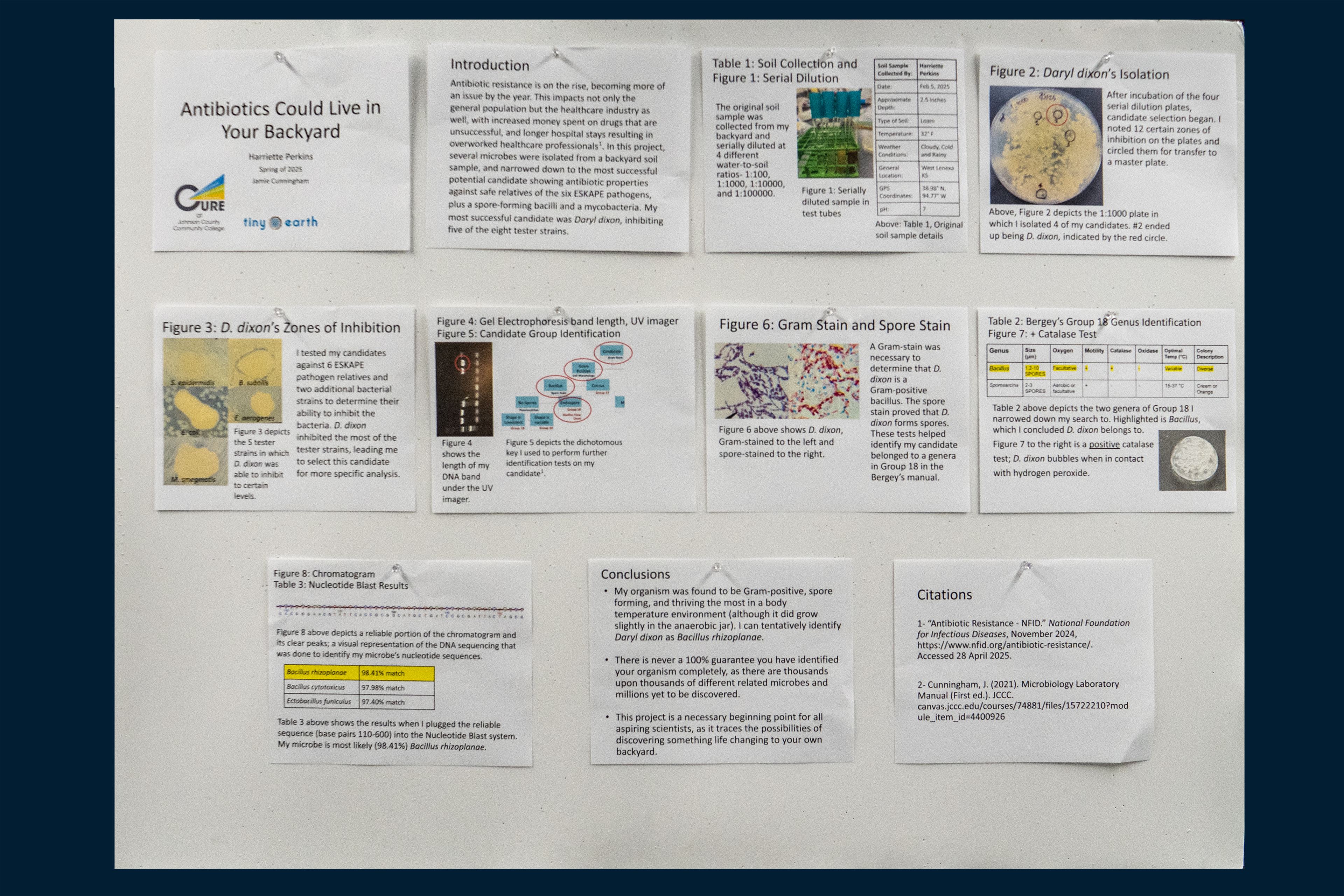
Antibiotics Could Live In Your Back Yard Antibiotic resistance is on the rise, and finding ways that it could potentially be avoided could prove very useful to modern medicine. Infections that have become antibiotic resistant lead to longer hospital stays, higher costs, and an increased risk of death to patients. This project, led by the Tiny Earth Network, utilizes six species of safe bacteria similar to the coined ESKAPE pathogens that can be used in testing to represent the most common drug resistant species of bacteria. Through serial dilution of a soil sample from my backyard, I identified and tested candidates that exhibit properties against the six ESKAPE pathogen relatives, comparing their characteristics and narrowing down the search to one candidate of which I gave the name Daryl dixon. D. dixon showed inhibition towards Eschericia coli, Enterobacter aerogenes, Staphylococcus epidermidis, Bacillus subtilis, and Mycobacterium smegmatis. With gene sequencing, I will be able to identify which genus and species this candidate belongs to, and present my research with the aim to contribute to the fight against the ubiquitous issue of antibiotic resistance.
Image
Antibiotics Could Live In Your Back Yard
CoLab, COM 100
Antibiotics Could Live In Your Back Yard Antibiotic resistance is on the rise, and finding ways that it could potentially be avoided could prove very useful to modern medicine. Infections that have become antibiotic resistant lead to longer hospital stays, higher costs, and an increased risk of death to patients. This project, led by the Tiny Earth Network, utilizes six species of safe bacteria similar to the coined ESKAPE pathogens that can be used in testing to represent the most common drug resistant species of bacteria. Through serial dilution of a soil sample from my backyard, I identified and tested candidates that exhibit properties against the six ESKAPE pathogen relatives, comparing their characteristics and narrowing down the search to one candidate of which I gave the name Daryl dixon. D. dixon showed inhibition towards Eschericia coli, Enterobacter aerogenes, Staphylococcus epidermidis, Bacillus subtilis, and Mycobacterium smegmatis. With gene sequencing, I will be able to identify which genus and species this candidate belongs to, and present my research with the aim to contribute to the fight against the ubiquitous issue of antibiotic resistance.
Comments
The faculty mentor for this project was Jamie Cunningham, Biology.