

Location
CoLab, COM 100
Start Date
1-5-2025 2:45 PM
Document Type
Poster
Description
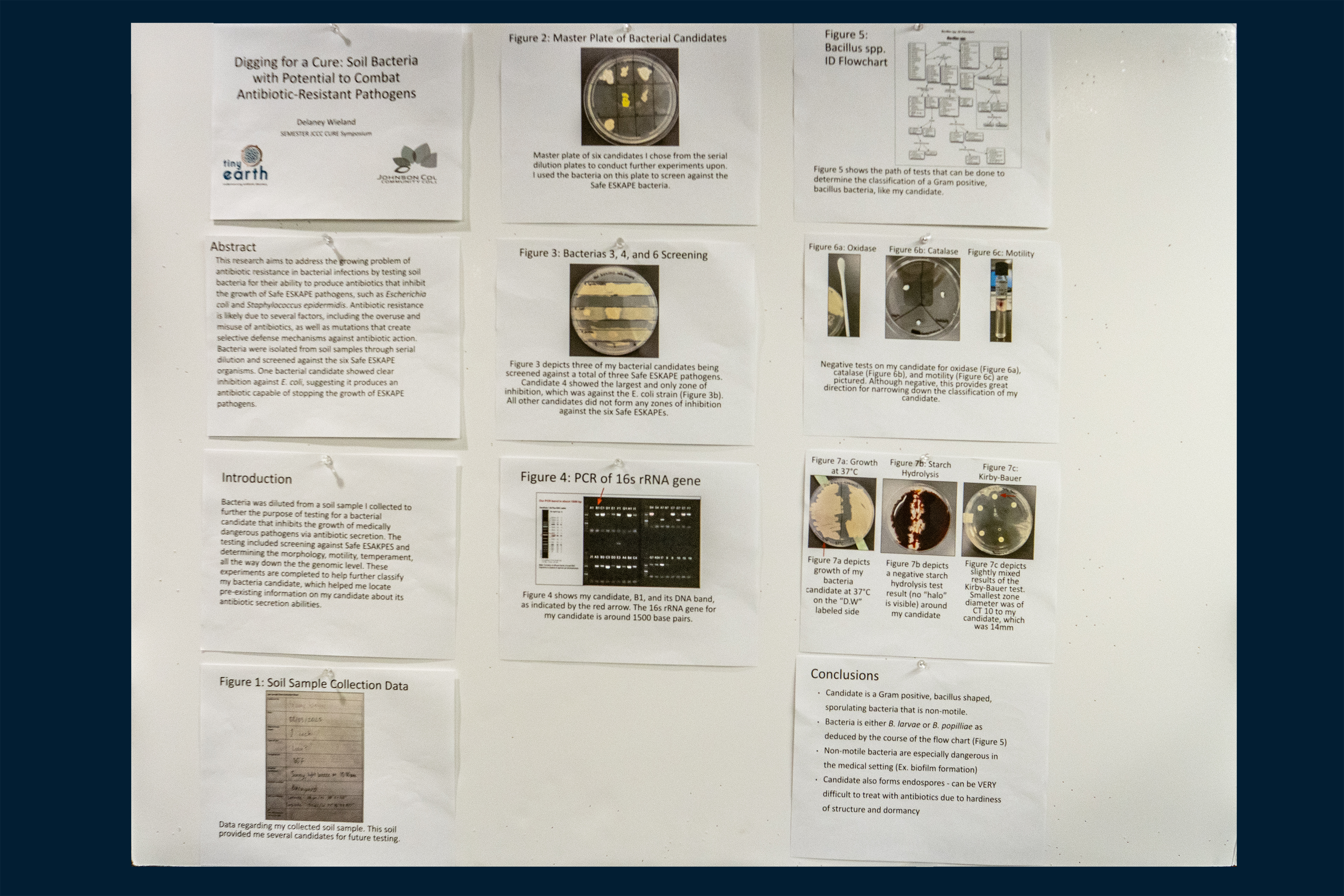
This research aims to address the growing problem of antibiotic resistance in bacterial infections by testing for bacteria that could produce antibiotics that inhibit the growth of Safe ESKAPE like Escherichia coli or Staphylococcus epidermidis. The increase in antibiotic resistance in bacterial pathogens is likely due to a number of reasons, including the prolonged overuse and misuse of antibiotics, and mutations in bacteria that lead to selective defense mechanisms that combat an antibiotic’s mechanism of action. Bacteria were isolated from soil by performing a serial dilution and screened against the 6 safe ESKAPEs. One particular bacterial candidate showed inhibition when screened against the Escherichia coli safe ESKAPE. The inhibition of Escherichia coli growth exhibited by this one bacterial candidate indicates that it produces antibiotics that may be capable of stopping the growth of ESKAPE pathogens.
Image
Discovery of Soil-Derived Antibiotic Producers Against Safe ESKAPE Pathogens
CoLab, COM 100
This research aims to address the growing problem of antibiotic resistance in bacterial infections by testing for bacteria that could produce antibiotics that inhibit the growth of Safe ESKAPE like Escherichia coli or Staphylococcus epidermidis. The increase in antibiotic resistance in bacterial pathogens is likely due to a number of reasons, including the prolonged overuse and misuse of antibiotics, and mutations in bacteria that lead to selective defense mechanisms that combat an antibiotic’s mechanism of action. Bacteria were isolated from soil by performing a serial dilution and screened against the 6 safe ESKAPEs. One particular bacterial candidate showed inhibition when screened against the Escherichia coli safe ESKAPE. The inhibition of Escherichia coli growth exhibited by this one bacterial candidate indicates that it produces antibiotics that may be capable of stopping the growth of ESKAPE pathogens.
Comments
The faculty mentor for this project was Eulandria Biddle, Biology.