

Location
CoLab, COM 100
Start Date
1-5-2025 2:45 PM
Document Type
Poster
Description
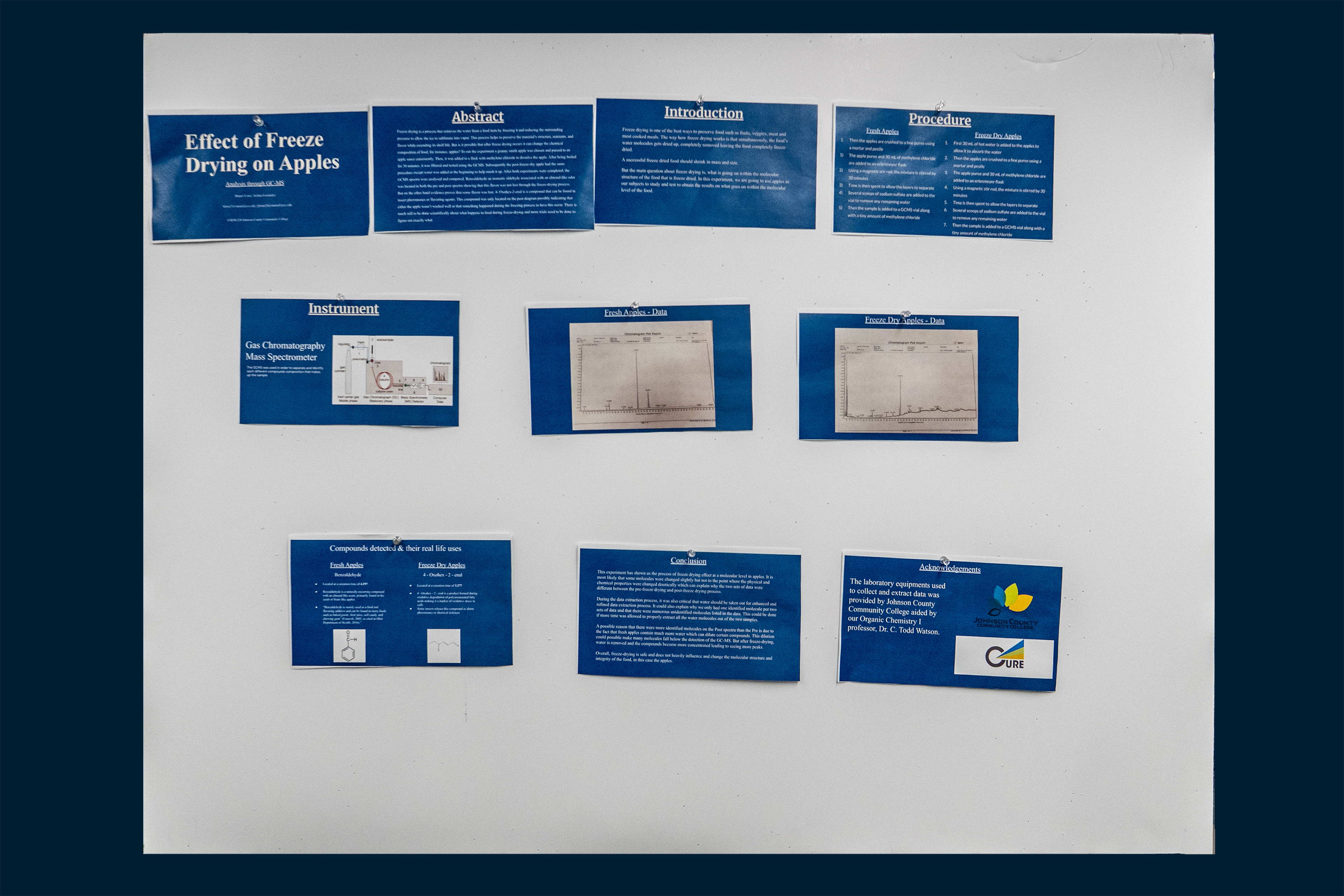
Freeze drying is a process that removes the water from a food item by freezing it and reducing the surrounding pressure to allow the ice to sublimate into vapor. This process helps to preserve the material’s structure, nutrients, and flavor while extending its shelf life. But is it possible that after freeze drying occurs it changes the chemical composition of food, for instance, apples? To run the experiment a granny smith apple was chosen and pureed to an apple sauce consistently. Then, it was added to a flask with methylene chloride to dissolve the apple. After being boiled for 30 minutes, it was filtered and tested using the GCMS. Subsequently the post-freeze-dry apple had the same procedure except water was added at the beginning to help mush it up. After both experiments were completed, the GCMS spectra were analyzed and compared. Benzaldehyde an aromatic aldehyde associated with an almond-like odor was located in both the pre and post spectra showing that this flavor was not lost through the freeze-drying process. But on the other hand evidence proves that some flavor was lost. 4- Oxohex-2-enal is a compound that can be found in insect pheromones or flavoring agents. This compound was only located on the post diagram possibly indicating that either the apple wasn’t washed well or that something happened during the freezing process to have this occur. There is much still to be done scientifically about what happens to food during freeze-drying and more trials need to be done to figure out exactly what.
Image
Does Freeze Drying Change the Chemical Composition of Apples?
CoLab, COM 100
Freeze drying is a process that removes the water from a food item by freezing it and reducing the surrounding pressure to allow the ice to sublimate into vapor. This process helps to preserve the material’s structure, nutrients, and flavor while extending its shelf life. But is it possible that after freeze drying occurs it changes the chemical composition of food, for instance, apples? To run the experiment a granny smith apple was chosen and pureed to an apple sauce consistently. Then, it was added to a flask with methylene chloride to dissolve the apple. After being boiled for 30 minutes, it was filtered and tested using the GCMS. Subsequently the post-freeze-dry apple had the same procedure except water was added at the beginning to help mush it up. After both experiments were completed, the GCMS spectra were analyzed and compared. Benzaldehyde an aromatic aldehyde associated with an almond-like odor was located in both the pre and post spectra showing that this flavor was not lost through the freeze-drying process. But on the other hand evidence proves that some flavor was lost. 4- Oxohex-2-enal is a compound that can be found in insect pheromones or flavoring agents. This compound was only located on the post diagram possibly indicating that either the apple wasn’t washed well or that something happened during the freezing process to have this occur. There is much still to be done scientifically about what happens to food during freeze-drying and more trials need to be done to figure out exactly what.
Comments
The faculty mentor for this project was Todd Watson, Chemistry.