

Location
CoLab, COM 100
Start Date
1-5-2025 2:45 PM
Document Type
Poster
Description
The purpose of this experiment was to determine the chemical compounds present in apples and how those compounds change when the apple is dehydrated. Apple samples were extracted using dichloromethane (CH₂Cl₂) before and after dehydration to pull out a range of organic molecules. The concentrated extracts were analyzed using gas chromatography-mass spectrometry (GC-MS), a technique that separates and identifies individual compounds. Before dehydration, the apple extract contained compounds such as alpha-Farnesene, Acetamide, N-phenyl-, 2-p-Tolylpyridine, Phenol, and 2,4-bis(1,1-dimethylethyl). After dehydration, these compounds were no longer detected. Instead, compounds like n-Hexadecanoic acid, Octadecanoic acid, Oleic acid, and (E)-Stilbene were found. The results suggest that the removal of water during dehydration plays a key role in the disappearance of certain aroma-related compounds, while more stable and less water-soluble compounds remain or become more concentrated.
Image
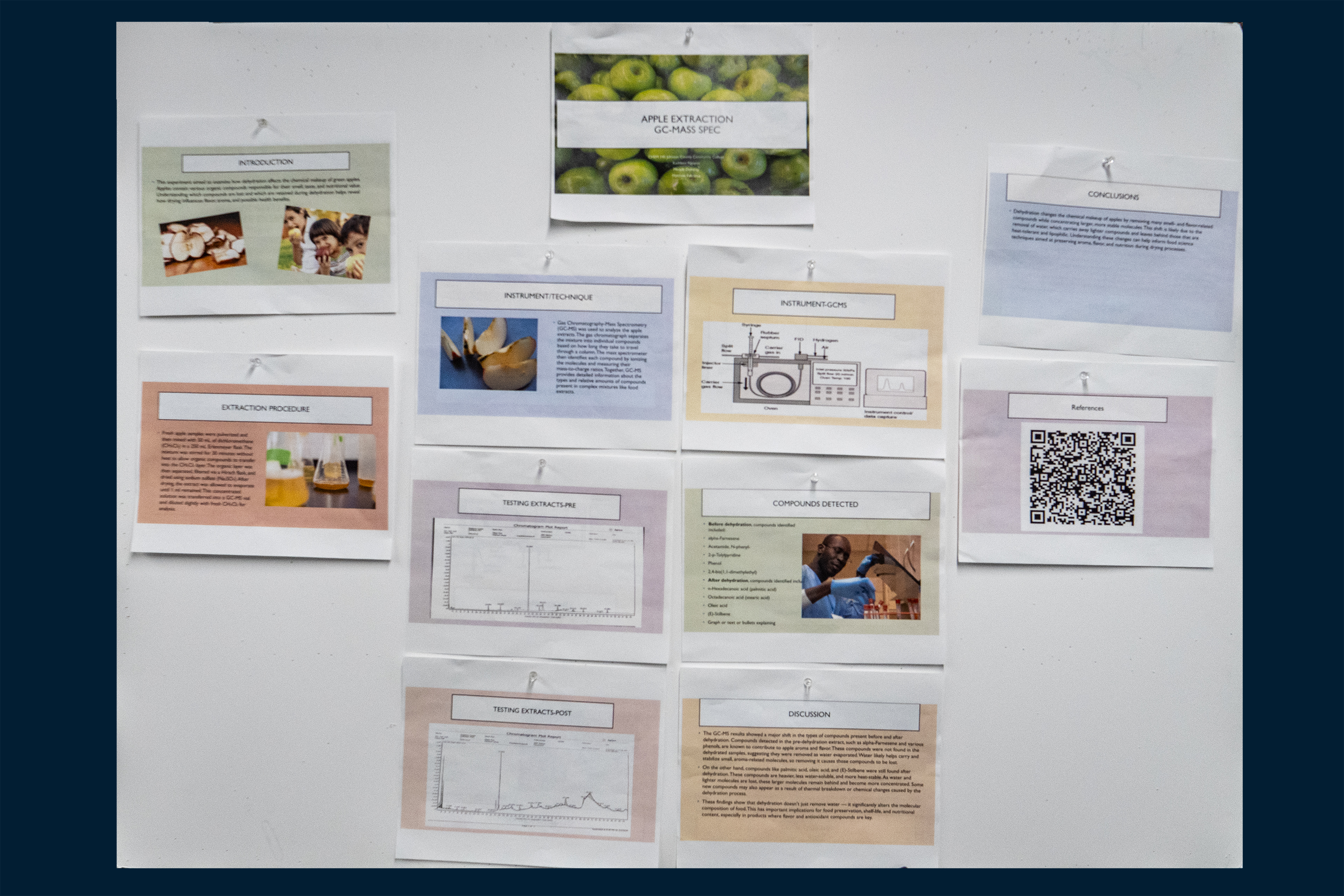
GC-MS Analysis of Apple Compounds Pre- and Post-Dehydration
CoLab, COM 100
The purpose of this experiment was to determine the chemical compounds present in apples and how those compounds change when the apple is dehydrated. Apple samples were extracted using dichloromethane (CH₂Cl₂) before and after dehydration to pull out a range of organic molecules. The concentrated extracts were analyzed using gas chromatography-mass spectrometry (GC-MS), a technique that separates and identifies individual compounds. Before dehydration, the apple extract contained compounds such as alpha-Farnesene, Acetamide, N-phenyl-, 2-p-Tolylpyridine, Phenol, and 2,4-bis(1,1-dimethylethyl). After dehydration, these compounds were no longer detected. Instead, compounds like n-Hexadecanoic acid, Octadecanoic acid, Oleic acid, and (E)-Stilbene were found. The results suggest that the removal of water during dehydration plays a key role in the disappearance of certain aroma-related compounds, while more stable and less water-soluble compounds remain or become more concentrated.
Comments
The faculty mentor for this project was Todd Watson, Chemistry.