

Location
CoLab, COM 100
Start Date
1-5-2025 2:45 PM
Document Type
Poster
Description
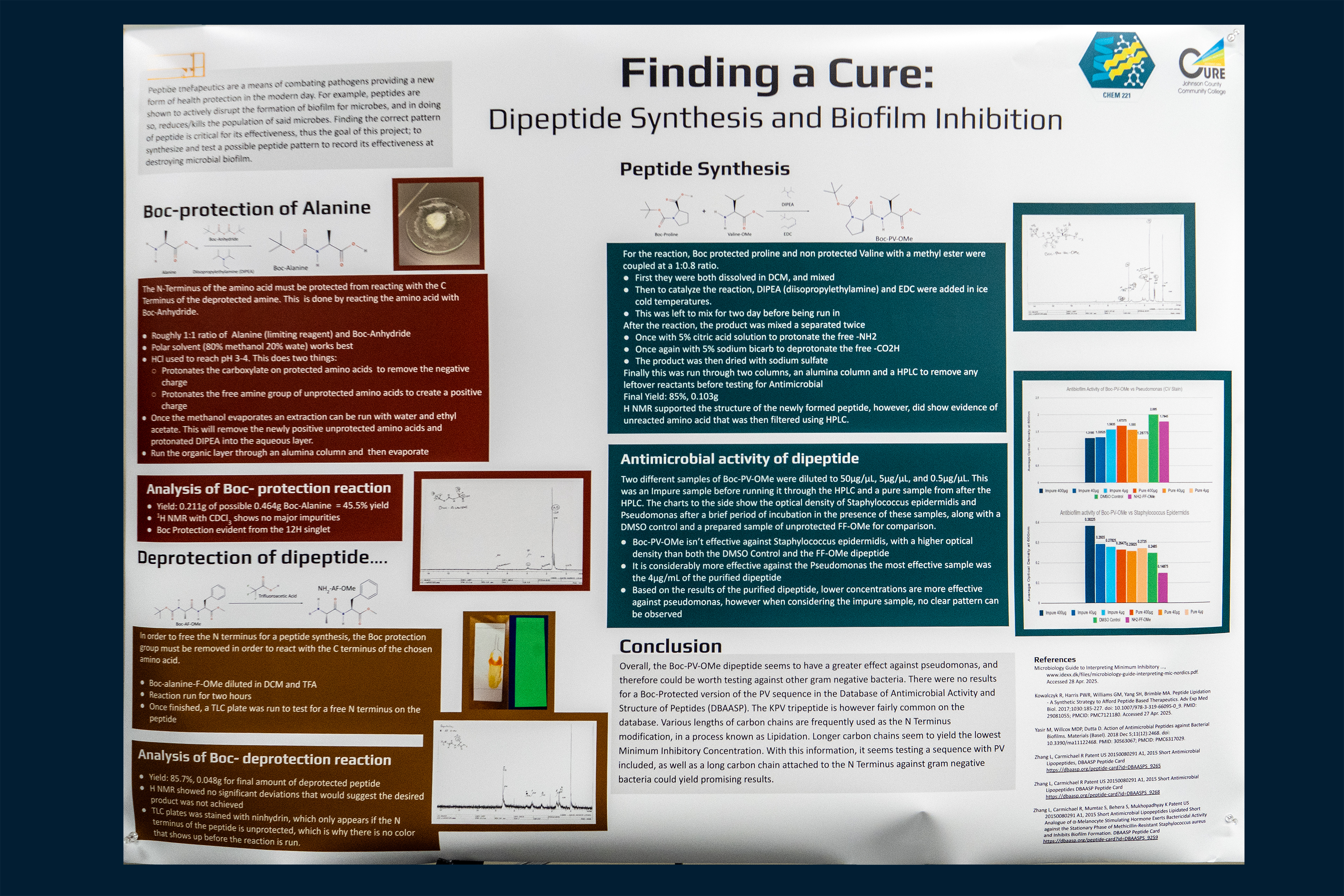
This project involved the synthesis of a tripeptide using amino acids to accomplish the goal of antimicrobial activity being present in the final product. This will happen with a dipeptide with alanine and phenylalanine, or AF, which is protected with a Boc-group. Before this can react, the Boc must be removed, so that the n-terminus of the acid can participate and the desired reaction can be run. The alanine is not protected, however for the desired product to be made, it must be. This is done by reacting the alanine with Boc Anhydride to add a Boc protecting group, which will prevent the amine group on the dipeptide from reacting and give more control for what reaction will take place, which is its addition to the dipeptide. TLC plates are used throughout this experiment in order to monitor the progress of reaction via UV light or staining. Once completed, the final product will be an AFA amino acid, and tested for its effectiveness and viability as an agent for antimicrobial usage.
Image
Synthesis of Polypeptides for Antibacterial Activity
CoLab, COM 100
This project involved the synthesis of a tripeptide using amino acids to accomplish the goal of antimicrobial activity being present in the final product. This will happen with a dipeptide with alanine and phenylalanine, or AF, which is protected with a Boc-group. Before this can react, the Boc must be removed, so that the n-terminus of the acid can participate and the desired reaction can be run. The alanine is not protected, however for the desired product to be made, it must be. This is done by reacting the alanine with Boc Anhydride to add a Boc protecting group, which will prevent the amine group on the dipeptide from reacting and give more control for what reaction will take place, which is its addition to the dipeptide. TLC plates are used throughout this experiment in order to monitor the progress of reaction via UV light or staining. Once completed, the final product will be an AFA amino acid, and tested for its effectiveness and viability as an agent for antimicrobial usage.
Comments
The faculty mentor for this project was Meagan Weldele, Chemistry.