

Location
CoLab, COM 100
Start Date
1-5-2025 2:45 PM
Document Type
Poster
Description
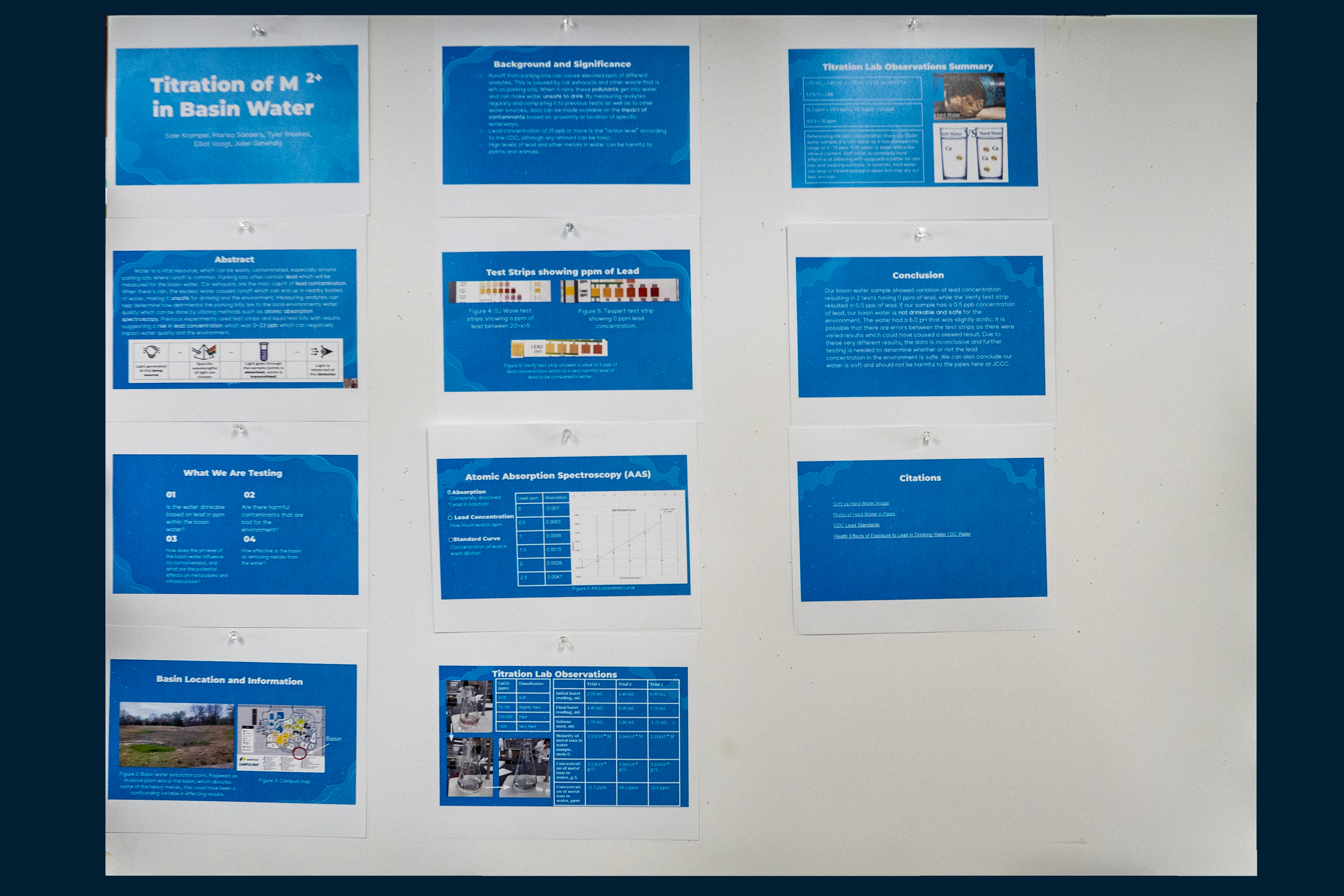
Problem/research question: Is the water drinkable based on lead in ppm within the basin water? Are there harmful contaminants that are bad for the environment? Background: Lead concentration of 15 ppm or more is not safe to drink. Overall Significance: Runoff from parking lots can cause elevated ppm of different analytes, this is caused by car exhausts and other waste that is left on parking lots. When it rains these pollutants get into water and can make water unsafe to drink. By measuring analytes regularly and comparing it to previous tests as well as to other water sources data can be made available on the impact of contaminants based on proximity or location of specific waterways. Key Findings: One group results with 0 lead while the other shows results of 2.5 in Varify and 20 in SJ Wave. Clear summary: Abstract: Water is a vital resource, which can be easily contaminated, especially around parking lots where runoff is common. Parking lots often contain lead which will be measured for the basin water. Car exhausts are the main culprit of lead contamination. When there's rain, the excess water causes runoff which can end up in nearby bodies of water, making it unsafe for drinking and the environment. Measuring analytes can help determine how detrimental the parking lots are to the local environment's water quality by utilizing methods used in atomic absorption spectroscopy. Previous experiments used test strips and liquid test kits with results suggesting a risk in lead concentration which was 0-23 ppm depending on the test utilized which can negatively impact water quality and the environment.
Image
Testing for Lead in Basin Water
CoLab, COM 100
Problem/research question: Is the water drinkable based on lead in ppm within the basin water? Are there harmful contaminants that are bad for the environment? Background: Lead concentration of 15 ppm or more is not safe to drink. Overall Significance: Runoff from parking lots can cause elevated ppm of different analytes, this is caused by car exhausts and other waste that is left on parking lots. When it rains these pollutants get into water and can make water unsafe to drink. By measuring analytes regularly and comparing it to previous tests as well as to other water sources data can be made available on the impact of contaminants based on proximity or location of specific waterways. Key Findings: One group results with 0 lead while the other shows results of 2.5 in Varify and 20 in SJ Wave. Clear summary: Abstract: Water is a vital resource, which can be easily contaminated, especially around parking lots where runoff is common. Parking lots often contain lead which will be measured for the basin water. Car exhausts are the main culprit of lead contamination. When there's rain, the excess water causes runoff which can end up in nearby bodies of water, making it unsafe for drinking and the environment. Measuring analytes can help determine how detrimental the parking lots are to the local environment's water quality by utilizing methods used in atomic absorption spectroscopy. Previous experiments used test strips and liquid test kits with results suggesting a risk in lead concentration which was 0-23 ppm depending on the test utilized which can negatively impact water quality and the environment.
Comments
The faculty mentor for this project was Amanda Glass, Chemistry.