

Location
CoLab, COM 100
Start Date
1-5-2025 2:45 PM
Document Type
Poster
Description
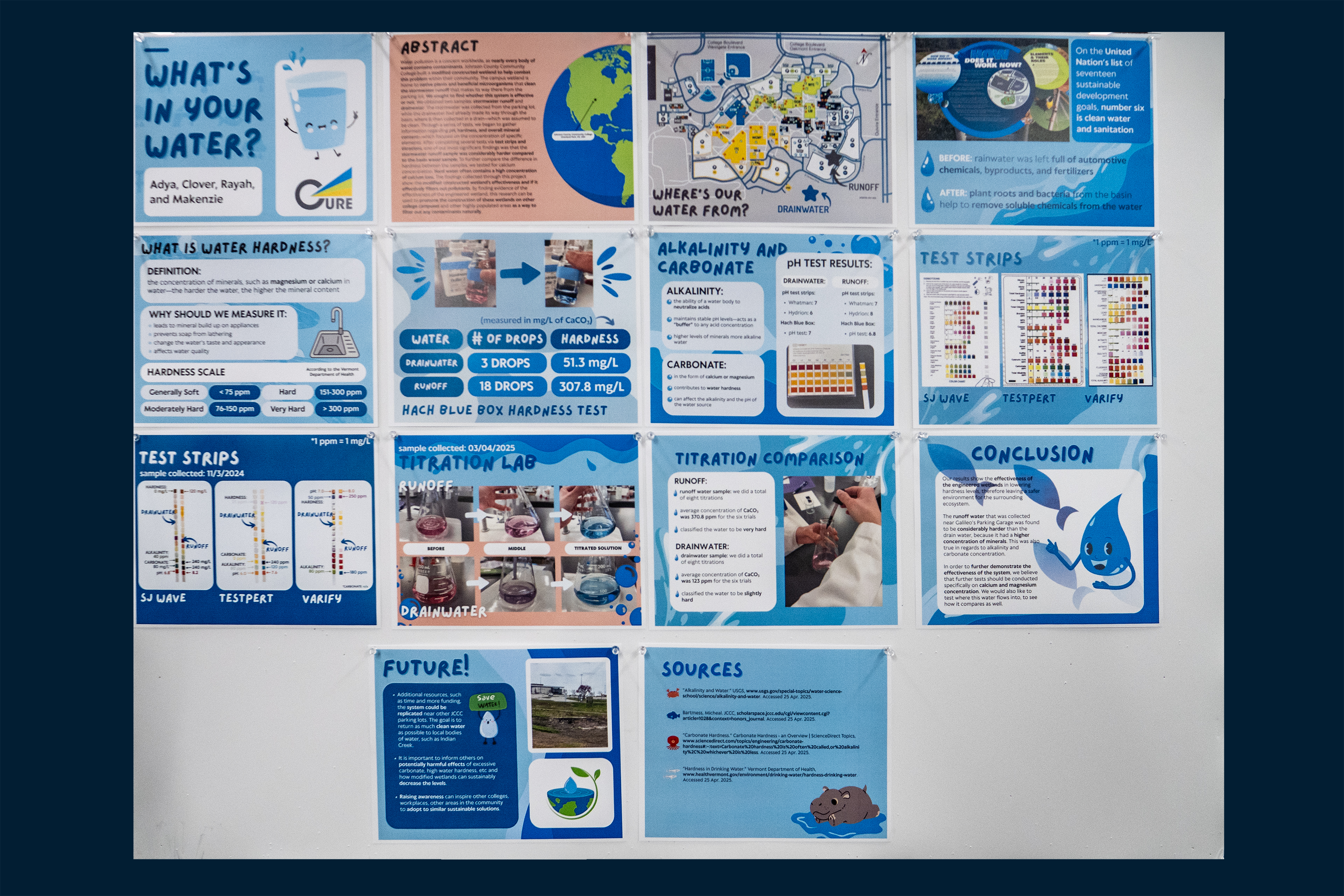
Water pollution is a concern worldwide, as nearly every body of water contains contaminants. Johnson County Community College built a modified constructed wetland to help combat this problem within their community. The campus wetland is home to native plants and beneficial microorganisms that clean the stormwater runoff that makes its way there from the parking lot. We sought to find whether this system is effective or not. We obtained two samples: stormwater runoff and drainwater. The stormwater was collected from the parking lot, while the drainwater had already made its way through the basin, where it then collected in a drain—which was assumed to be clean. Through a series of tests, we began to gather information regarding pH, hardness, and overall mineral content—which focused on the concentration of specific elements. After completing several tests via test strips and titrations, one of our most significant findings was that the stormwater runoff sample was considerably harder compared to the basin water sample. To further compare the difference in hardness between the samples, we tested for calcium concentration. Hard water often contains a high concentration of calcium ions. The findings collected through this project show the modified constructed wetland's effectiveness and if it effectively filters out pollutants. By finding evidence of the effectiveness of the engineered wetland, this research can be used to promote the construction of these wetlands on other college campuses and other highly populated areas as a way to filter out any contaminants naturally.
Image
What's In Your Water?
CoLab, COM 100
Water pollution is a concern worldwide, as nearly every body of water contains contaminants. Johnson County Community College built a modified constructed wetland to help combat this problem within their community. The campus wetland is home to native plants and beneficial microorganisms that clean the stormwater runoff that makes its way there from the parking lot. We sought to find whether this system is effective or not. We obtained two samples: stormwater runoff and drainwater. The stormwater was collected from the parking lot, while the drainwater had already made its way through the basin, where it then collected in a drain—which was assumed to be clean. Through a series of tests, we began to gather information regarding pH, hardness, and overall mineral content—which focused on the concentration of specific elements. After completing several tests via test strips and titrations, one of our most significant findings was that the stormwater runoff sample was considerably harder compared to the basin water sample. To further compare the difference in hardness between the samples, we tested for calcium concentration. Hard water often contains a high concentration of calcium ions. The findings collected through this project show the modified constructed wetland's effectiveness and if it effectively filters out pollutants. By finding evidence of the effectiveness of the engineered wetland, this research can be used to promote the construction of these wetlands on other college campuses and other highly populated areas as a way to filter out any contaminants naturally.
Comments
The faculty mentor for this project was Amanda Glass, Chemistry.