

Location
CoLab, COM 100
Start Date
1-5-2025 8:30 AM
Document Type
Poster
Description
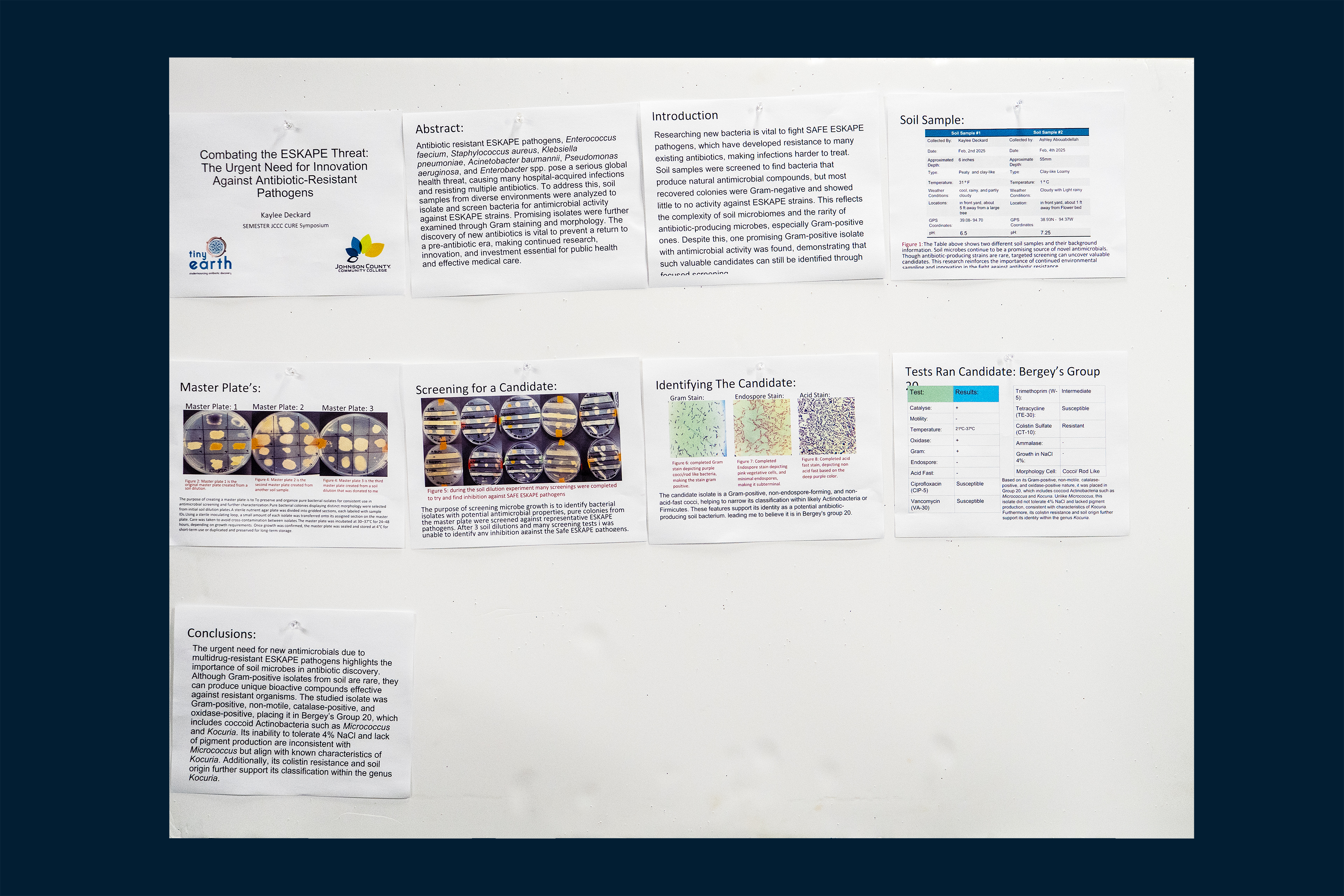
The rise of antibiotic-resistant pathogens poses a severe global health threat, with the safe ESKAPE; Enterococcus faecium, Staphylococcus aureus, Klebsiella pneumoniae, Acinetobacter baumannii, Pseudomonas aeruginosa, and Enterobacter species group leading the charge. These bacteria are responsible for a significant proportion of hospital acquired infections and are increasingly resistant to multiple classes of antibiotics. Despite ongoing efforts, resistance mechanisms continue to evolve, rendering many current treatments ineffective. Continued research into antimicrobials, alternative therapies, and innovative prevention strategies is essential. To investigate this, soil samples were collected from diverse environments and subjected to serial dilution and plating on selective media to isolate bacterial colonies. Pure isolates were screened for antimicrobial activity using cross streak and agar diffusion analysis against representative ESKAPE strains. Positive hits were further characterized by Gram staining, and colony morphology. The discovery of new antibiotics offers hope in counteracting resistance. Failing to prioritize the discovery of new treatments risks returning healthcare to a pre-antibiotic era, where minor infections and routine surgeries become life threatening. Therefore, ongoing exploration, innovation, and investment in combating ESKAPE pathogens are crucial to public health and ensuring the continued effectiveness of medical interventions.
Image
Combating the ESKAPE Threat: The Urgent Need for Innovation Against Antibiotic-Resistant Pathogens
CoLab, COM 100
The rise of antibiotic-resistant pathogens poses a severe global health threat, with the safe ESKAPE; Enterococcus faecium, Staphylococcus aureus, Klebsiella pneumoniae, Acinetobacter baumannii, Pseudomonas aeruginosa, and Enterobacter species group leading the charge. These bacteria are responsible for a significant proportion of hospital acquired infections and are increasingly resistant to multiple classes of antibiotics. Despite ongoing efforts, resistance mechanisms continue to evolve, rendering many current treatments ineffective. Continued research into antimicrobials, alternative therapies, and innovative prevention strategies is essential. To investigate this, soil samples were collected from diverse environments and subjected to serial dilution and plating on selective media to isolate bacterial colonies. Pure isolates were screened for antimicrobial activity using cross streak and agar diffusion analysis against representative ESKAPE strains. Positive hits were further characterized by Gram staining, and colony morphology. The discovery of new antibiotics offers hope in counteracting resistance. Failing to prioritize the discovery of new treatments risks returning healthcare to a pre-antibiotic era, where minor infections and routine surgeries become life threatening. Therefore, ongoing exploration, innovation, and investment in combating ESKAPE pathogens are crucial to public health and ensuring the continued effectiveness of medical interventions.
Comments
The faculty mentor for this project was Eulandria Biddle, Biology.