

Location
CoLab, COM 100
Start Date
1-5-2025 1:30 PM
Document Type
Poster
Description
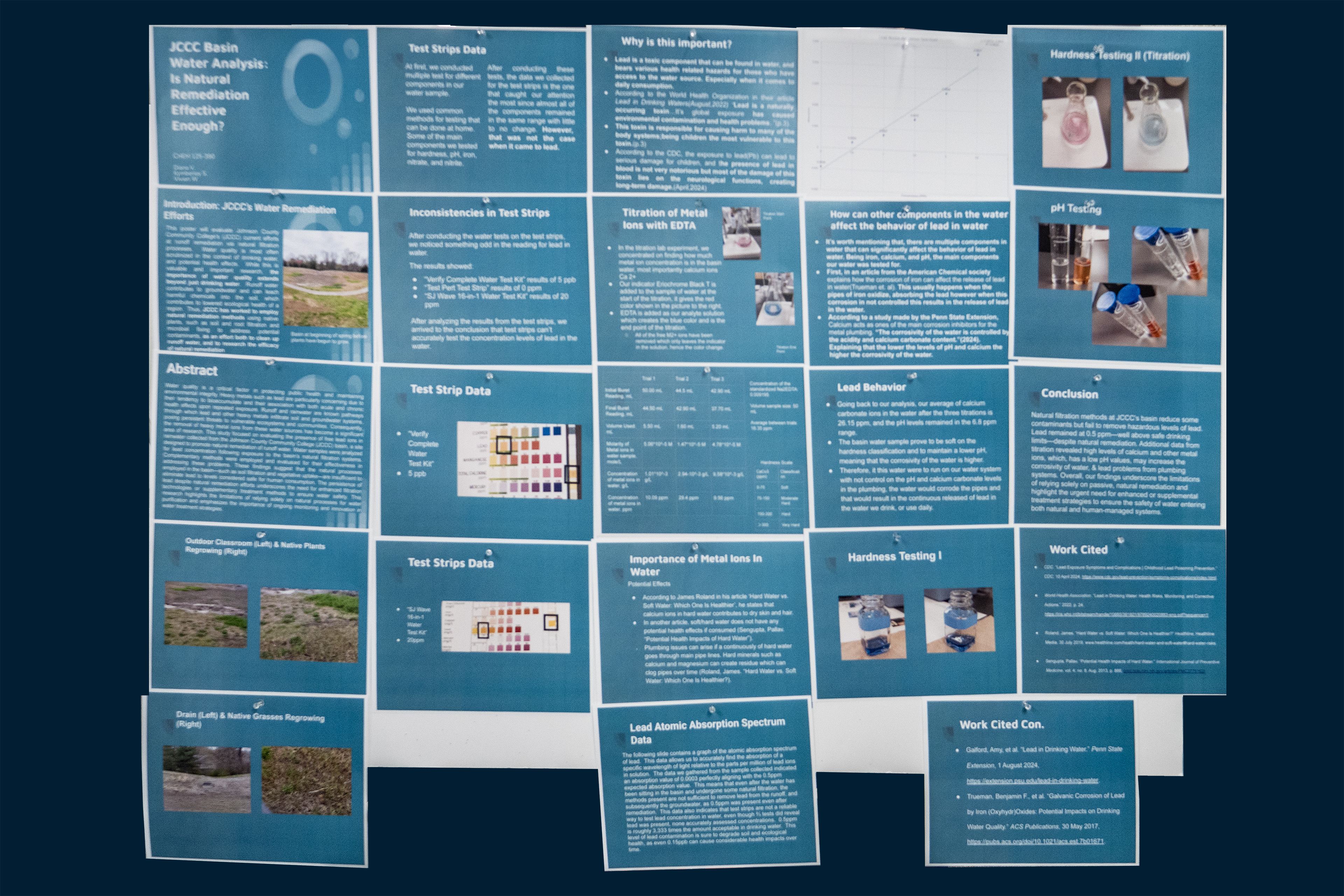
Water quality is a critical factor in protecting public health and maintaining environmental integrity. Heavy metals such as lead are particularly concerning due to their tendency to bioaccumulate and their association with both acute and chronic health effects upon repeated exposure. Runoff and rainwater are known pathways through which lead and other heavy metals infiltrate soil and groundwater systems, posing persistent threats to vulnerable ecosystems and communities. Consequently, the removal of heavy metal ions from these water sources has become a significant area of research. This study focused on evaluating the presence of free lead ions in rainwater collected from the Johnson County Community College (JCCC) basin, a site designed to promote natural remediation of runoff water. Water samples were analyzed for lead concentration following exposure to the basin’s natural filtration systems. Complementary methods were employed and evaluated for their effectiveness in addressing these problems. These findings suggest that the natural processes employed in the basin—such as soil filtration and vegetative uptake—are insufficient to eliminate lead to levels considered safe for human consumption. The persistence of lead despite natural remediation efforts underscores the need for enhanced filtration technologies or supplementary treatment methods to ensure water safety. This research highlights the limitations of relying solely on natural processes for water purification and emphasizes the importance of ongoing monitoring and innovation in water treatment strategies.
Image
JCCC Basin Water Quality
CoLab, COM 100
Water quality is a critical factor in protecting public health and maintaining environmental integrity. Heavy metals such as lead are particularly concerning due to their tendency to bioaccumulate and their association with both acute and chronic health effects upon repeated exposure. Runoff and rainwater are known pathways through which lead and other heavy metals infiltrate soil and groundwater systems, posing persistent threats to vulnerable ecosystems and communities. Consequently, the removal of heavy metal ions from these water sources has become a significant area of research. This study focused on evaluating the presence of free lead ions in rainwater collected from the Johnson County Community College (JCCC) basin, a site designed to promote natural remediation of runoff water. Water samples were analyzed for lead concentration following exposure to the basin’s natural filtration systems. Complementary methods were employed and evaluated for their effectiveness in addressing these problems. These findings suggest that the natural processes employed in the basin—such as soil filtration and vegetative uptake—are insufficient to eliminate lead to levels considered safe for human consumption. The persistence of lead despite natural remediation efforts underscores the need for enhanced filtration technologies or supplementary treatment methods to ensure water safety. This research highlights the limitations of relying solely on natural processes for water purification and emphasizes the importance of ongoing monitoring and innovation in water treatment strategies.
Comments
The faculty mentor for this project was Amanda Glass, Chemistry.