

Location
CoLab, COM 100
Start Date
1-5-2025 12:15 PM
Document Type
Poster
Description
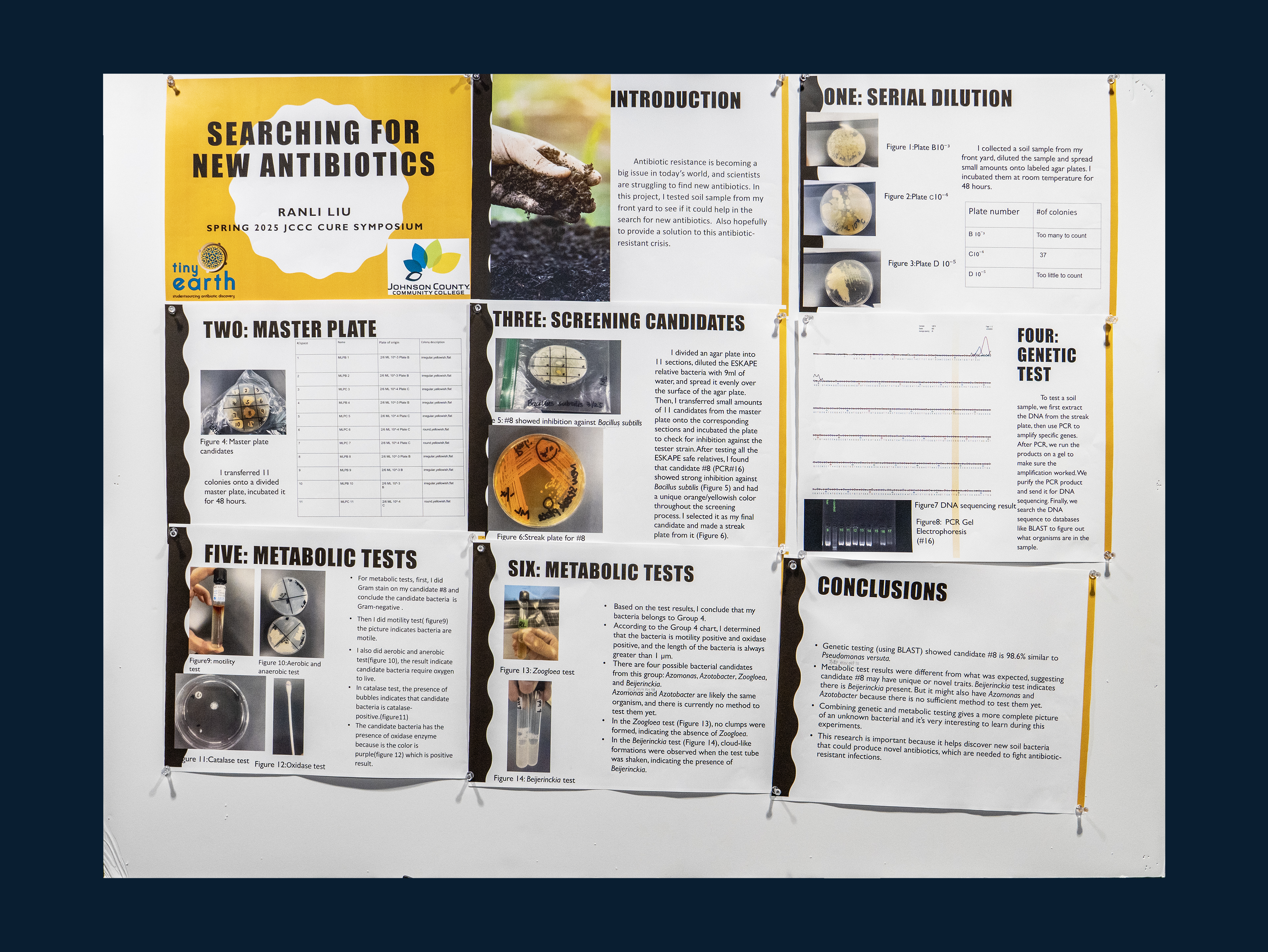
Screening candidates from a master plate soil sample taken from my front yard and testing them against a safe relative tester strain helps identify colonies that produce substances inhibiting bacterial growth. This process can potentially lead to the discovery of new antibiotics. I collected a soil sample from my front yard on February 6th and performed a serial dilution. After incubation, I selected 11 and made a master plate. I then used this master plate to screen the safe relative pathogens. Finally, Candidate #9 on March 4th showed strong inhibition against Enterococcus faecalis. I successfully made a streak plate to isolated it for further study. This research has taught me valuable microbiology techniques, including soil dilution, aseptic transfer, and antibiotic screening methods. It has also deepened my understanding of microbial interactions and the potential of soil bacteria as sources of new antibiotics. This project demonstrates the importance of exploring natural environments, like soil, to identify new bacterial strains that could contribute to the development of effective antibiotics.
Image
Finding a Potential New Antibiotic in a Sample from My Front Yard
CoLab, COM 100
Screening candidates from a master plate soil sample taken from my front yard and testing them against a safe relative tester strain helps identify colonies that produce substances inhibiting bacterial growth. This process can potentially lead to the discovery of new antibiotics. I collected a soil sample from my front yard on February 6th and performed a serial dilution. After incubation, I selected 11 and made a master plate. I then used this master plate to screen the safe relative pathogens. Finally, Candidate #9 on March 4th showed strong inhibition against Enterococcus faecalis. I successfully made a streak plate to isolated it for further study. This research has taught me valuable microbiology techniques, including soil dilution, aseptic transfer, and antibiotic screening methods. It has also deepened my understanding of microbial interactions and the potential of soil bacteria as sources of new antibiotics. This project demonstrates the importance of exploring natural environments, like soil, to identify new bacterial strains that could contribute to the development of effective antibiotics.
Comments
The faculty mentor for this project was Heather Seitz, Biology.