

Location
CoLab, COM 100
Start Date
1-5-2025 12:15 PM
Document Type
Poster
Description
This study examines natural hazards that may impact future housing development in a 1-square-mile area located in San Bernardino County, California. The goal is to identify potential geologic risks and inform residents and developers about land safety. We focus on analyzing geological materials, seismic history, and topographic features. The site’s geology includes gabbro, monzogranite, granodiorite, and granophyre, which may pose risks. For example, radon could lead to lung cancer. We also reviewed seismic hazards by examining the region’s earthquake history. Since 1902, the area has experienced 2,192 earthquakes, with an average magnitude of 3.0 and a maximum magnitude of 6.7. This frequency and intensity suggest the area is prone to earthquakes, as well as quarry blasts. Topographic features could also pose additional risks. These could exacerbate problems like mass movements. By identifying geological, seismic, and topographic hazards, this research provides valuable insights to guide development decisions. We recommend implementing strategies like earthquake resistant homes to mitigate these risks and ensure safer living environments for future residents. Understanding these hazards is essential for creating sustainable, safe housing developments in San Bernardino County, California.
Image
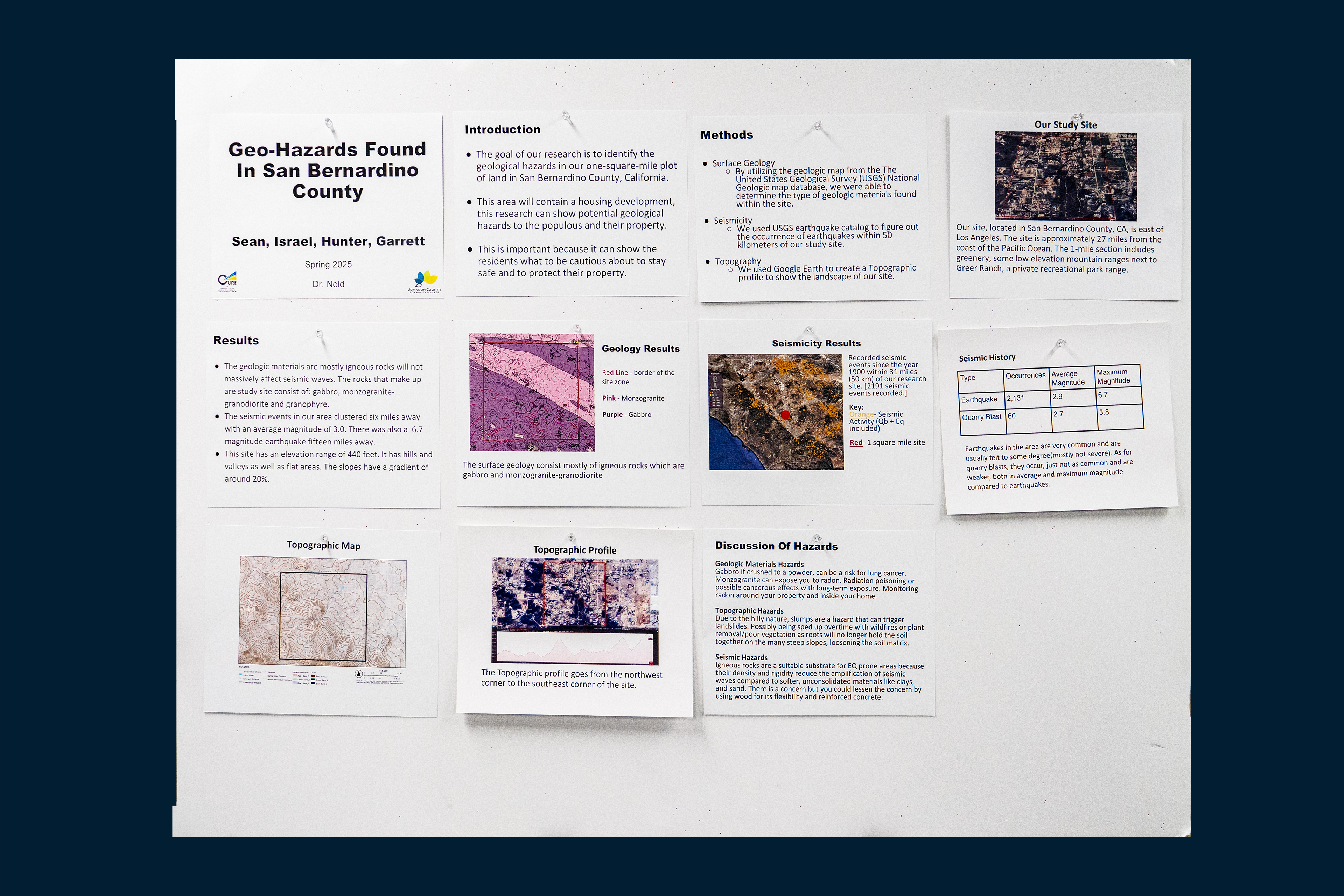
Geo-Hazards Found In San Bernardino County
CoLab, COM 100
This study examines natural hazards that may impact future housing development in a 1-square-mile area located in San Bernardino County, California. The goal is to identify potential geologic risks and inform residents and developers about land safety. We focus on analyzing geological materials, seismic history, and topographic features. The site’s geology includes gabbro, monzogranite, granodiorite, and granophyre, which may pose risks. For example, radon could lead to lung cancer. We also reviewed seismic hazards by examining the region’s earthquake history. Since 1902, the area has experienced 2,192 earthquakes, with an average magnitude of 3.0 and a maximum magnitude of 6.7. This frequency and intensity suggest the area is prone to earthquakes, as well as quarry blasts. Topographic features could also pose additional risks. These could exacerbate problems like mass movements. By identifying geological, seismic, and topographic hazards, this research provides valuable insights to guide development decisions. We recommend implementing strategies like earthquake resistant homes to mitigate these risks and ensure safer living environments for future residents. Understanding these hazards is essential for creating sustainable, safe housing developments in San Bernardino County, California.
Comments
The faculty mentor for this project was Kathryn Nold, Geosciences.