

Location
CoLab, COM 100
Start Date
1-5-2025 12:15 PM
Document Type
Poster
Description
Traditional car batteries contain toxic chemicals and require frequent replacement, contributing to environmental waste. This project explores whether a combination of supercapacitors and solar trickle charging can fully replace traditional car batteries for vehicle starting and power management. Supercapacitors provide rapid energy discharge, making them suitable for engine startup. However, they have low energy storage capacity and self-discharge over time, making overnight energy retention a challenge. To address this, a solar trickle charger is integrated to maintain charge levels. Additionally, an auxiliary capacitor bank supports essential car electronics when the engine is off. Through energy calculations, a supercapacitor bank of 5 x 100F (2.7V each) is determined to be sufficient to start a Honda Civic reliably. A 10W–30W solar panel can sustain charge levels, while the car’s alternator replenishes energy while driving. The estimated implementation cost ranges from $215 to $490, higher than a traditional battery but with a significantly longer lifespan. This research suggests that a fully battery-free car is possible, provided that supercapacitor charge retention is optimized. While challenges exist, such as weather-dependent charging and energy storage limitations, further advancements in capacitor technology and hybrid energy solutions could make this a viable and sustainable alternative to traditional car batteries. This project highlights a potential step toward eco-friendly automotive energy systems, reducing environmental impact while maintaining reliability.
Image
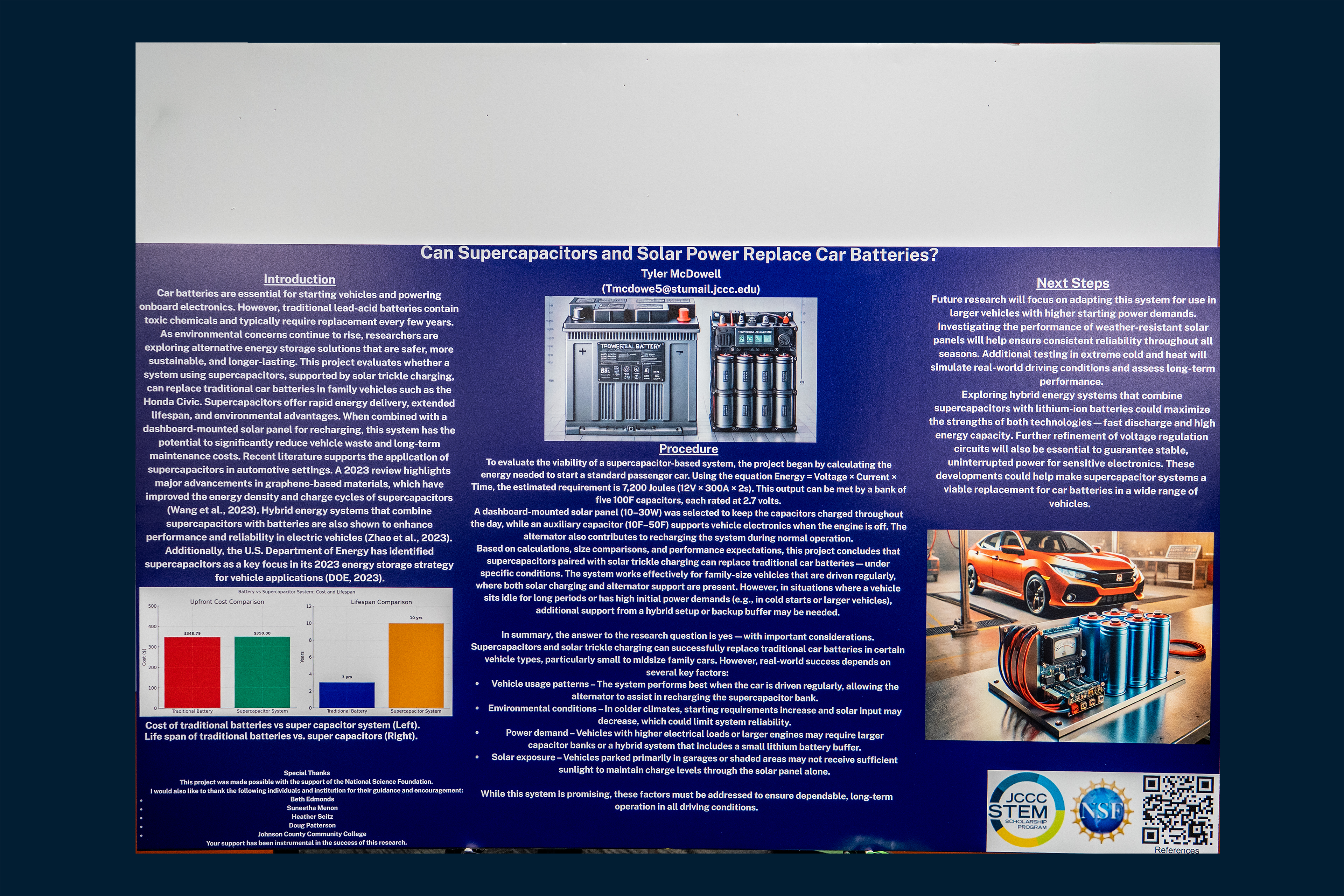
Can Supercapacitors and Solar Power Replace Car Batteries?
CoLab, COM 100
Traditional car batteries contain toxic chemicals and require frequent replacement, contributing to environmental waste. This project explores whether a combination of supercapacitors and solar trickle charging can fully replace traditional car batteries for vehicle starting and power management. Supercapacitors provide rapid energy discharge, making them suitable for engine startup. However, they have low energy storage capacity and self-discharge over time, making overnight energy retention a challenge. To address this, a solar trickle charger is integrated to maintain charge levels. Additionally, an auxiliary capacitor bank supports essential car electronics when the engine is off. Through energy calculations, a supercapacitor bank of 5 x 100F (2.7V each) is determined to be sufficient to start a Honda Civic reliably. A 10W–30W solar panel can sustain charge levels, while the car’s alternator replenishes energy while driving. The estimated implementation cost ranges from $215 to $490, higher than a traditional battery but with a significantly longer lifespan. This research suggests that a fully battery-free car is possible, provided that supercapacitor charge retention is optimized. While challenges exist, such as weather-dependent charging and energy storage limitations, further advancements in capacitor technology and hybrid energy solutions could make this a viable and sustainable alternative to traditional car batteries. This project highlights a potential step toward eco-friendly automotive energy systems, reducing environmental impact while maintaining reliability.
Comments
The faculty mentor for this project was Beth Edmonds, STEM Scholars.