

Location
CoLab, COM 100
Start Date
1-5-2025 11:00 AM
Document Type
Poster
Description
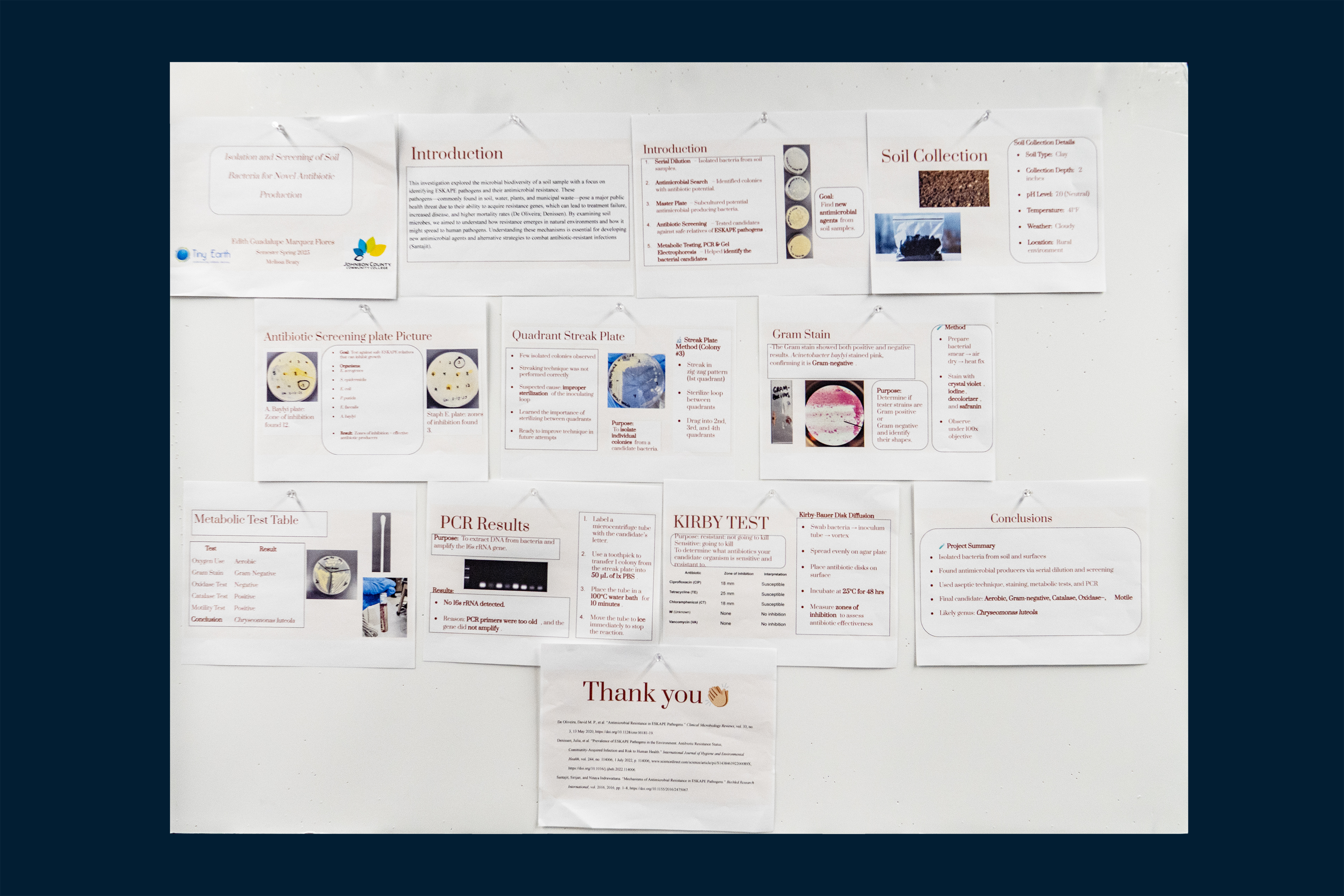
The overall goal of this research is to find new antimicrobial agents and antibiotics in soil samples that we each have collected. First was serial dilution in order to determine if your soil sample is more biodiverse than the soil sample of others at your table. Second we searched for antimicrobials to find 10-12 potential colonies of bacteria producing an antimicrobial. Third, we created a master plate and subcultured potential antimicrobial candidates from serial dilution plates to a master plate. We did this in order to get individual colonies and not have additional contamination. Another experiment we did was antibiotic screening, to see if antibiotic producing candidates are able to inhibit growth of safe relatives of the ESKAPE pathogens. We determined that only two pathogens that had inhibitions were Staphylococcus epidermidis and Enterococcus faecalis. Metabolic testing, PCR and gel electrophoresis were used to determine the identity of the candidate.
Image
Isolation and Screening of Soil Bacteria for Novel Antibiotic Production
CoLab, COM 100
The overall goal of this research is to find new antimicrobial agents and antibiotics in soil samples that we each have collected. First was serial dilution in order to determine if your soil sample is more biodiverse than the soil sample of others at your table. Second we searched for antimicrobials to find 10-12 potential colonies of bacteria producing an antimicrobial. Third, we created a master plate and subcultured potential antimicrobial candidates from serial dilution plates to a master plate. We did this in order to get individual colonies and not have additional contamination. Another experiment we did was antibiotic screening, to see if antibiotic producing candidates are able to inhibit growth of safe relatives of the ESKAPE pathogens. We determined that only two pathogens that had inhibitions were Staphylococcus epidermidis and Enterococcus faecalis. Metabolic testing, PCR and gel electrophoresis were used to determine the identity of the candidate.
Comments
The faculty mentor for this project was Melissa Beaty, Biology.