

Location
CoLab, OCB 100
Start Date
25-4-2024 10:30 AM
Document Type
Poster
Description
Abstract: The purpose of my sample soil serial dilution project was to identify and analyze possible antibiotic agents produced by sample soil dilutions in a countable range of 25 to 250. Once I had a countable range of colonies, I was able to test these selected countable colonies from my soil dilutions and begin to make a master plate which included 8 total countable colony samples. I was then able to test from my master plate any of these soil samples that may have exhibited zones of inhibition when these colonies were tested against safe ESKAPE relatives. The purpose of this project overall was to find possible antimicrobial agents on specific strands of bacteria. The methods to test this included obtaining a natural soil sample and using serial dilutions and the crowded plate technique to plate the soil sample and isolate a countable colony and compare these to safe ESKAPE pathogens using aseptic techniques and room temperature incubation. My colonies initially showed possible zones of inhibition and therefore were chosen from the plates and then streaked. After incubation of these promising candidates from the master plate, these individual colonies were tested against the safe ESKAPE relatives again. Unfortunately, none of my serial dilutions showed zones of inhibition against the safe ESKAPE relatives.
Image
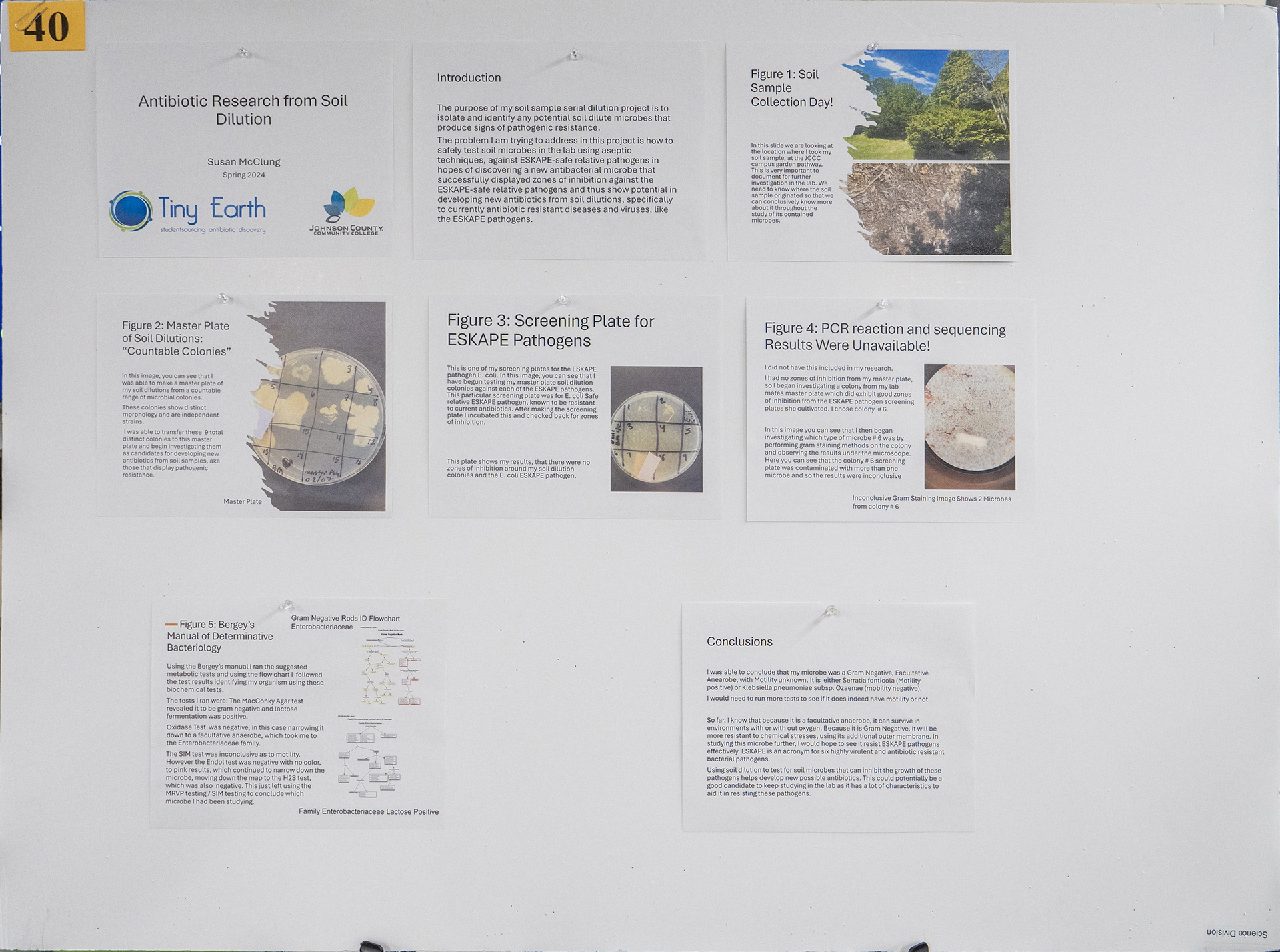
Using Serial Dilution Processes from Soil Samples
CoLab, OCB 100
Abstract: The purpose of my sample soil serial dilution project was to identify and analyze possible antibiotic agents produced by sample soil dilutions in a countable range of 25 to 250. Once I had a countable range of colonies, I was able to test these selected countable colonies from my soil dilutions and begin to make a master plate which included 8 total countable colony samples. I was then able to test from my master plate any of these soil samples that may have exhibited zones of inhibition when these colonies were tested against safe ESKAPE relatives. The purpose of this project overall was to find possible antimicrobial agents on specific strands of bacteria. The methods to test this included obtaining a natural soil sample and using serial dilutions and the crowded plate technique to plate the soil sample and isolate a countable colony and compare these to safe ESKAPE pathogens using aseptic techniques and room temperature incubation. My colonies initially showed possible zones of inhibition and therefore were chosen from the plates and then streaked. After incubation of these promising candidates from the master plate, these individual colonies were tested against the safe ESKAPE relatives again. Unfortunately, none of my serial dilutions showed zones of inhibition against the safe ESKAPE relatives.
Comments
The faculty mentor for this project was Rachael Ott, Biology.