

Location
CoLab, OCB 100
Start Date
25-4-2024 10:30 AM
Document Type
Poster
Description
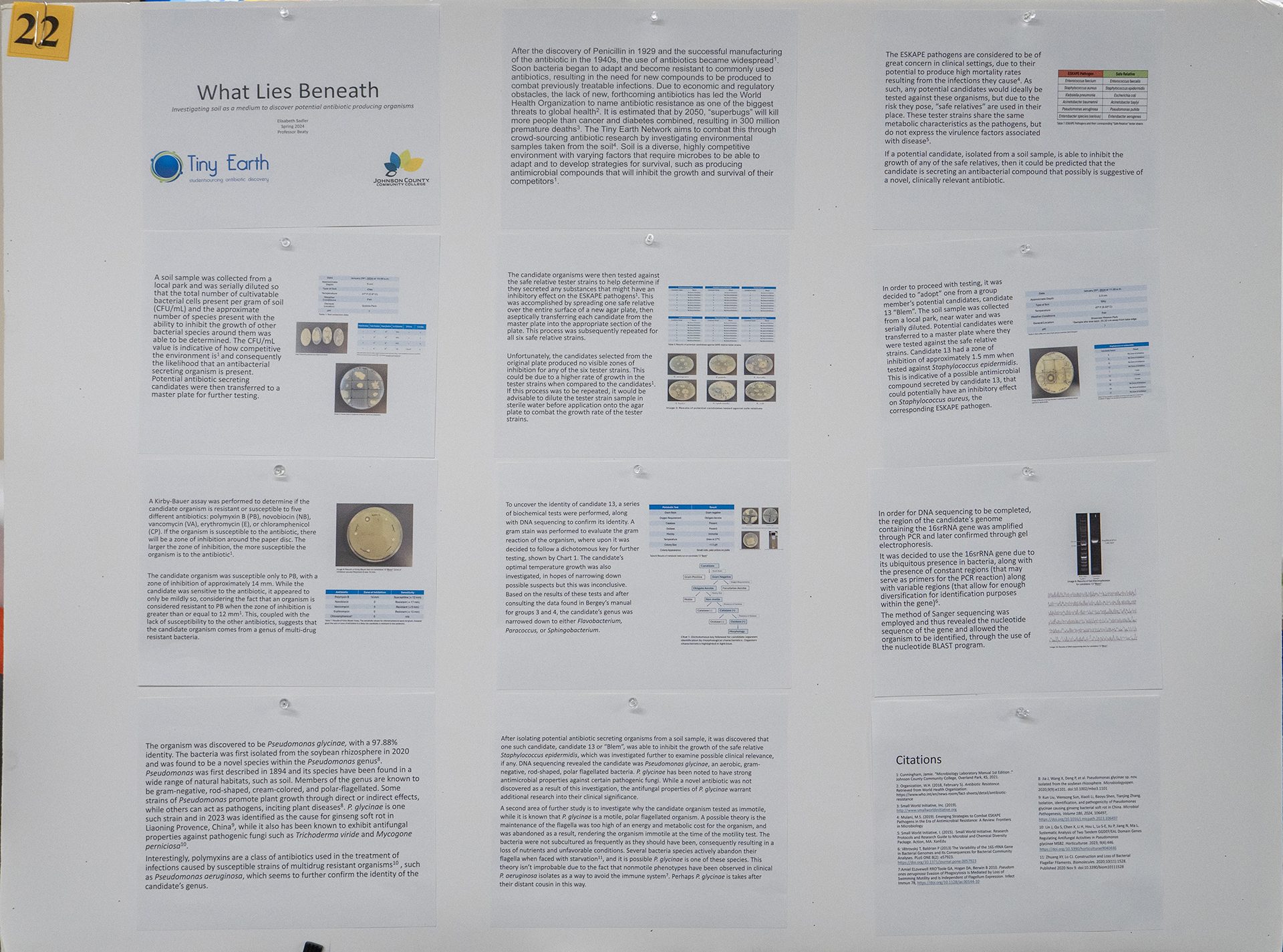
Due to the highly competitive nature of soil, microbes produce chemicals that inhibit the growth of other microbes. This type of competition favors bacteria that can then produce an antibiotic, allowing soil to be a verifiable gold mine of potential antibiotic producing microbes, thus helping to solve the problem of antibiotic resistance. After serially diluting previously collected soil samples and testing the antibiotic candidates found in the sample against the ESKAPE safe relatives, it was discovered that one potential candidate, “Blem” exhibited antibacterial qualities against Staphylococcus epidermidis. Using PCR analysis and subsequent gel electrophoresis, the DNA of Blem was then sent to an outside facility for sequencing. The properties of this compound studied thus far suggest the discovery of a novel antibiotic and will require further study, such as performing a disc diffusion assay to determine the Minimum Inhibitory Concentration (MIC).
Image
Utilizing Soil to Combat Antibiotic Resistance
CoLab, OCB 100
Due to the highly competitive nature of soil, microbes produce chemicals that inhibit the growth of other microbes. This type of competition favors bacteria that can then produce an antibiotic, allowing soil to be a verifiable gold mine of potential antibiotic producing microbes, thus helping to solve the problem of antibiotic resistance. After serially diluting previously collected soil samples and testing the antibiotic candidates found in the sample against the ESKAPE safe relatives, it was discovered that one potential candidate, “Blem” exhibited antibacterial qualities against Staphylococcus epidermidis. Using PCR analysis and subsequent gel electrophoresis, the DNA of Blem was then sent to an outside facility for sequencing. The properties of this compound studied thus far suggest the discovery of a novel antibiotic and will require further study, such as performing a disc diffusion assay to determine the Minimum Inhibitory Concentration (MIC).
Comments
The faculty mentor for this project was Melissa Beaty, Biology.