

Location
CoLab, OCB 100
Start Date
25-4-2024 10:30 AM
Document Type
Poster
Description
When bacteria no longer respond to the drugs designed to kill them, they become antibiotic-resistant, making future infections harder to treat. Without the development of new antibiotics to fight these “super” bacteria, we face a future of increasing death rates due to infections that otherwise should be treatable. In response to this growing public health threat, a soil sample was obtained from Fleming Park, a 7,800-acre recreational parkland in Jackson County, Missouri, to discover and isolate potential undiscovered antibiotic-producing bacteria in the soil. Through serial dilution of the sample, 15 bacterial colonies were isolated for further testing. Ultimately, six bacterial colonies were chosen for additional testing for inhibition against ESKAPE pathogen relatives. ESKAPE is an acronym for the names of six highly virulent and antibiotic-resistant bacterial pathogens. In the student lab setting, safe relatives of these pathogens were used to test the soil bacterial candidates in terms of their ability to inhibit the growth of these bacteria. Ultimately, one candidate stood out in its ability to inhibit pathogens' growth around it, and this candidate was named Zoe. Zoe showed promising results in inhibiting several tester strains of pathogens. There was a clear and significant inhibition zone against Bacillus subtilis, Mycobacterium smegmatis, and Enterococcus faecalis. Additionally, there was moderate inhibition against Acinetobacter baylyi and Pseudomonas putida , and slight inhibition against Escherichia coli and Enterobacter aerogenes. Gram and spore staining showed that Zoe was a gram-positive spore-forming rod bacterium. Polymerase Chain Reaction (PCR) and Gel Electrophoresis were conducted for DNA analysis.
Image
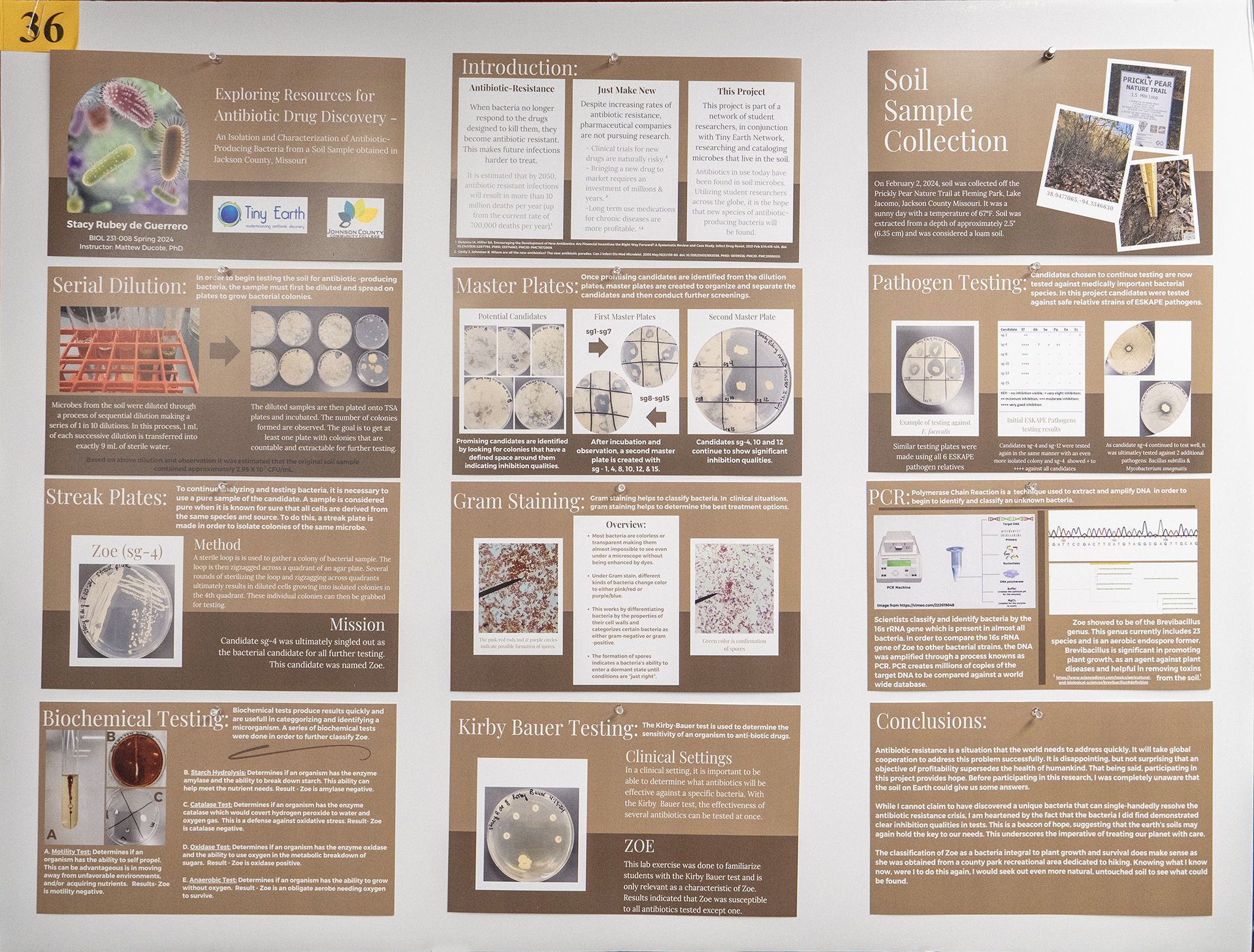
Exploring Resources for Antibiotic Drug Discovery – An Isolation and Characterization of Antibiotic-Producing Bacteria from a Soil Sample Obtained in Jackson County, Missouri
CoLab, OCB 100
When bacteria no longer respond to the drugs designed to kill them, they become antibiotic-resistant, making future infections harder to treat. Without the development of new antibiotics to fight these “super” bacteria, we face a future of increasing death rates due to infections that otherwise should be treatable. In response to this growing public health threat, a soil sample was obtained from Fleming Park, a 7,800-acre recreational parkland in Jackson County, Missouri, to discover and isolate potential undiscovered antibiotic-producing bacteria in the soil. Through serial dilution of the sample, 15 bacterial colonies were isolated for further testing. Ultimately, six bacterial colonies were chosen for additional testing for inhibition against ESKAPE pathogen relatives. ESKAPE is an acronym for the names of six highly virulent and antibiotic-resistant bacterial pathogens. In the student lab setting, safe relatives of these pathogens were used to test the soil bacterial candidates in terms of their ability to inhibit the growth of these bacteria. Ultimately, one candidate stood out in its ability to inhibit pathogens' growth around it, and this candidate was named Zoe. Zoe showed promising results in inhibiting several tester strains of pathogens. There was a clear and significant inhibition zone against Bacillus subtilis, Mycobacterium smegmatis, and Enterococcus faecalis. Additionally, there was moderate inhibition against Acinetobacter baylyi and Pseudomonas putida , and slight inhibition against Escherichia coli and Enterobacter aerogenes. Gram and spore staining showed that Zoe was a gram-positive spore-forming rod bacterium. Polymerase Chain Reaction (PCR) and Gel Electrophoresis were conducted for DNA analysis.
Comments
The faculty mentor for this project was Matthew Ducote, Biology.