

Location
CoLab, OCB 100
Start Date
25-4-2024 10:30 AM
Document Type
Poster
Description
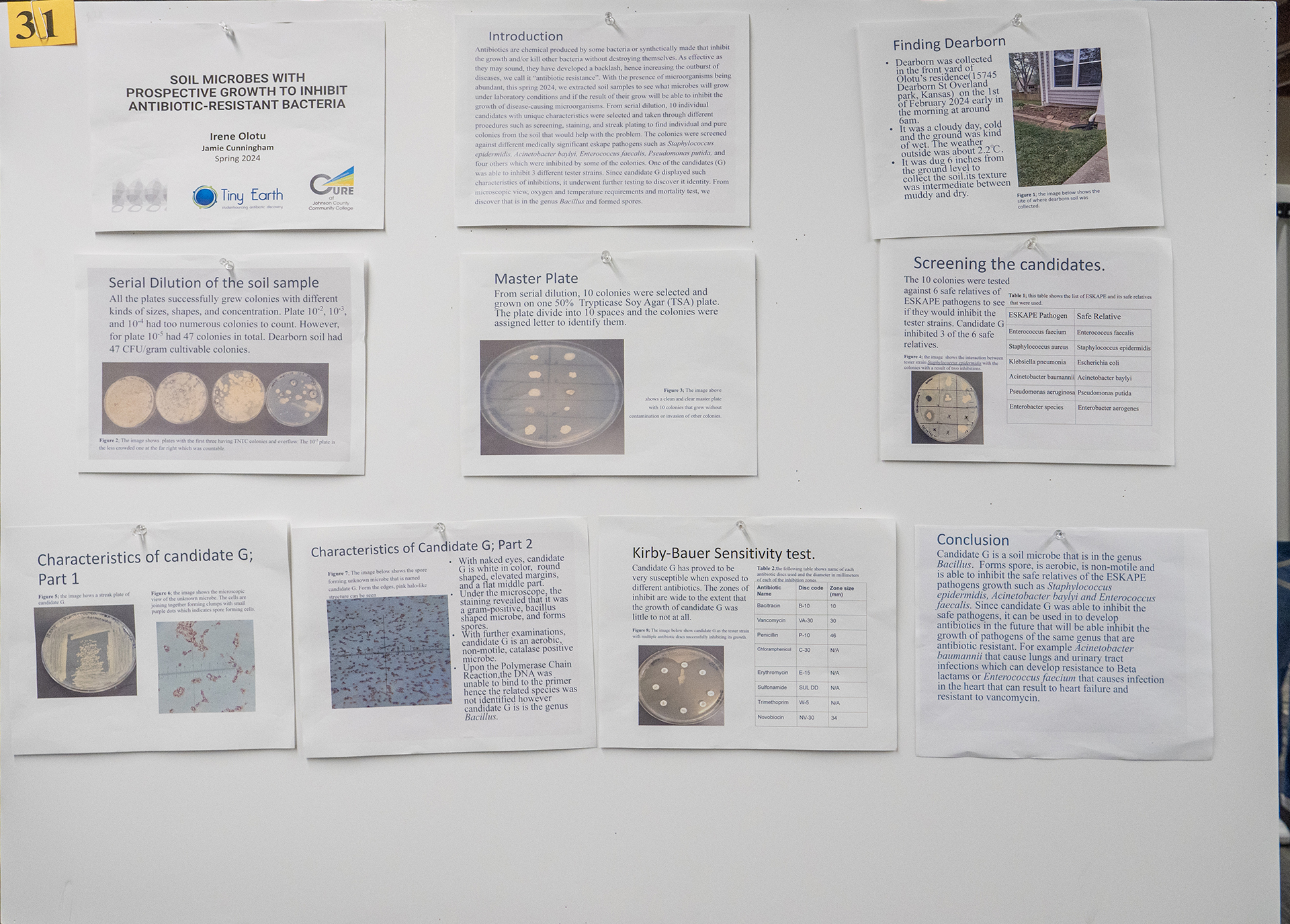
Antibiotics are chemical produced by some bacteria or synthetically made that inhibit the growth and/or kill other bacteria without destroying themselves. As effective as they may sound, they have developed a backlash, hence increasing the outburst of diseases, we call it “antibiotic resistance”. Due to the life and death situation at hand, a lab experiment with microbes was conducted in hopes that it will perhaps contribute to finding solutions to overcome a medication resistance. With the presence of microorganisms being abundant, this spring 2024, we extracted soil samples to see what microbes will grow under laboratory conditions and if the result of their grow will be able to inhibit the growth of disease-causing microorganisms. From serial dilution, 12 individual candidates with unique characteristics were selected and taken though different procedures such as screening, staining, and streak plating to find individual and pure colonies from the soil that would help with the problem. The colonies were screened against different medically significant pathogens such as Staphylococcus epidermidis, Acinetobacter baylyi, Enterococcus faecalis, Pseudomonas putida, and four others which were inhibited by some of the colonies. One of the candidates (G) was able to inhibit 3 different tester strains. For example, vancomycin-resistance Enterococcus (VRE) is a bacteria strain specifically of enterococcus faecalis that is resistant to the antibiotic vancomycin. With the inhibition of this microbe by one of the selected candidates from the soil, opens a new window to our understanding of antibiotic resistance.
Image
Soil Microbes with Prospective Growth to Inhibit Antibiotic-Resistant Bacteria
CoLab, OCB 100
Antibiotics are chemical produced by some bacteria or synthetically made that inhibit the growth and/or kill other bacteria without destroying themselves. As effective as they may sound, they have developed a backlash, hence increasing the outburst of diseases, we call it “antibiotic resistance”. Due to the life and death situation at hand, a lab experiment with microbes was conducted in hopes that it will perhaps contribute to finding solutions to overcome a medication resistance. With the presence of microorganisms being abundant, this spring 2024, we extracted soil samples to see what microbes will grow under laboratory conditions and if the result of their grow will be able to inhibit the growth of disease-causing microorganisms. From serial dilution, 12 individual candidates with unique characteristics were selected and taken though different procedures such as screening, staining, and streak plating to find individual and pure colonies from the soil that would help with the problem. The colonies were screened against different medically significant pathogens such as Staphylococcus epidermidis, Acinetobacter baylyi, Enterococcus faecalis, Pseudomonas putida, and four others which were inhibited by some of the colonies. One of the candidates (G) was able to inhibit 3 different tester strains. For example, vancomycin-resistance Enterococcus (VRE) is a bacteria strain specifically of enterococcus faecalis that is resistant to the antibiotic vancomycin. With the inhibition of this microbe by one of the selected candidates from the soil, opens a new window to our understanding of antibiotic resistance.
Comments
The faculty mentor for this project was Jaime Cunningham, Biology.