

Location
CoLab, OCB 100
Start Date
25-4-2024 9:00 AM
Document Type
Poster
Description
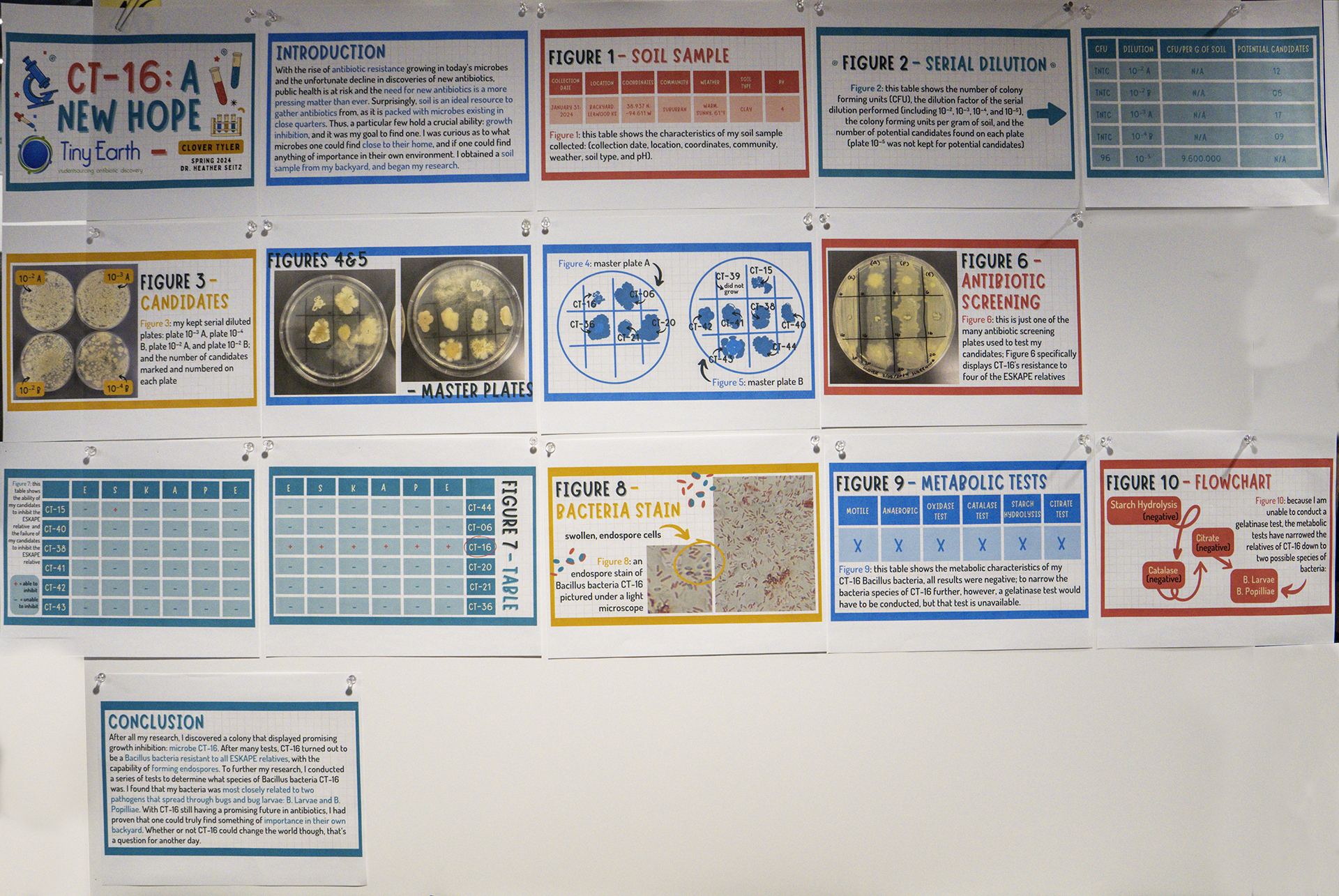
With the rise of antibiotic resistance growing in today’s microbes and the unfortunate decline in discoveries of new antibiotics, public health is at risk and the need for new antibiotics is a more pressing matter than ever. Surprisingly, soil is an ideal resource to gather antibiotics from, as it holds a diverse, crowded ecosystem of microbes. A majority of the antibiotics discovered came from the very ground we walk on. This is due to the fact that soil is packed with microbes existing in close quarters, thus, a particular few hold a crucial ability: growth inhibition; and it was my goal to find one. I was curious as to what microbes one could find close to their home, and if one could find anything of importance in their own environment. I obtained a soil sample from my backyard, and through a series of serial dilutions, began to gather potential candidates that showed promising areas of inhibition. These candidates were then tested against specific pathogens to determine their ability to inhibit other bacteria. Only one of my chosen colonies, the sixteenth colony, showed inhibition against all pathogens, making it my strongest candidate—hence where it got its name: CT-16. The next step was to identify what bacteria I had discovered and its relatives—if it was already an existing bacteria—and determine if CT-16 truly was a new antibiotic capable of changing the world of antibiotics for the better.
Image
A New Hope CT-16
CoLab, OCB 100
With the rise of antibiotic resistance growing in today’s microbes and the unfortunate decline in discoveries of new antibiotics, public health is at risk and the need for new antibiotics is a more pressing matter than ever. Surprisingly, soil is an ideal resource to gather antibiotics from, as it holds a diverse, crowded ecosystem of microbes. A majority of the antibiotics discovered came from the very ground we walk on. This is due to the fact that soil is packed with microbes existing in close quarters, thus, a particular few hold a crucial ability: growth inhibition; and it was my goal to find one. I was curious as to what microbes one could find close to their home, and if one could find anything of importance in their own environment. I obtained a soil sample from my backyard, and through a series of serial dilutions, began to gather potential candidates that showed promising areas of inhibition. These candidates were then tested against specific pathogens to determine their ability to inhibit other bacteria. Only one of my chosen colonies, the sixteenth colony, showed inhibition against all pathogens, making it my strongest candidate—hence where it got its name: CT-16. The next step was to identify what bacteria I had discovered and its relatives—if it was already an existing bacteria—and determine if CT-16 truly was a new antibiotic capable of changing the world of antibiotics for the better.
Comments
The faculty mentor for this project was Heather Seitz, Biology.