

Location
CoLab, OCB 100
Start Date
25-4-2024 9:00 AM
Document Type
Poster
Description
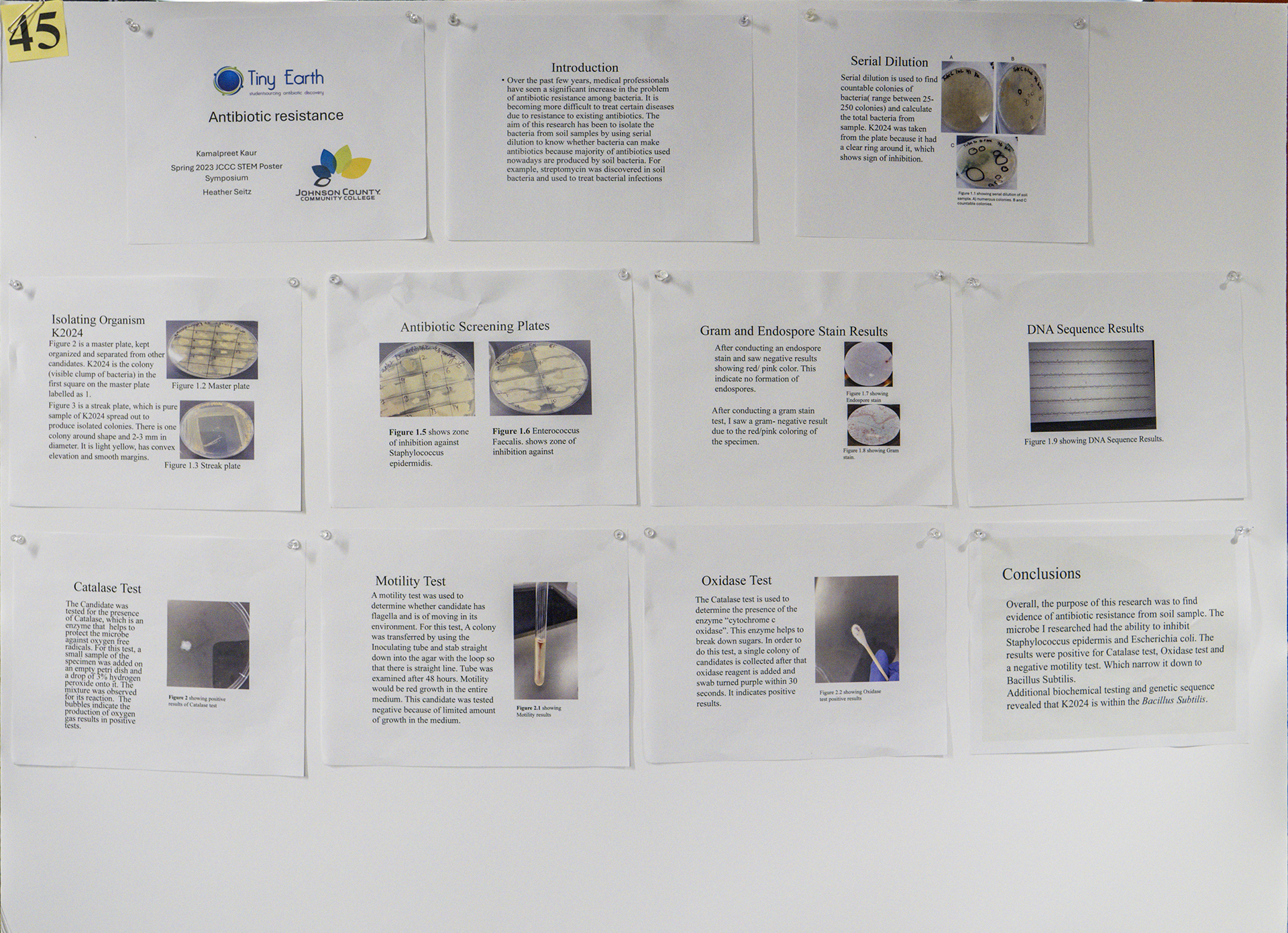
Over the past few years, medical professionals have seen a significant increase in the problem of antibiotic resistance among bacteria. It is becoming more difficult to treat certain diseases due to resistance to existing antibiotics.The aim of this research has been to isolate the bacteria from soil samples by using serial dilution to know whether bacteria can make antibiotics because the majority of antibiotics used nowadays are produced by soil bacteria. For example, streptomycin was discovered in soil bacteria and used to treat bacterial infections. In order to find new antibiotics, a soil sample was collected at the Claremont apartment located in Overland Park KS to identify whether the bacteria is present in the soil sample and also to know whether this bacteria is capable of producing antibiotics. I picked this place because I live there.This place is unique because a lot of people live here and have many domestic animals, such as cats and dogs. Many procedures were followed throughout the semester. One of them, serial dilution, is used to pick isolated colonies and helps to screen potential candidates against the ESKAPE relatives. ESKAPE is an acrostic that stands for different species of bacteria that are antibiotic resistant. I took a candidate and grew it alongside an ESKAPE relative to see if it will inhibit the growth of the ESKAPE relative. Afterwards, I selected one candidate that I believe is capable of producing antibiotics. I named the discovered candidate K2024. It inhibits the growth of Enterococcus Faecalis. Research is ongoing.
Image
A New Hope for Antibiotics: K2024
CoLab, OCB 100
Over the past few years, medical professionals have seen a significant increase in the problem of antibiotic resistance among bacteria. It is becoming more difficult to treat certain diseases due to resistance to existing antibiotics.The aim of this research has been to isolate the bacteria from soil samples by using serial dilution to know whether bacteria can make antibiotics because the majority of antibiotics used nowadays are produced by soil bacteria. For example, streptomycin was discovered in soil bacteria and used to treat bacterial infections. In order to find new antibiotics, a soil sample was collected at the Claremont apartment located in Overland Park KS to identify whether the bacteria is present in the soil sample and also to know whether this bacteria is capable of producing antibiotics. I picked this place because I live there.This place is unique because a lot of people live here and have many domestic animals, such as cats and dogs. Many procedures were followed throughout the semester. One of them, serial dilution, is used to pick isolated colonies and helps to screen potential candidates against the ESKAPE relatives. ESKAPE is an acrostic that stands for different species of bacteria that are antibiotic resistant. I took a candidate and grew it alongside an ESKAPE relative to see if it will inhibit the growth of the ESKAPE relative. Afterwards, I selected one candidate that I believe is capable of producing antibiotics. I named the discovered candidate K2024. It inhibits the growth of Enterococcus Faecalis. Research is ongoing.
Comments
The faculty mentor for this project was Heather Seitz, Biology.