

Location
CoLab, OCB 100
Start Date
25-4-2024 9:00 AM
Document Type
Poster
Description
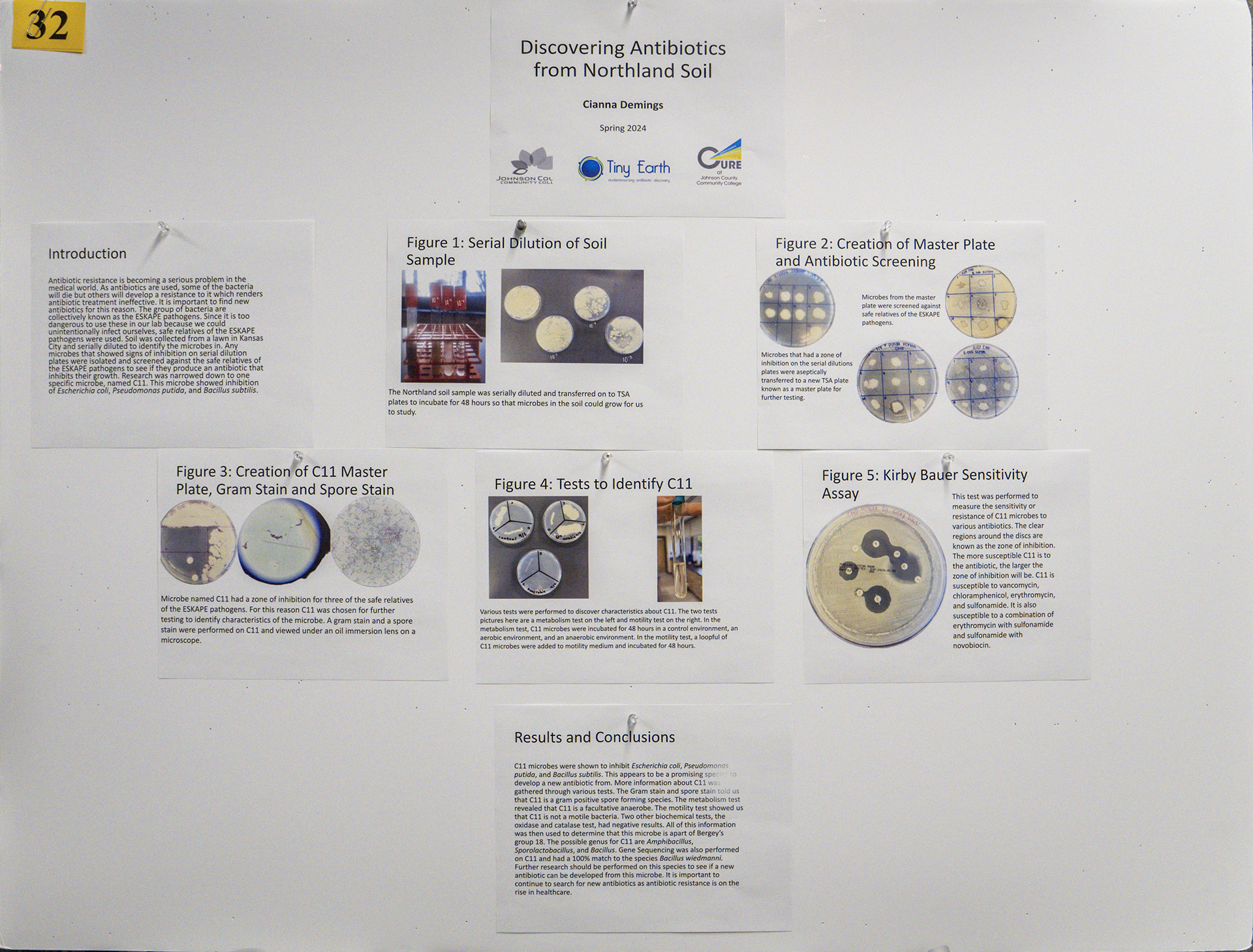
Antibiotic resistance is becoming a serious problem in the medical world. As antibiotics are used, some of the bacteria will die but others will develop a resistance to it which renders antibiotic treatment ineffective. It is important to find new antibiotics for this reason. The group of bacteria are collectively known as the ESKAPE pathogens. Since it is too dangerous to use these in our lab because we could unintentionally infect ourselves, safe relatives of the ESKAPE pathogens were used. Soil was collected from a lawn in Kansas City and serially diluted to identify the microbes in. Any microbes that showed signs of inhibition on serial dilution plates were isolated and screened against the safe relatives of the ESKAPE pathogens to see if they produce an antibiotic that inhibits their growth. Research was narrowed down to one specific microbe, named C11. This microbe showed inhibition of Escherichia coli, Pseudomonas putida, and Bacillus subtilis.
Image
Discovering Antibiotics from Northland Soil
CoLab, OCB 100
Antibiotic resistance is becoming a serious problem in the medical world. As antibiotics are used, some of the bacteria will die but others will develop a resistance to it which renders antibiotic treatment ineffective. It is important to find new antibiotics for this reason. The group of bacteria are collectively known as the ESKAPE pathogens. Since it is too dangerous to use these in our lab because we could unintentionally infect ourselves, safe relatives of the ESKAPE pathogens were used. Soil was collected from a lawn in Kansas City and serially diluted to identify the microbes in. Any microbes that showed signs of inhibition on serial dilution plates were isolated and screened against the safe relatives of the ESKAPE pathogens to see if they produce an antibiotic that inhibits their growth. Research was narrowed down to one specific microbe, named C11. This microbe showed inhibition of Escherichia coli, Pseudomonas putida, and Bacillus subtilis.
Comments
The faculty mentor for this project was Jaime Cunningham, Biology.