

Location
CoLab, OCB 100
Start Date
25-4-2024 9:00 AM
Document Type
Poster
Description
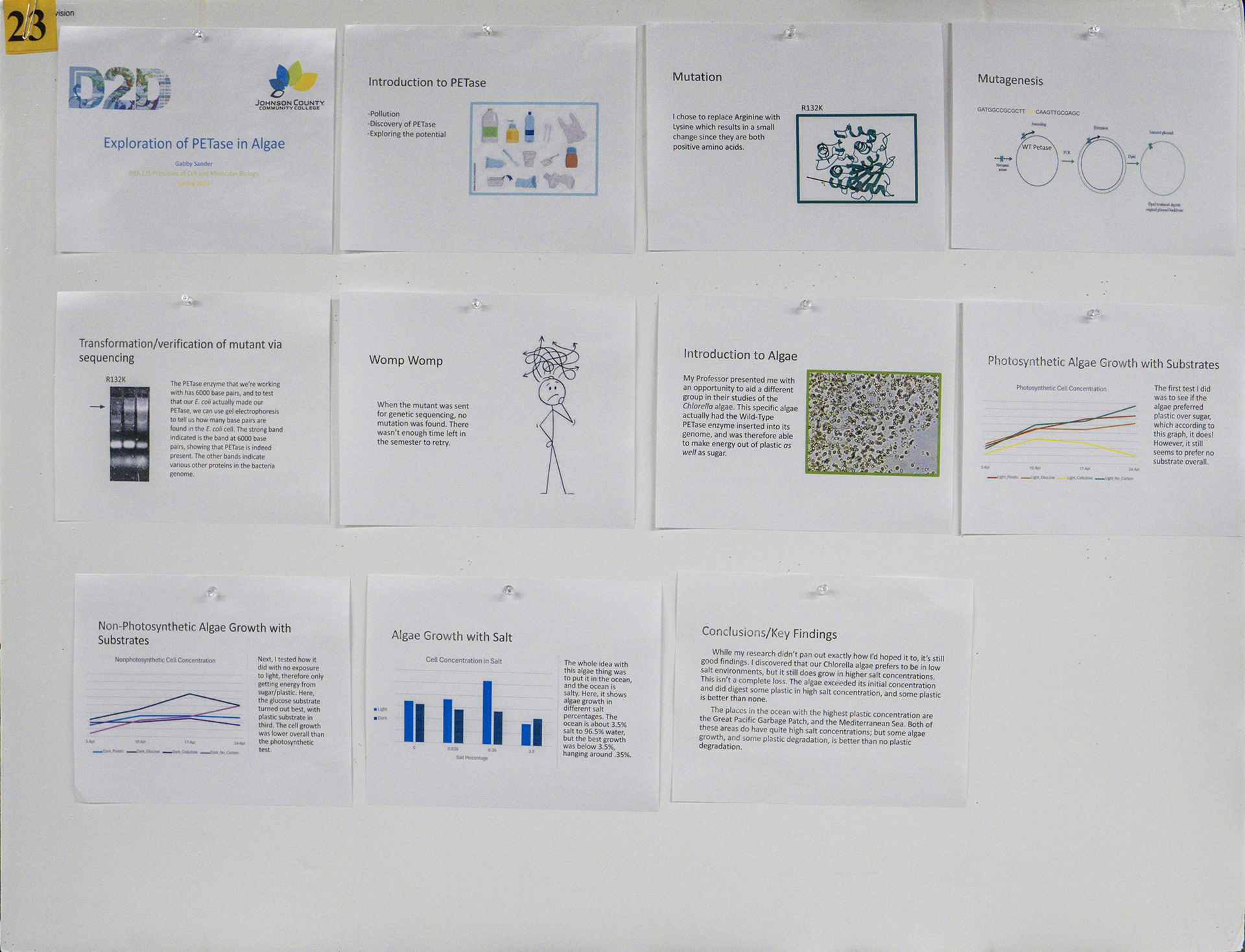
Pollution is an extreme dilemma in the world today and is continuing to escalate each year. After the discovery of an enzyme called PETase, things are looking brighter for the future. The main function of PETase is to degrade plastics. In my Honors Biology class, we found that the PETase enzyme works the most optimally at a pH of 10 through an experiment that I conducted using a wide range of acidic and basic pH's. As for another experiment, I am mutating a sequence site in the PETase of DNA. I chose to replace Arginine with Lysine which results in a small change since they are both positive amino acids. This is because I believe that small changes lead to great success. To do so, we performed site directed mutagenesis, so then I could introduce it to E. coli. After an initial attempt it was ineffective, steps were repeated and mutated plasmid DNA was isolated. The mutation will be verified using sequencing and protein activity will be compared with wildtype. Finally, I isolated the mutated plasmid DNA to be eligible to send out for sequencing. I am currently waiting to receive my results.
Image
Exploration of PETase
CoLab, OCB 100
Pollution is an extreme dilemma in the world today and is continuing to escalate each year. After the discovery of an enzyme called PETase, things are looking brighter for the future. The main function of PETase is to degrade plastics. In my Honors Biology class, we found that the PETase enzyme works the most optimally at a pH of 10 through an experiment that I conducted using a wide range of acidic and basic pH's. As for another experiment, I am mutating a sequence site in the PETase of DNA. I chose to replace Arginine with Lysine which results in a small change since they are both positive amino acids. This is because I believe that small changes lead to great success. To do so, we performed site directed mutagenesis, so then I could introduce it to E. coli. After an initial attempt it was ineffective, steps were repeated and mutated plasmid DNA was isolated. The mutation will be verified using sequencing and protein activity will be compared with wildtype. Finally, I isolated the mutated plasmid DNA to be eligible to send out for sequencing. I am currently waiting to receive my results.
Comments
The faculty mentor for this project was Heather Seitz, Biology.