

Location
CoLab, OCB 100
Start Date
25-4-2024 6:00 PM
Document Type
Poster
Description
PETase is an enzyme, originally discovered in bacteria, that works to break down certain plastics. With plastic pollution increasing, this enzyme could play a significant role in counteracting its negative effects. Research has revealed that, at higher temperatures, PETase’s rate of reaction slows significantly. In an effort to accelerate this process, I attempted to mutate the bacteria. The results of the original mutation came up inconclusive, so instead, I tested the wild-type of the bacteria to serve as a baseline for my peers’ research. My data will include DNA mutation by way of site directed mutagenesis, gene transformation into E. coli, isolation of mutated plasmid DNA, and gene sequencing. It will also include data comparing the function of the class set of mutated enzymes to that of the wild type.
Image
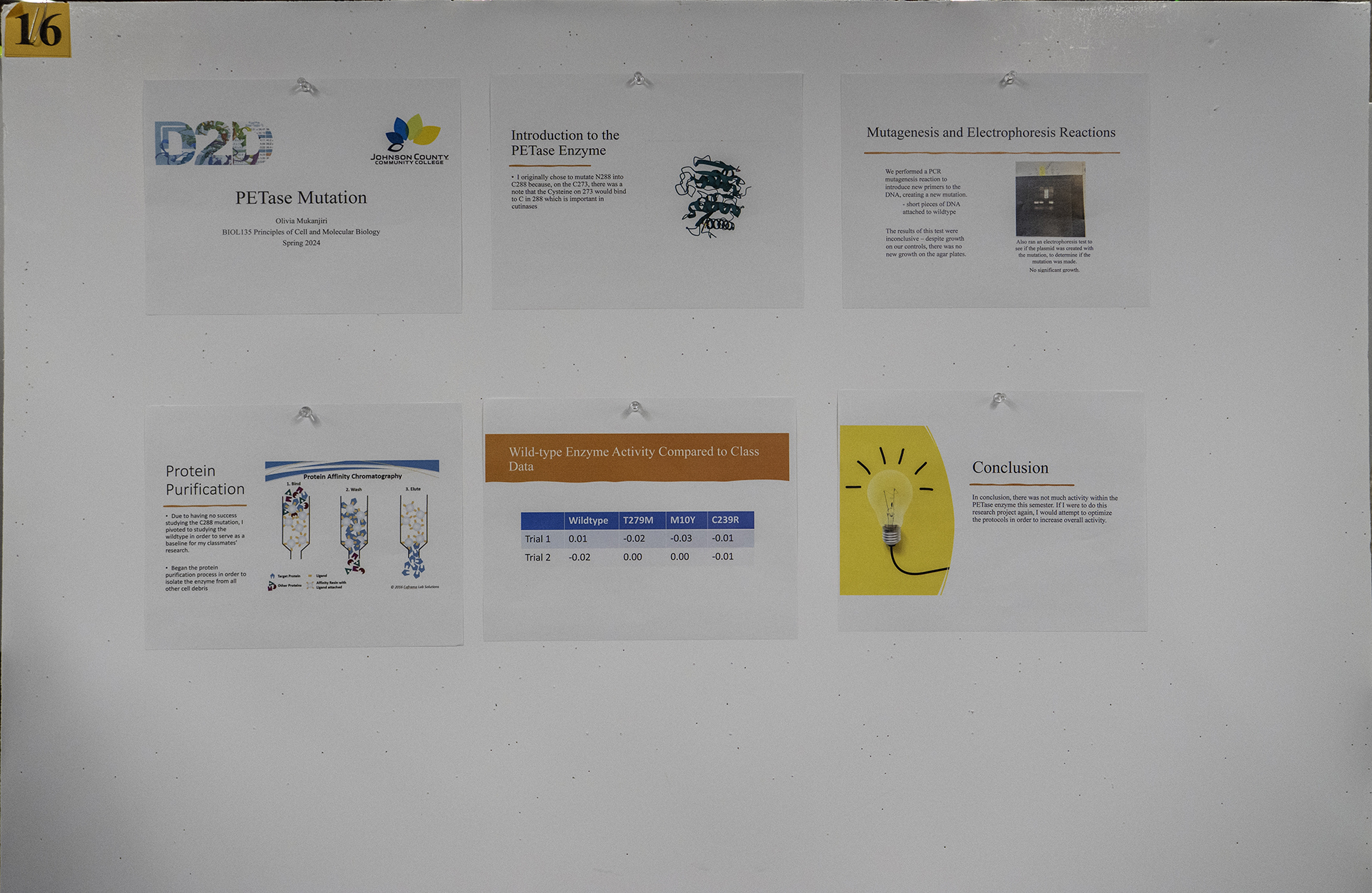
PETase Wildtype Reaction
CoLab, OCB 100
PETase is an enzyme, originally discovered in bacteria, that works to break down certain plastics. With plastic pollution increasing, this enzyme could play a significant role in counteracting its negative effects. Research has revealed that, at higher temperatures, PETase’s rate of reaction slows significantly. In an effort to accelerate this process, I attempted to mutate the bacteria. The results of the original mutation came up inconclusive, so instead, I tested the wild-type of the bacteria to serve as a baseline for my peers’ research. My data will include DNA mutation by way of site directed mutagenesis, gene transformation into E. coli, isolation of mutated plasmid DNA, and gene sequencing. It will also include data comparing the function of the class set of mutated enzymes to that of the wild type.
Comments
The faculty mentor for this project was Heather Seitz, Biology.