

Location
CoLab, OCB 100
Start Date
25-4-2024 1:30 PM
Document Type
Poster
Description
Antibiotics were discovered and popularized around a century ago. Although the variety of antibiotics has increased since then, the effectiveness of specific antibiotics has decreased. Since the world is in need of new antibiotic discoveries, the Tiny Earth Committee has incorporated research for a new antibiotic as part of its curriculum. A personal soil sample from a location of choice was required and sampled in order to participate in this research. I carefully chose a section of soil to acquire my sample from in my front yard. In the soil sample I provided, one candidate in particular, named Alex H., showed a potential zone of inhibition, which sometimes is an indicator of antibiotic properties. By diluting the original soil sample and isolating the visually-promising bacteria onto a master plate, the candidates were then tested for their personal antibiotic resistance to the provided, safe close relatives of dangerous pathogenic bacteria. To identify the morphology and makeup of the potentially-identified antibiotics, biochemical tests, such as PCR, polymerase chain reaction, gel electrophoresis, as well as differential staining, were performed to identify and isolate the potential candidate.
Image
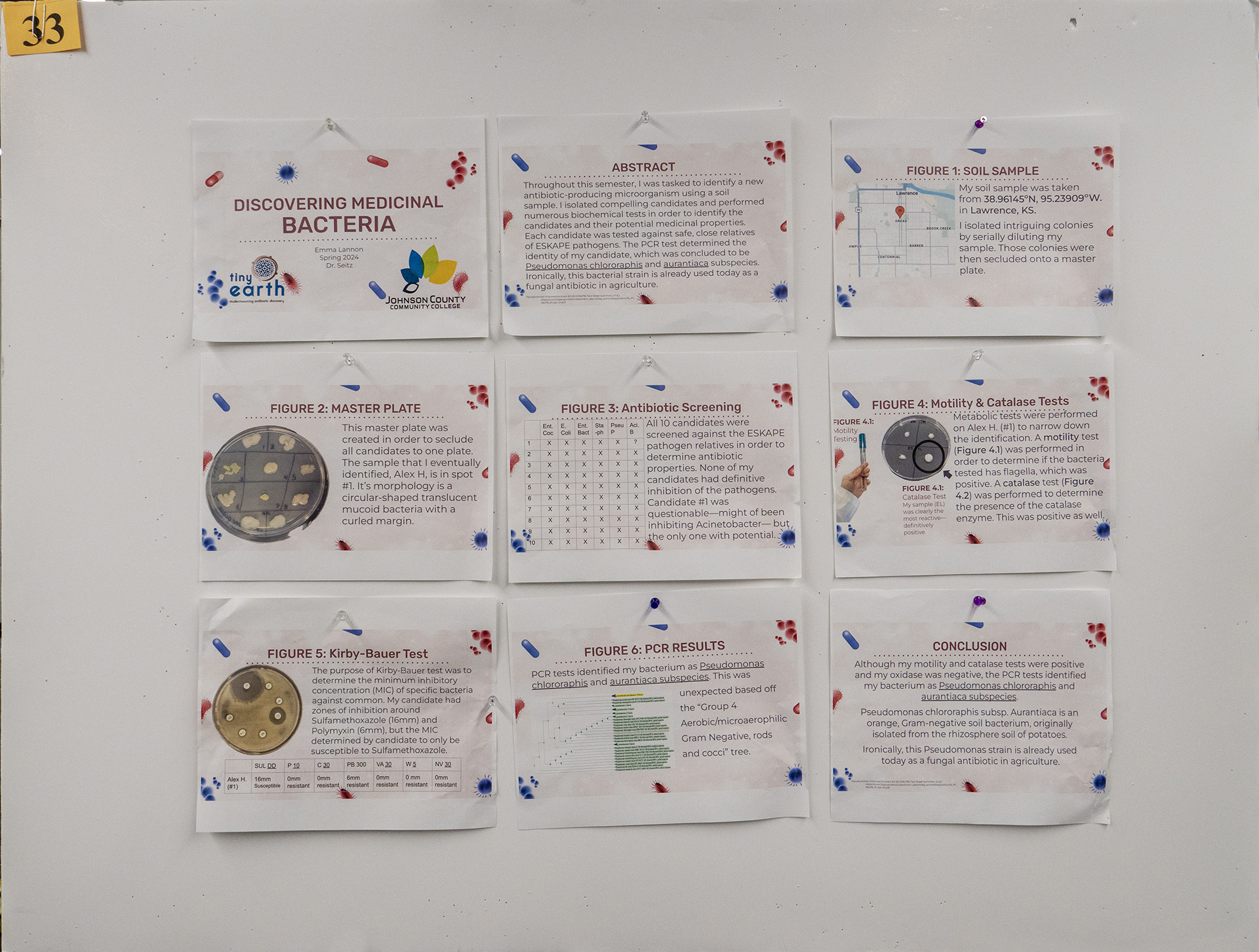
Antibiotic Discovery
CoLab, OCB 100
Antibiotics were discovered and popularized around a century ago. Although the variety of antibiotics has increased since then, the effectiveness of specific antibiotics has decreased. Since the world is in need of new antibiotic discoveries, the Tiny Earth Committee has incorporated research for a new antibiotic as part of its curriculum. A personal soil sample from a location of choice was required and sampled in order to participate in this research. I carefully chose a section of soil to acquire my sample from in my front yard. In the soil sample I provided, one candidate in particular, named Alex H., showed a potential zone of inhibition, which sometimes is an indicator of antibiotic properties. By diluting the original soil sample and isolating the visually-promising bacteria onto a master plate, the candidates were then tested for their personal antibiotic resistance to the provided, safe close relatives of dangerous pathogenic bacteria. To identify the morphology and makeup of the potentially-identified antibiotics, biochemical tests, such as PCR, polymerase chain reaction, gel electrophoresis, as well as differential staining, were performed to identify and isolate the potential candidate.
Comments
The faculty mentor for this project was Heather Seitz, Biology.