

Location
CoLab, OCB 100
Start Date
25-4-2024 1:30 PM
Document Type
Poster
Description
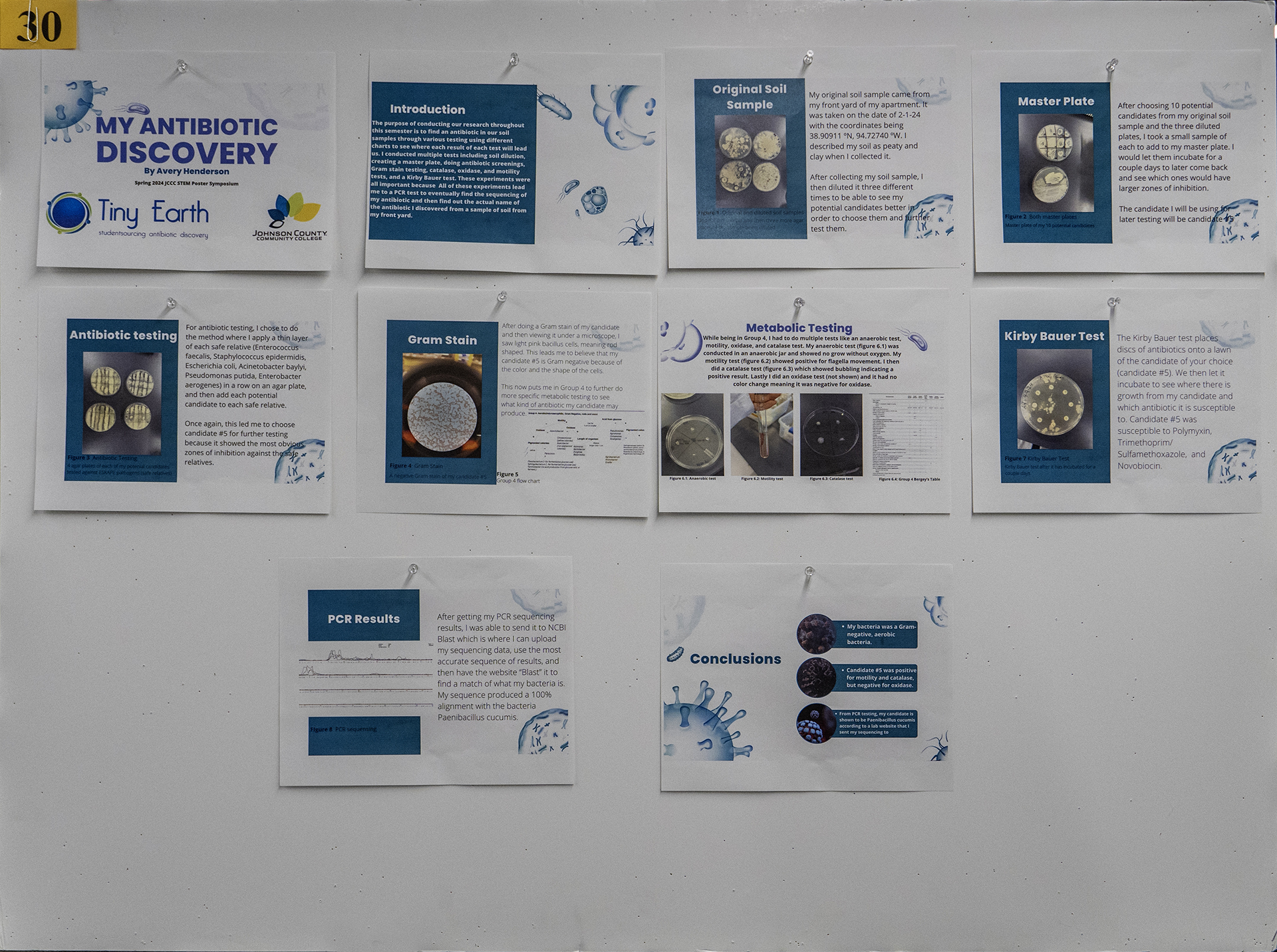
The purpose of conducting our research this semester is to find an antibiotic in our soil samples that shows the most antibiotic resistance to bacteria. The process of antibiotic resistance is to find which bacteria have evolved mechanisms that protect them against the effect of the antibiotic. In this process, you will see zones of inhibition around the growth of that colony of bacteria. My soil sample that I collected came from my front yard where it was diluted and tested for colony growth in class. We chose to use soil samples to grow the bacteria because they are normally non-pathogenic. Throughout diluting, transferring, and incubating our soil samples, we found large numbers of bacterial colonies in our agar plates of the soil samples. There were many potential candidates that we discovered in our agar plates. These would then transfer over to a master plate to see their individual growth on their own. Antibiotic screenings were the next step in finding which potential candidate would show antibiotic resistance. Most of mine were negative, but there were a couple that showed positive for creating a zone of inhibition against certain pathogens. After choosing the candidate with the best zone of inhibition for the potential of creating an antibiotic through antibiotic screenings, a streak plate was performed to obtain a pure culture of my potential candidate for further experiments. My single colony will later go through a polymerase chain reaction, different stainings, and other experiments to eventually identify an antibiotic. When successfully completing all of these experiments, we will be able to uncover an antibody through our isolated colony.
Image
Antibiotic Discovery
CoLab, OCB 100
The purpose of conducting our research this semester is to find an antibiotic in our soil samples that shows the most antibiotic resistance to bacteria. The process of antibiotic resistance is to find which bacteria have evolved mechanisms that protect them against the effect of the antibiotic. In this process, you will see zones of inhibition around the growth of that colony of bacteria. My soil sample that I collected came from my front yard where it was diluted and tested for colony growth in class. We chose to use soil samples to grow the bacteria because they are normally non-pathogenic. Throughout diluting, transferring, and incubating our soil samples, we found large numbers of bacterial colonies in our agar plates of the soil samples. There were many potential candidates that we discovered in our agar plates. These would then transfer over to a master plate to see their individual growth on their own. Antibiotic screenings were the next step in finding which potential candidate would show antibiotic resistance. Most of mine were negative, but there were a couple that showed positive for creating a zone of inhibition against certain pathogens. After choosing the candidate with the best zone of inhibition for the potential of creating an antibiotic through antibiotic screenings, a streak plate was performed to obtain a pure culture of my potential candidate for further experiments. My single colony will later go through a polymerase chain reaction, different stainings, and other experiments to eventually identify an antibiotic. When successfully completing all of these experiments, we will be able to uncover an antibody through our isolated colony.
Comments
The faculty mentor for this project was Heather Seitz, Biology.