

Location
CoLab, OCB 100
Start Date
25-4-2024 1:30 PM
Document Type
Poster
Description
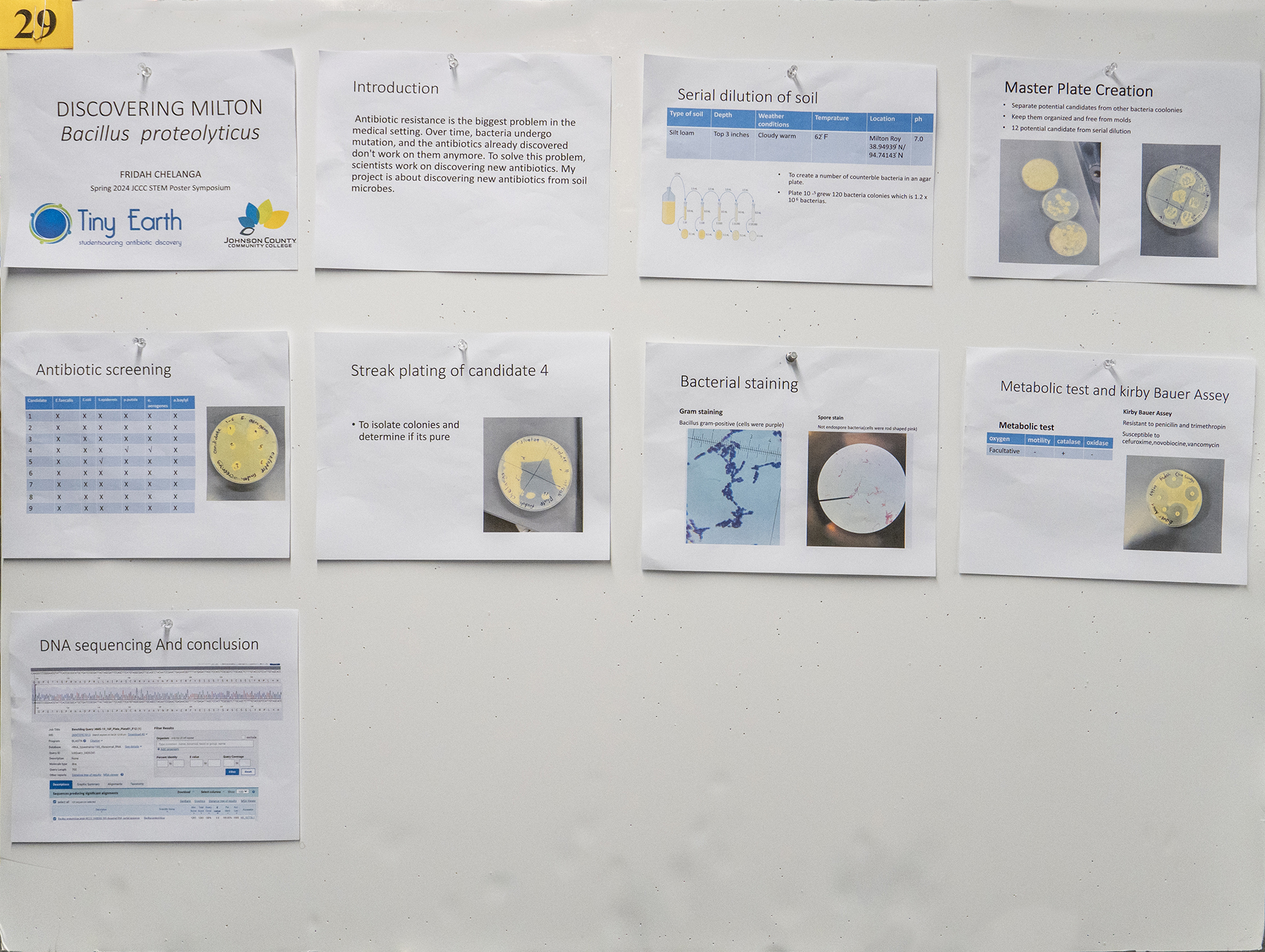
Antibiotic resistance is one of the problems we face in the fight against bacteria. Replication creates mutations in the cells over time, which creates resistant cells. The antibiotics kill all the sensitive cells, leaving behind the resistant cells, which take over the cell population. Over time, antibiotic-resistant organisms have evolved, and the medical field is running out of safe and effective antibiotics. In search of new antibiotic-producing bacteria, soil microbes have yielded majority of the antibiotics we use today. In. my new research, I collected a sample from Milton Roy's lawn on February 1. I did a serial dilution to create a number of countable bacteria colonies. The plate with the dilution factor 10^-4 and 10^-3 created too numerous to count bacteria. Plate 10^-5 created 1.2*10^6 bacteria colonies per gram of soil. Out of the three plates, I had 12 potential candidates. I made a master plate for my potential candidates to separate them from the other bacteria colonies from the crowded plates. After growing the bacteria on my master plate, I screened them against all five escape-safe relatives. Candidate 4 showed inhibition against Pseudomonas pituda and Enterobacter aerogenes. I created a streak plate for candidate 4 to determine if it's pure and uncontaminated for PCR. I collected a sample of my pure bacteria for PCR, and I am yet to know the results. The next step will be to prepare my bacteria sample for DNA sequencing and visually inspect the cell's DNA on a chromatogram. Then perform a biochemical test to identify the bacteria.
Image
Creating New Antibiotics
CoLab, OCB 100
Antibiotic resistance is one of the problems we face in the fight against bacteria. Replication creates mutations in the cells over time, which creates resistant cells. The antibiotics kill all the sensitive cells, leaving behind the resistant cells, which take over the cell population. Over time, antibiotic-resistant organisms have evolved, and the medical field is running out of safe and effective antibiotics. In search of new antibiotic-producing bacteria, soil microbes have yielded majority of the antibiotics we use today. In. my new research, I collected a sample from Milton Roy's lawn on February 1. I did a serial dilution to create a number of countable bacteria colonies. The plate with the dilution factor 10^-4 and 10^-3 created too numerous to count bacteria. Plate 10^-5 created 1.2*10^6 bacteria colonies per gram of soil. Out of the three plates, I had 12 potential candidates. I made a master plate for my potential candidates to separate them from the other bacteria colonies from the crowded plates. After growing the bacteria on my master plate, I screened them against all five escape-safe relatives. Candidate 4 showed inhibition against Pseudomonas pituda and Enterobacter aerogenes. I created a streak plate for candidate 4 to determine if it's pure and uncontaminated for PCR. I collected a sample of my pure bacteria for PCR, and I am yet to know the results. The next step will be to prepare my bacteria sample for DNA sequencing and visually inspect the cell's DNA on a chromatogram. Then perform a biochemical test to identify the bacteria.
Comments
The faculty mentor for this project was Heather Seitz, Biology.