

Location
CoLab, OCB 100
Start Date
25-4-2024 1:30 PM
Document Type
Poster
Description
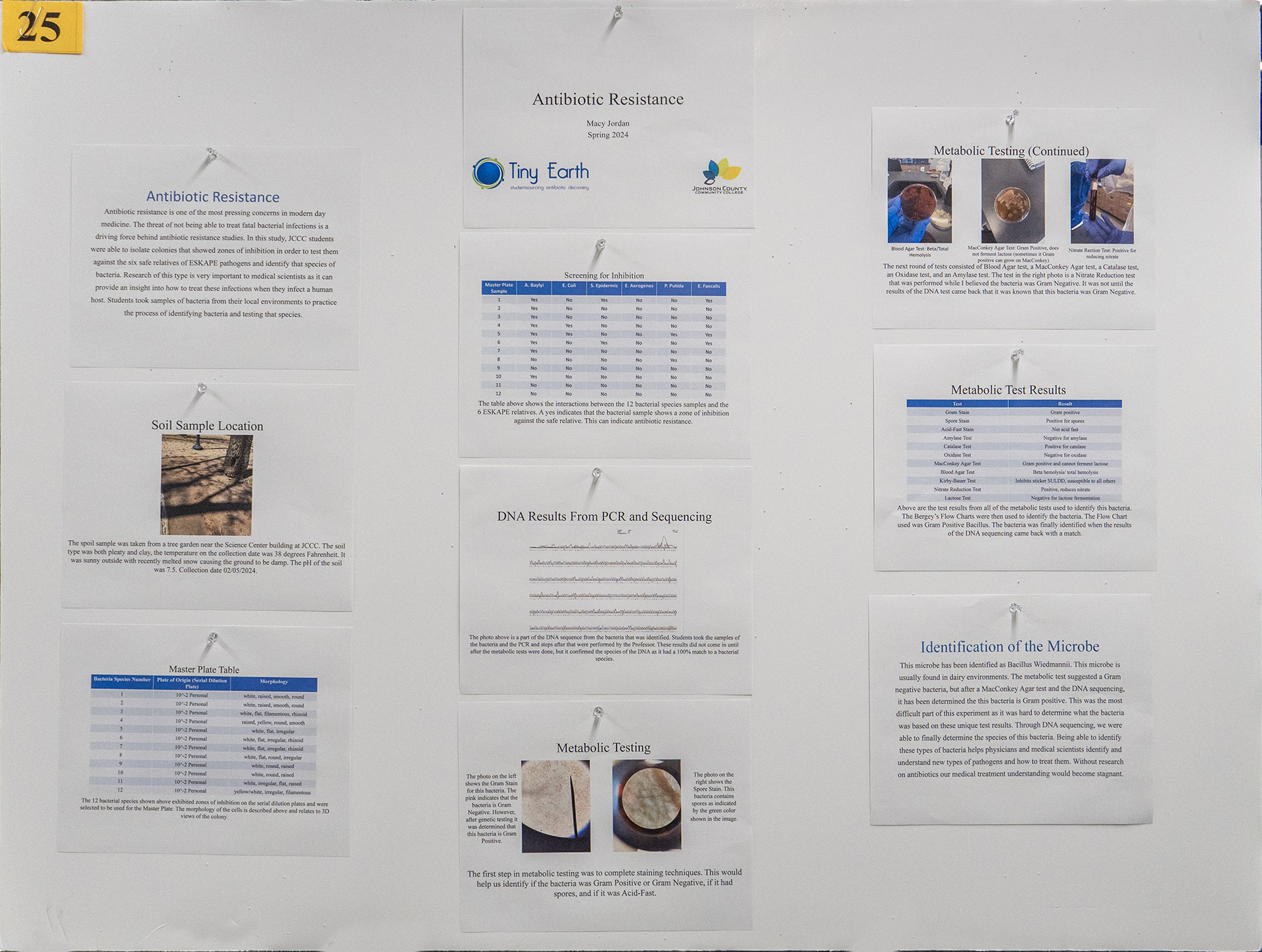
Antibiotic resistance is one of the most pressing concerns in modern day medicine. The threat of not being able to treat fatal bacterial infections is a driving force behind antibiotic resistance studies. In this study, JCCC students were able to isolate colonies that showed zones of inhibition in order to test them against the six safe relatives of ESKAPE pathogens. Students selected a soil sample from any local area of their choosing and documented the conditions in which the soil was found. Through serial dilution, the students were able grow several species of bacteria on an agar plate. Using proper aseptic technique, a master plate was formed using any species that showed a zone of inhibition. These were the species that were then tested against the six safe relatives. Once again, the goal was to find a zone of inhibition between the safe relative and the master plate species. This study shed light on the types of bacteria present in the local environment that may possess antibiotic resistance. Research of this type is very important to medical scientists as it can provide an insight into how to treat these infections when they infect a human host. The number of bacteria that show resistance to antibiotics within this study express the urgency in which antibiotic resistance research is needed.
Image
Antibiotic Resistance
CoLab, OCB 100
Antibiotic resistance is one of the most pressing concerns in modern day medicine. The threat of not being able to treat fatal bacterial infections is a driving force behind antibiotic resistance studies. In this study, JCCC students were able to isolate colonies that showed zones of inhibition in order to test them against the six safe relatives of ESKAPE pathogens. Students selected a soil sample from any local area of their choosing and documented the conditions in which the soil was found. Through serial dilution, the students were able grow several species of bacteria on an agar plate. Using proper aseptic technique, a master plate was formed using any species that showed a zone of inhibition. These were the species that were then tested against the six safe relatives. Once again, the goal was to find a zone of inhibition between the safe relative and the master plate species. This study shed light on the types of bacteria present in the local environment that may possess antibiotic resistance. Research of this type is very important to medical scientists as it can provide an insight into how to treat these infections when they infect a human host. The number of bacteria that show resistance to antibiotics within this study express the urgency in which antibiotic resistance research is needed.
Comments
The faculty mentor for this project was Rachael Ott, Biology.