

Location
CoLab, OCB 100
Start Date
25-4-2024 1:30 PM
Document Type
Poster
Description
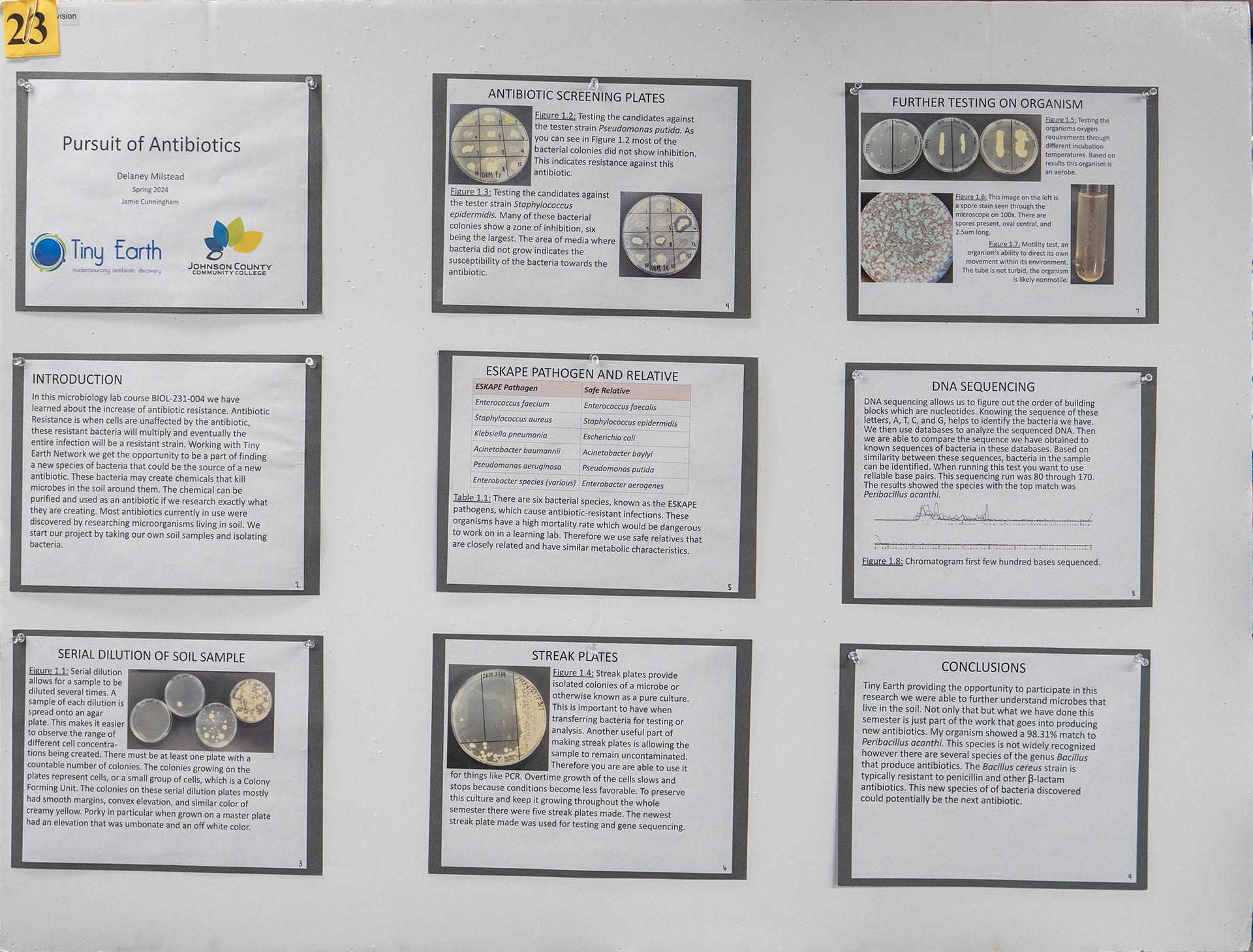
In this microbiology lab course BIOL-231-004 we have learned about the increase of antibiotic resistance. Antibiotic Resistance is when cells are unaffected by the antibiotic, these resistant bacteria will multiply and eventually the entire infection will be a resistant strain. Working with Tiny Earth Network we get the opportunity to be a part of finding a new species of bacteria that could be the source of a new antibiotic. These bacteria may create chemicals that kill microbes in the soil around them. The chemical can be purified and used as an antibiotic if we research exactly what they are creating. Most antibiotics currently in use were discovered by researching microorganisms living in soil. We start our project by taking our own soil samples and isolating bacteria. I tested 12 microbes against eight different tester strains to check for zones of inhibition. A zone of inhibition is an area around the bacteria where there is no growth because of the chemical created by the microbe preventing the growth of other microbes. In my case I chose candidate number 6 because it inhibited the tester strain Staphylococcus epidermidis. This species of bacteria we use in the lab is related closely to Staphylococcus aureus which is a pathogen capable of causing severe MRSA infections. The inhibition of this safe relative suggests the presence of a possible antibiotic that could be used to treat staph infections.
Image
Pursuit of Antibiotics
CoLab, OCB 100
In this microbiology lab course BIOL-231-004 we have learned about the increase of antibiotic resistance. Antibiotic Resistance is when cells are unaffected by the antibiotic, these resistant bacteria will multiply and eventually the entire infection will be a resistant strain. Working with Tiny Earth Network we get the opportunity to be a part of finding a new species of bacteria that could be the source of a new antibiotic. These bacteria may create chemicals that kill microbes in the soil around them. The chemical can be purified and used as an antibiotic if we research exactly what they are creating. Most antibiotics currently in use were discovered by researching microorganisms living in soil. We start our project by taking our own soil samples and isolating bacteria. I tested 12 microbes against eight different tester strains to check for zones of inhibition. A zone of inhibition is an area around the bacteria where there is no growth because of the chemical created by the microbe preventing the growth of other microbes. In my case I chose candidate number 6 because it inhibited the tester strain Staphylococcus epidermidis. This species of bacteria we use in the lab is related closely to Staphylococcus aureus which is a pathogen capable of causing severe MRSA infections. The inhibition of this safe relative suggests the presence of a possible antibiotic that could be used to treat staph infections.
Comments
The faculty mentor for this project was Jaime Cunningham, Biology.