

Location
CoLab, OCB 100
Start Date
25-4-2024 1:30 PM
Document Type
Poster
Description
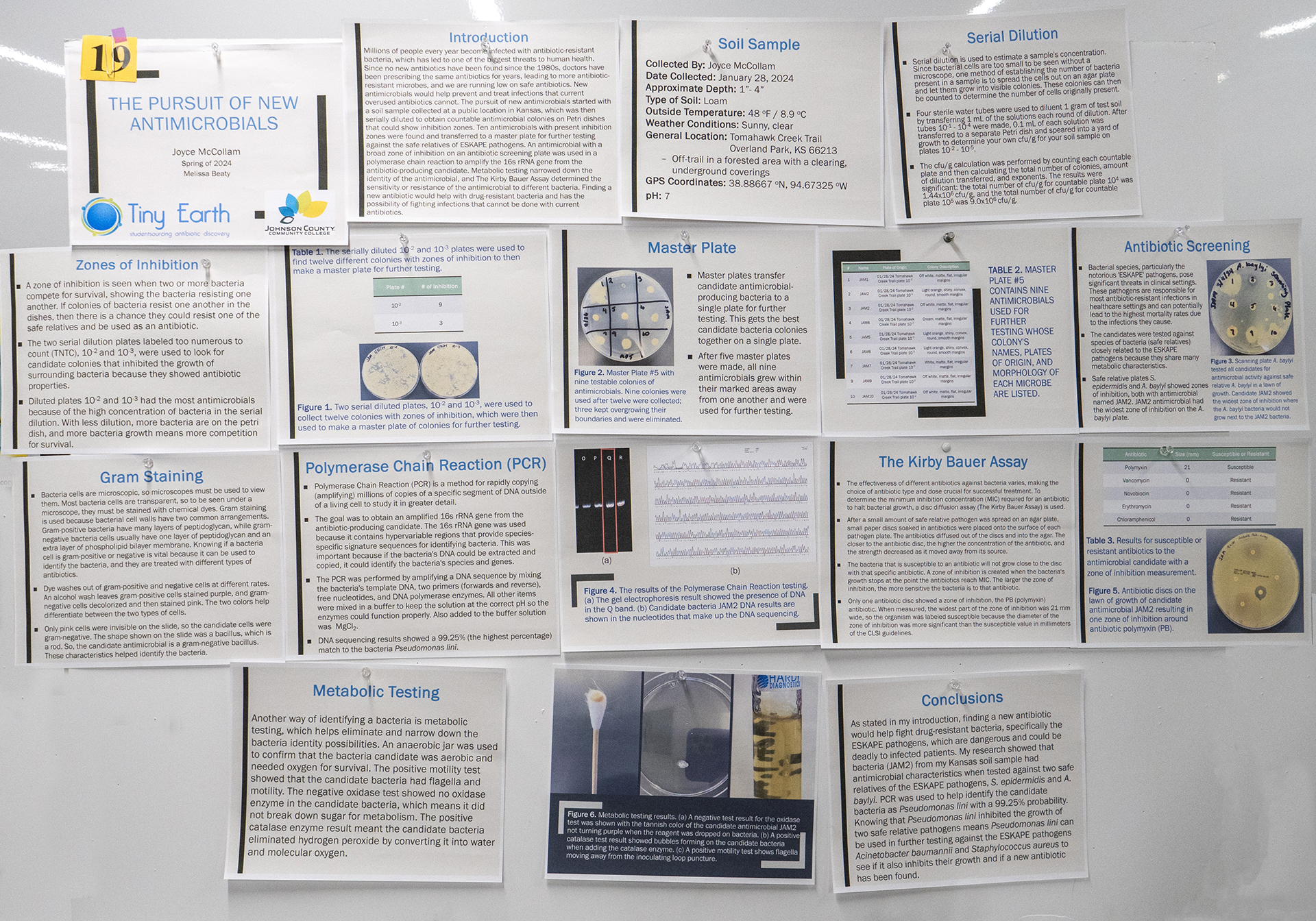
Millions of people every year become infected with antibiotic-resistant bacteria, which has led to one of the biggest threats to human health. Since no new antibiotics have been found since the 1980s, doctors have been prescribing the same antibiotics for years, leading to more antibiotic-resistant microbes, and we are running low on safe antibiotics. New antimicrobials would help prevent and treat infections that current overused antibiotics cannot. The pursuit of new antimicrobials started with a soil sample collected at a public location in Kansas, which was then serially diluted to obtain countable antimicrobial colonies on Petri dishes that could show zones of inhibition. Twelve antimicrobials with present zones of inhibition were found and transferred to a master plate for further testing against the safe relatives of ESKAPE pathogens. An antimicrobial with a broad zone of inhibition on an antibiotic screening plate was used in a polymerase chain reaction to amplify the 16s rRNA gene from the antibiotic-producing candidate. Metabolic testing narrowed down the identity of the antimicrobial, and The Kirby Bauer Assay determined the sensitivity or resistance of the antimicrobial to different bacteria. Finding a new antibiotic would help with drug-resistant bacteria and has the possibility of fighting infections that cannot be done with current antibiotics.
Image
The Pursuit of New Antimicrobials
CoLab, OCB 100
Millions of people every year become infected with antibiotic-resistant bacteria, which has led to one of the biggest threats to human health. Since no new antibiotics have been found since the 1980s, doctors have been prescribing the same antibiotics for years, leading to more antibiotic-resistant microbes, and we are running low on safe antibiotics. New antimicrobials would help prevent and treat infections that current overused antibiotics cannot. The pursuit of new antimicrobials started with a soil sample collected at a public location in Kansas, which was then serially diluted to obtain countable antimicrobial colonies on Petri dishes that could show zones of inhibition. Twelve antimicrobials with present zones of inhibition were found and transferred to a master plate for further testing against the safe relatives of ESKAPE pathogens. An antimicrobial with a broad zone of inhibition on an antibiotic screening plate was used in a polymerase chain reaction to amplify the 16s rRNA gene from the antibiotic-producing candidate. Metabolic testing narrowed down the identity of the antimicrobial, and The Kirby Bauer Assay determined the sensitivity or resistance of the antimicrobial to different bacteria. Finding a new antibiotic would help with drug-resistant bacteria and has the possibility of fighting infections that cannot be done with current antibiotics.
Comments
The faculty mentor for this project was Melissa Beaty, Biology.