

Location
CoLab, OCB 100
Start Date
25-4-2024 12:00 PM
Document Type
Poster
Description
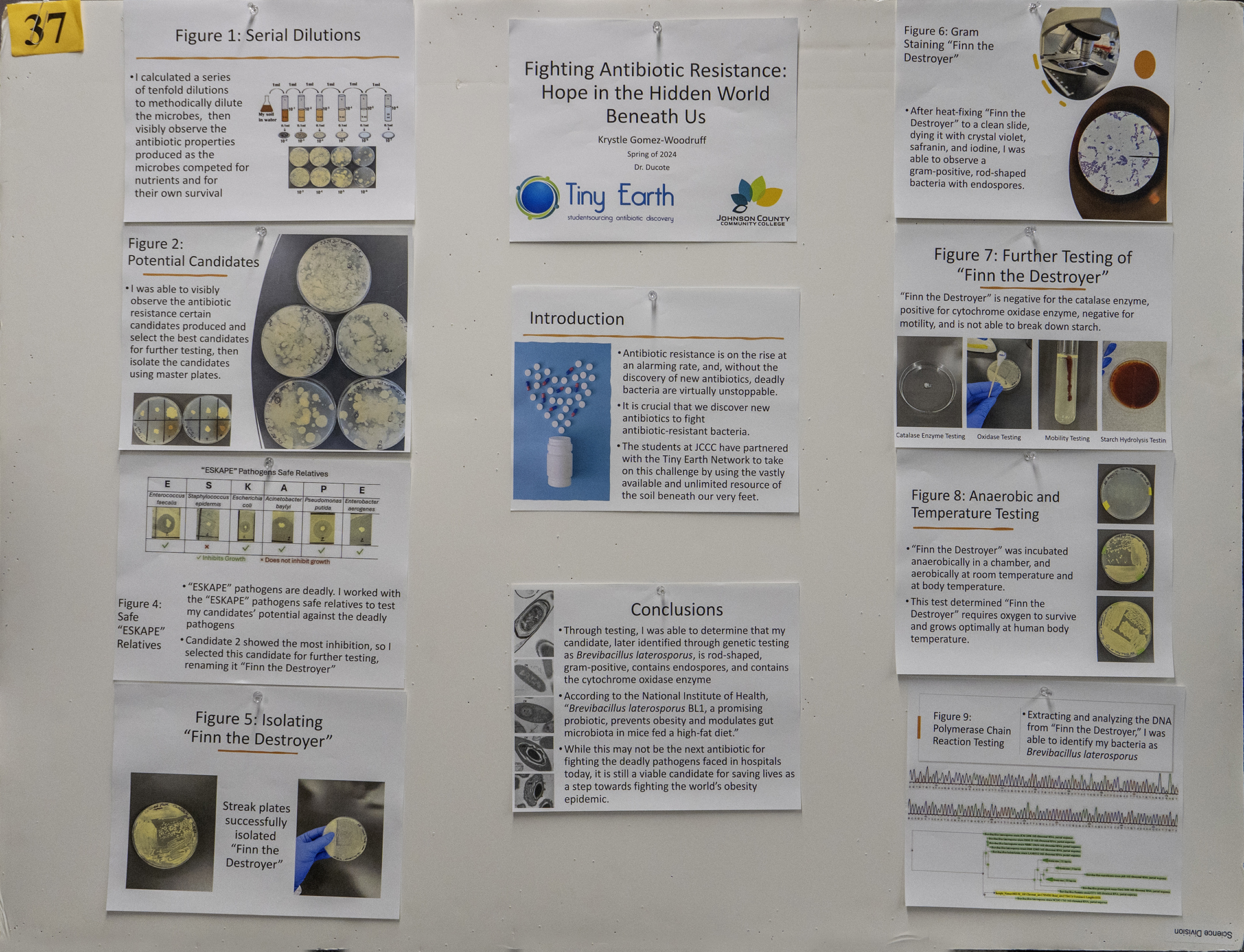
Antibiotic resistance is on the rise at an alarming rate, and, without the discovery of new antibiotics, deadly bacteria are virtually unstoppable. Since Fleming’s discovery of penicillin in 1928, the overuse and misuse of antibiotics have resulted in bacteria capable of resisting antibiotics, rendering our current antibiotics virtually useless against these deadly pathogens. Therefore, it is crucial that we discover new antibiotics to fight antibiotic-resistant bacteria. The students at JCCC have partnered with the Tiny Earth Network to take on the challenge of aiding in the research for new antibiotics by using the vastly available and unlimited resource of the soil beneath our very feet. Currently, many of our antibiotics are derived from microbes living in the soil. After collecting a soil sample of my own, I isolated the microbes from the soil sample for further research. Through a series of serial dilutions, master plates, and streak plates, I was able to successfully isolate a specific type of bacteria, referred to as “Finn the Destroyer,” that shows strong inhibition of other bacteria, including 5 harmful pathogen relatives: Enterococcus faecalis, Escherichia coli, Acinetobacter baylyi, Pseudomonas putida, and Enterobacter aerogenes. In colonies, “Finn the Destroyer” appears white, convex, smooth, and round. Further testing indicated “Finn the Destroyer” is rod-shaped, gram-positive, and contains endospores. While further testing is necessary, “Finn the Destroyer” shows promise to an antibiotic breakthrough.
Image
Fighting Antibiotic Resistance: Hope in the Hidden World Beneath Us
CoLab, OCB 100
Antibiotic resistance is on the rise at an alarming rate, and, without the discovery of new antibiotics, deadly bacteria are virtually unstoppable. Since Fleming’s discovery of penicillin in 1928, the overuse and misuse of antibiotics have resulted in bacteria capable of resisting antibiotics, rendering our current antibiotics virtually useless against these deadly pathogens. Therefore, it is crucial that we discover new antibiotics to fight antibiotic-resistant bacteria. The students at JCCC have partnered with the Tiny Earth Network to take on the challenge of aiding in the research for new antibiotics by using the vastly available and unlimited resource of the soil beneath our very feet. Currently, many of our antibiotics are derived from microbes living in the soil. After collecting a soil sample of my own, I isolated the microbes from the soil sample for further research. Through a series of serial dilutions, master plates, and streak plates, I was able to successfully isolate a specific type of bacteria, referred to as “Finn the Destroyer,” that shows strong inhibition of other bacteria, including 5 harmful pathogen relatives: Enterococcus faecalis, Escherichia coli, Acinetobacter baylyi, Pseudomonas putida, and Enterobacter aerogenes. In colonies, “Finn the Destroyer” appears white, convex, smooth, and round. Further testing indicated “Finn the Destroyer” is rod-shaped, gram-positive, and contains endospores. While further testing is necessary, “Finn the Destroyer” shows promise to an antibiotic breakthrough.
Comments
The faculty mentor for this project was Matthew Ducote, Biology.