

Location
CoLab, OCB 100
Start Date
25-4-2024 12:00 PM
Document Type
Poster
Description
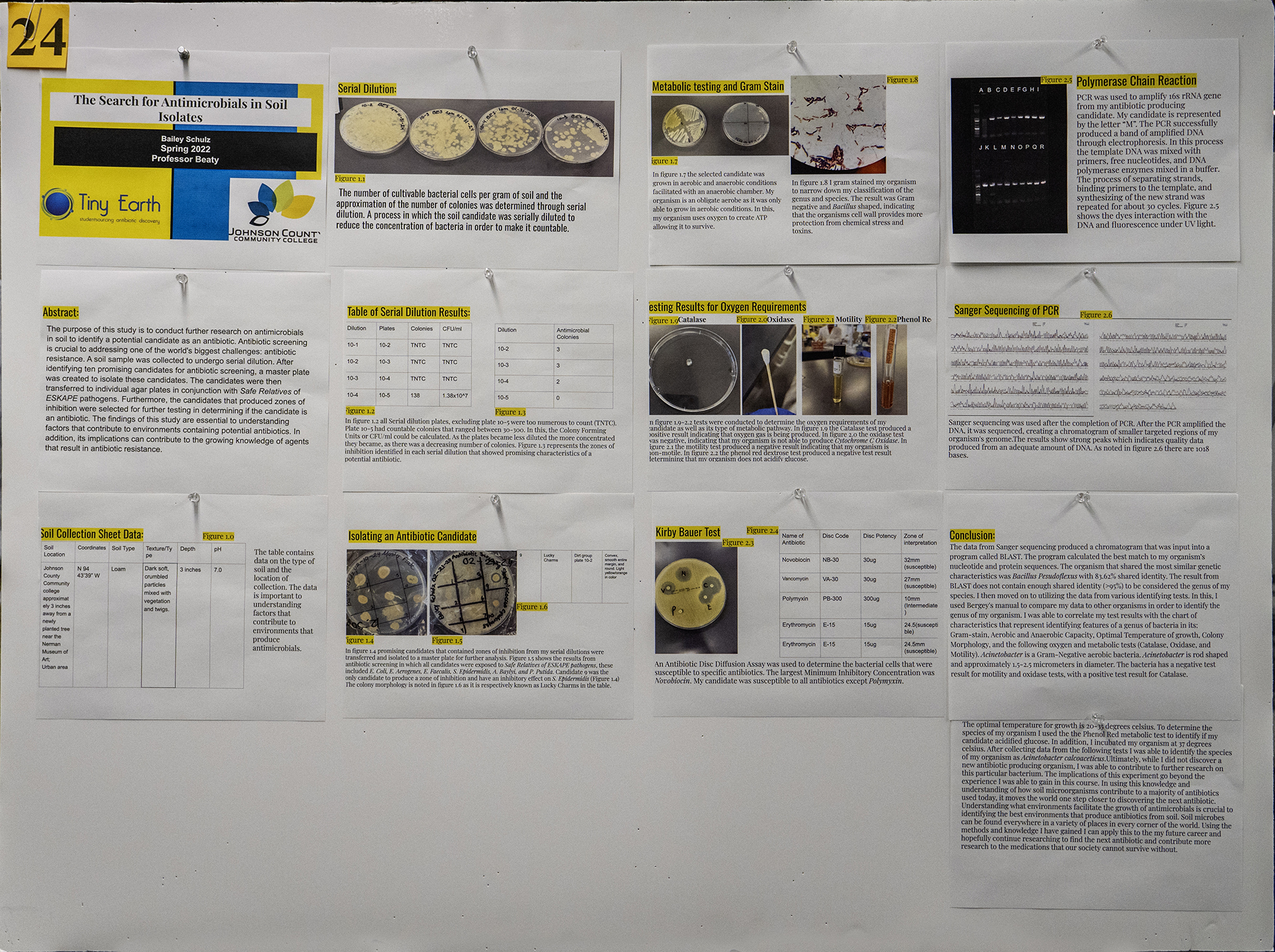
The purpose of this study is to conduct further research on antimicrobials in soil to identify a potential candidate as an antibiotic. Antibiotic screening is crucial to addressing one of the world's biggest challenges: antibiotic resistance. A soil sample was collected to undergo serial dilution. After identifying ten promising candidates for antibiotic screening, a master plate was created to isolate these candidates. The candidates were then transferred to individual agar plates in conjunction with safe relatives of ESKAPE pathogens. Furthermore, the candidates that produced zones of inhibition were selected for further testing in determining if the candidate is an antibiotic. The findings of this study are essential to understanding factors that contribute to environments containing potential antibiotics. In addition, its implications can contribute to the growing knowledge of agents that result in antibiotic resistance.
Image
The Search for Antimicrobials in Soil Isolates
CoLab, OCB 100
The purpose of this study is to conduct further research on antimicrobials in soil to identify a potential candidate as an antibiotic. Antibiotic screening is crucial to addressing one of the world's biggest challenges: antibiotic resistance. A soil sample was collected to undergo serial dilution. After identifying ten promising candidates for antibiotic screening, a master plate was created to isolate these candidates. The candidates were then transferred to individual agar plates in conjunction with safe relatives of ESKAPE pathogens. Furthermore, the candidates that produced zones of inhibition were selected for further testing in determining if the candidate is an antibiotic. The findings of this study are essential to understanding factors that contribute to environments containing potential antibiotics. In addition, its implications can contribute to the growing knowledge of agents that result in antibiotic resistance.
Comments
The faculty mentor for this project was Melissa Beaty, Biology.