

Location
CoLab, OCB 100
Start Date
25-4-2024 12:00 PM
Document Type
Poster
Description
The PETase enzyme is a fairly recently discovered enzyme that is able to break down polyethylene terephthalate, a common single-use plastic that is found in a variety of products, mainly plastic bottles and packaging. Plastic waste pollution is a rising issue on the global scale that not only negatively affects marine life, but also ocean biodiversity. The production and disposal of certain plastics can also release harmful chemicals into the air, water, and soil. The number one source of frustration that comes from dealing with plastic waste is that it can take hundreds of years for a single water bottle to be broken down. This is where PETase comes in, PETase can significantly cut down on the time needed for plastic to be broken down naturally; however, there are still a couple problems: few microorganisms have the PETase enzyme and PEtase does not work fast enough to keep up with the rate at which humans are consuming plastics. These problems are why up and coming scientific researchers have been tasked with finding ways to improve the PETase enzyme so that in the future it can break down as much plastic as we use. So far we have tested the optimal conditions for PETase function and now we are creating mutations to the enzyme itself to increase efficiency. I chose to replace the 157th codon Methionine with a Lysine. We then compared the enzyme activity data for the mutated PETase with the unmutated PETase to learn the impact of our mutation.
Image
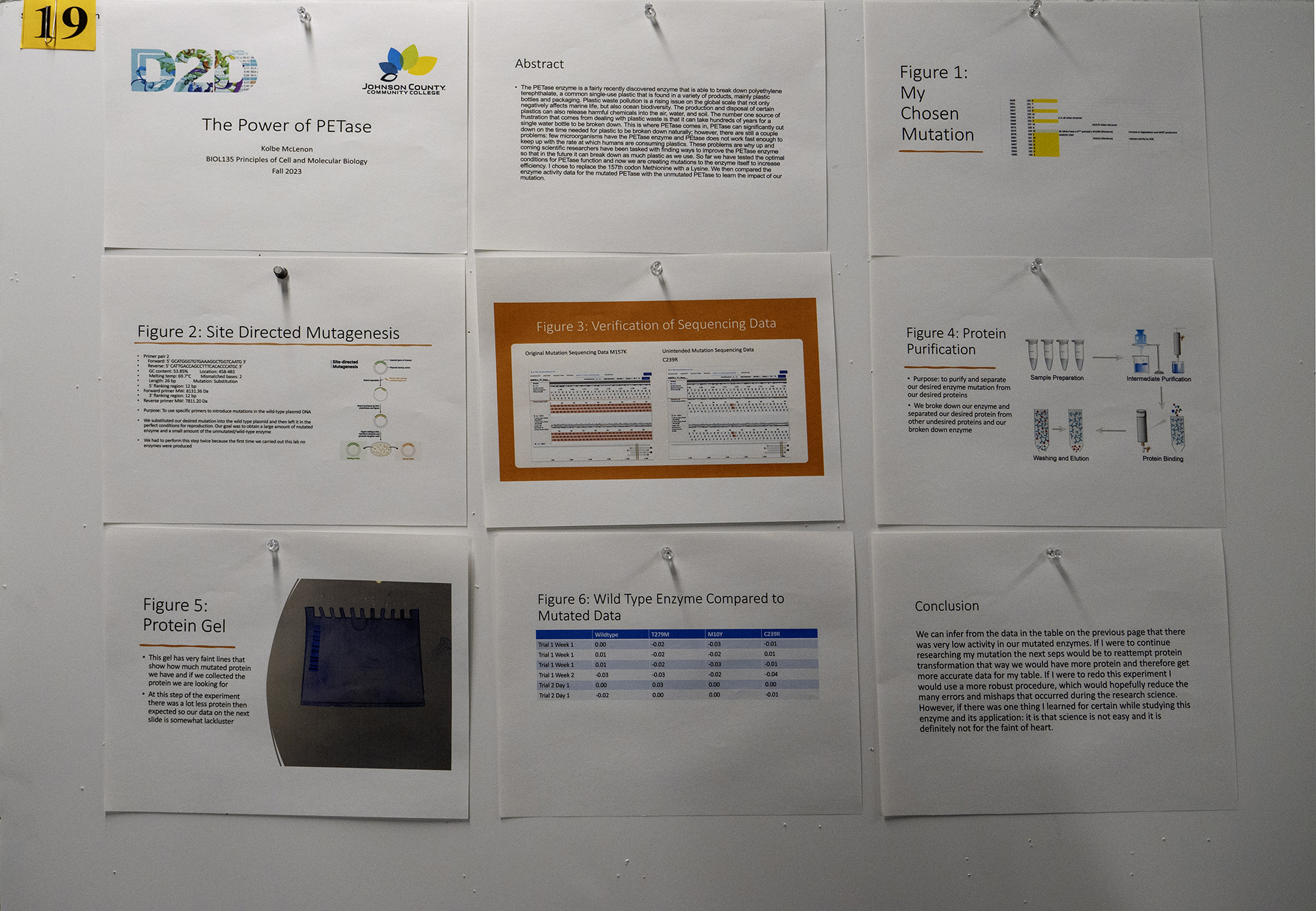
PETase Mutation Research Project
CoLab, OCB 100
The PETase enzyme is a fairly recently discovered enzyme that is able to break down polyethylene terephthalate, a common single-use plastic that is found in a variety of products, mainly plastic bottles and packaging. Plastic waste pollution is a rising issue on the global scale that not only negatively affects marine life, but also ocean biodiversity. The production and disposal of certain plastics can also release harmful chemicals into the air, water, and soil. The number one source of frustration that comes from dealing with plastic waste is that it can take hundreds of years for a single water bottle to be broken down. This is where PETase comes in, PETase can significantly cut down on the time needed for plastic to be broken down naturally; however, there are still a couple problems: few microorganisms have the PETase enzyme and PEtase does not work fast enough to keep up with the rate at which humans are consuming plastics. These problems are why up and coming scientific researchers have been tasked with finding ways to improve the PETase enzyme so that in the future it can break down as much plastic as we use. So far we have tested the optimal conditions for PETase function and now we are creating mutations to the enzyme itself to increase efficiency. I chose to replace the 157th codon Methionine with a Lysine. We then compared the enzyme activity data for the mutated PETase with the unmutated PETase to learn the impact of our mutation.
Comments
The faculty mentor for this project was Heather Seitz, Biology.