

Location
CoLab, OCB 100
Start Date
25-4-2024 12:00 PM
Document Type
Poster
Description
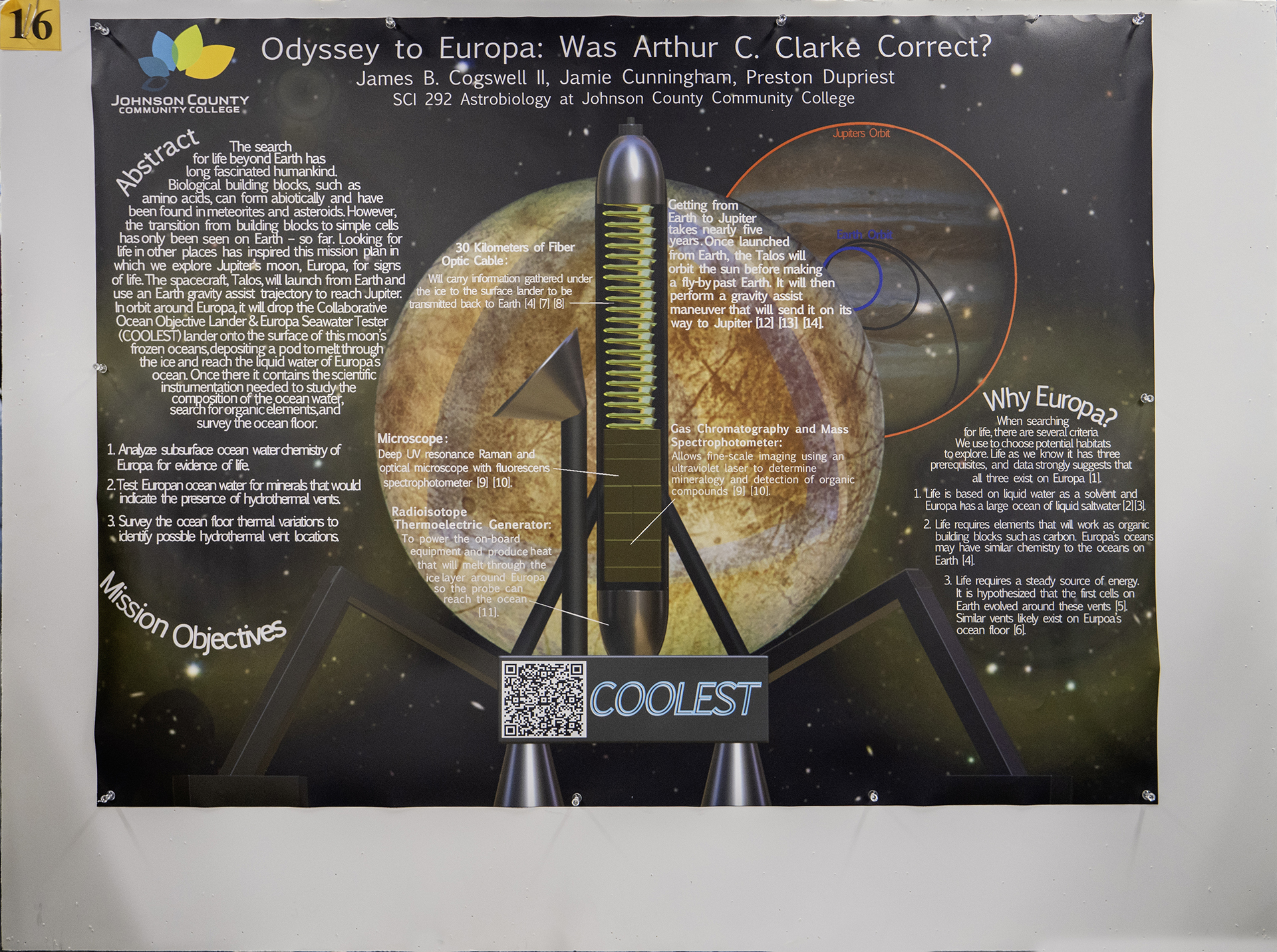
The search for life beyond Earth has long fascinated humankind. Biological building blocks, such as amino acids, can form abiotically and have been found in meteorites and asteroids. However, the transition from building blocks to simple cells has only been seen on Earth – so far. Looking for life in other places has inspired this mission plan in which we explore Jupiter’s moon, Europa, for signs of life. The spacecraft, Javelin, will launch from Earth and use an Earth gravity assist trajectory to reach Jupiter. In orbit around Europa, it will drop the Collaborative Ocean Objective Lander & Europa Seawater Tester (COOLEST) lander onto the surface of this moon’s frozen oceans, depositing a pod to melt through the ice and reach the liquid water of Europa’s ocean. Once there it contains the scientific instrumentation needed to study the composition of the ocean water, search for organic elements, and survey the ocean floor.
Image
Odyssey to Europa: Was Arthur C. Clarke Correct?
CoLab, OCB 100
The search for life beyond Earth has long fascinated humankind. Biological building blocks, such as amino acids, can form abiotically and have been found in meteorites and asteroids. However, the transition from building blocks to simple cells has only been seen on Earth – so far. Looking for life in other places has inspired this mission plan in which we explore Jupiter’s moon, Europa, for signs of life. The spacecraft, Javelin, will launch from Earth and use an Earth gravity assist trajectory to reach Jupiter. In orbit around Europa, it will drop the Collaborative Ocean Objective Lander & Europa Seawater Tester (COOLEST) lander onto the surface of this moon’s frozen oceans, depositing a pod to melt through the ice and reach the liquid water of Europa’s ocean. Once there it contains the scientific instrumentation needed to study the composition of the ocean water, search for organic elements, and survey the ocean floor.
Comments
The faculty mentors for this project were Steven Giambrone and Doug Patterson, Astrobiology.