

Getting Dirty
Location
CoLab, COM 191
Start Date
30-4-2026 10:45 AM
Document Type
Poster
Description
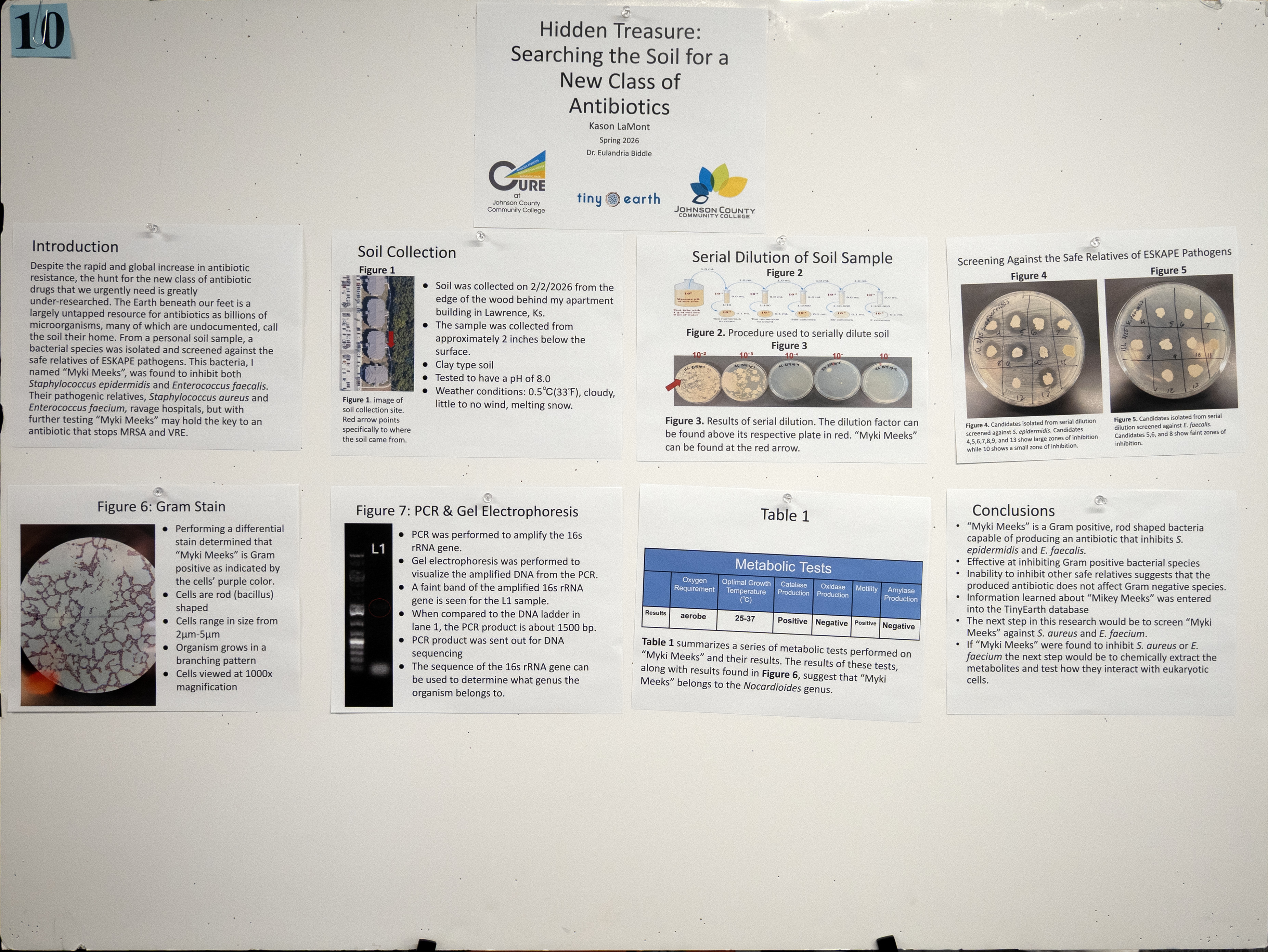
The rapid increase in antibiotic resistance has created an urgent need for a new class of antibiotic drugs. In my search for a new antibiotic, I turned to the soil. The Earth beneath our feet is a largely untapped resource containing billions of microbes, and may even hold the answer to the antibiotic resistance crisis. To perform my research I collected a sample of soil that was then serially diluted to a dilution factor of 10⁻⁶. After an incubation period of 48 hours at room temperature, the diluted soil sample allowed me to view the microbes present in my sample of soil, and more importantly, view what microbes possessed the ability to produce antibiotics. Ten candidates were chosen to be screened against tester strains that are closely related to the ESKAPE pathogens. After screening, I found that the candidate I named “Mary Beth Barone” produced zones of inhibition against Staphylococcus epidermidis (S. epidermidis) and Enterococcus faecalis (E. faecalis). These findings are interesting because S. epidermidis and are closely related to Staphylococcus aureus (S. aureus) and Enterococcus faecium (E. faucium) respectively. With more testing, “Mary Beth Barone” has the possibility of paving the way for drugs that fight both MRSA and VRE.
Image
Getting Dirty
CoLab, COM 191
The rapid increase in antibiotic resistance has created an urgent need for a new class of antibiotic drugs. In my search for a new antibiotic, I turned to the soil. The Earth beneath our feet is a largely untapped resource containing billions of microbes, and may even hold the answer to the antibiotic resistance crisis. To perform my research I collected a sample of soil that was then serially diluted to a dilution factor of 10⁻⁶. After an incubation period of 48 hours at room temperature, the diluted soil sample allowed me to view the microbes present in my sample of soil, and more importantly, view what microbes possessed the ability to produce antibiotics. Ten candidates were chosen to be screened against tester strains that are closely related to the ESKAPE pathogens. After screening, I found that the candidate I named “Mary Beth Barone” produced zones of inhibition against Staphylococcus epidermidis (S. epidermidis) and Enterococcus faecalis (E. faecalis). These findings are interesting because S. epidermidis and are closely related to Staphylococcus aureus (S. aureus) and Enterococcus faecium (E. faucium) respectively. With more testing, “Mary Beth Barone” has the possibility of paving the way for drugs that fight both MRSA and VRE.
Comments
The faculty mentor for this project was Eulandria Biddle.