

From Dirt to Discovery
Location
CoLab, COM 426
Start Date
30-4-2026 6:45 PM
Document Type
Poster
Description
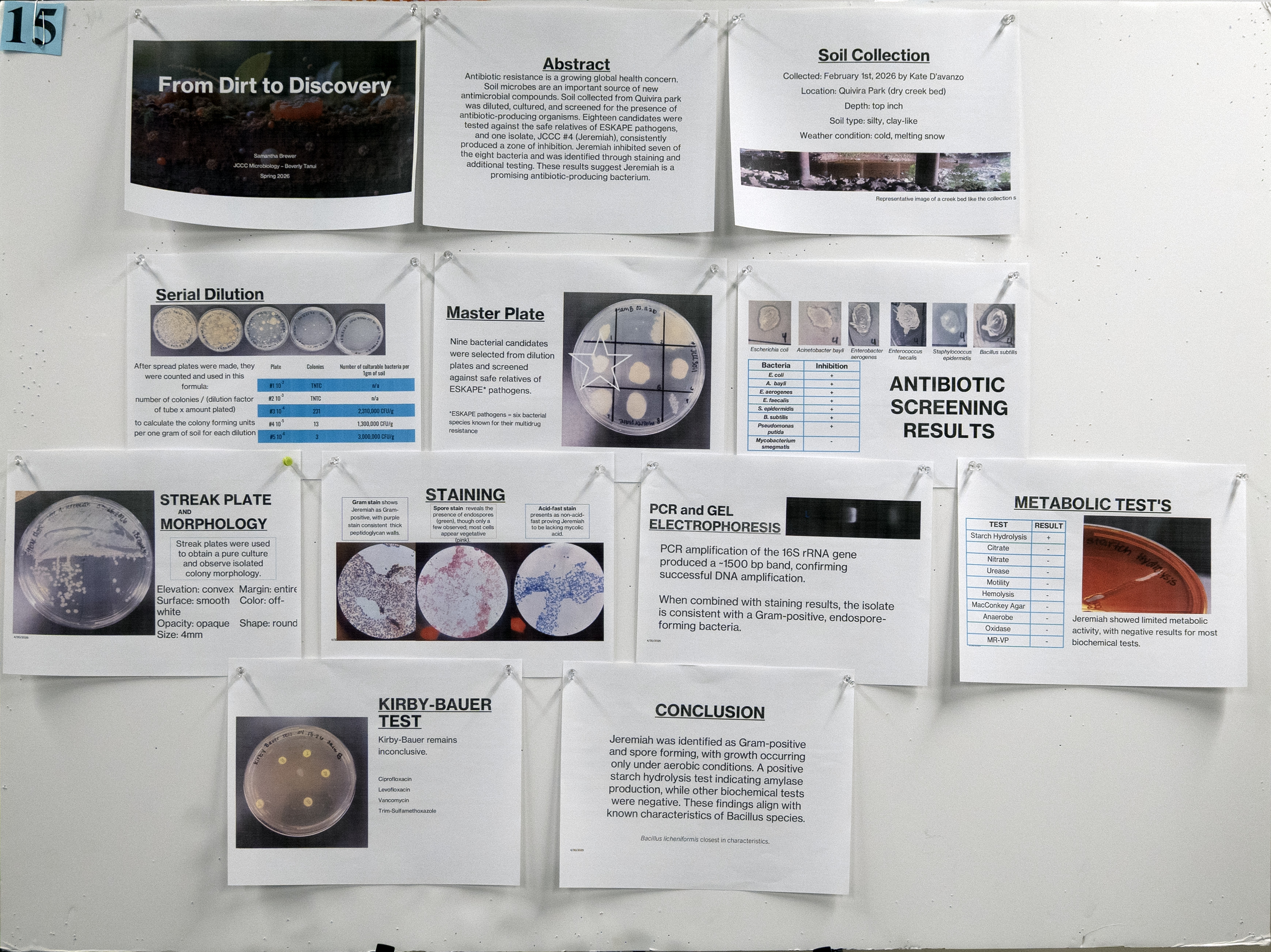
The microbiology lab explores the microbial diversity in local soil and aims to identify organisms capable of producing unique antimicrobial compounds. Soil collected from the JCCC campus was diluted, plated and examined for any signs of inhibition that would serve as potential antibiotic producing organisms. From these plates, eighteen candidates were chosen and screened against the ESKAPE pathogen relatives. Candidate four, Jeremiah, proved to be the most promising candidate by consistently producing a strong zone of inhibition, distinguishing itself from other isolates. These inhibitory responses further suggest that Jeremiah may produce a substance capable of suppressing microbial growth. At this stage of research Jeremiah has inhibited six of the seven relatives making it dependable. Current work is attempting to identify the bacteria through gel electrophoresis and various staining techniques. Overall, Jeremiah represents a strong lead in the search for soil-derived microbes with antibiotic-producing capabilities and makes progress in the broader effort to discover new antimicrobial agents.
Image
From Dirt to Discovery
CoLab, COM 426
The microbiology lab explores the microbial diversity in local soil and aims to identify organisms capable of producing unique antimicrobial compounds. Soil collected from the JCCC campus was diluted, plated and examined for any signs of inhibition that would serve as potential antibiotic producing organisms. From these plates, eighteen candidates were chosen and screened against the ESKAPE pathogen relatives. Candidate four, Jeremiah, proved to be the most promising candidate by consistently producing a strong zone of inhibition, distinguishing itself from other isolates. These inhibitory responses further suggest that Jeremiah may produce a substance capable of suppressing microbial growth. At this stage of research Jeremiah has inhibited six of the seven relatives making it dependable. Current work is attempting to identify the bacteria through gel electrophoresis and various staining techniques. Overall, Jeremiah represents a strong lead in the search for soil-derived microbes with antibiotic-producing capabilities and makes progress in the broader effort to discover new antimicrobial agents.
Comments
The faculty mentor for this project was Beverly Tanui.