

From Front Yard Soil to the Lab: Potential Antibiotic
Location
CoLab, COM 397
Start Date
30-4-2026 5:30 PM
Document Type
Poster
Description
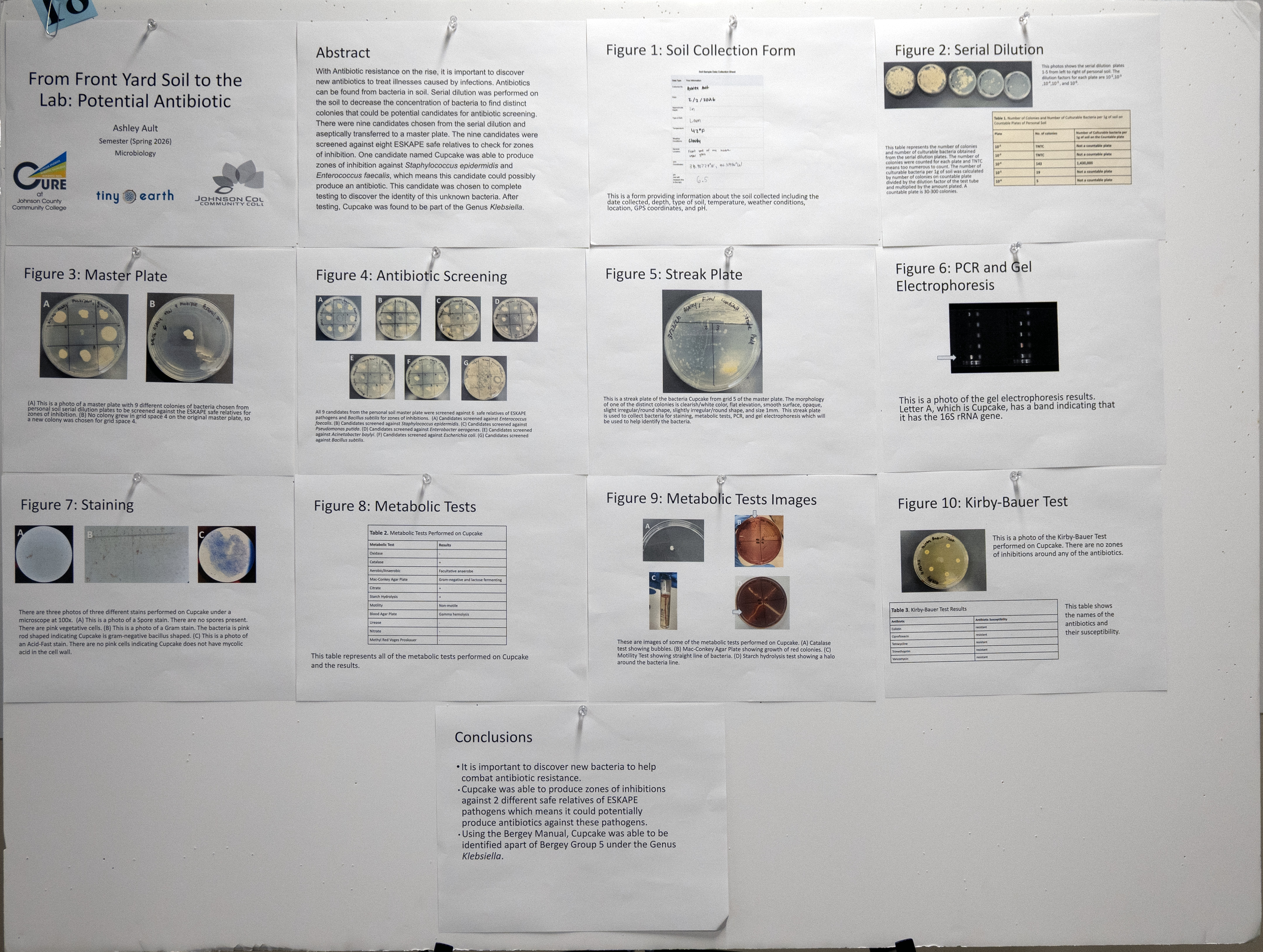
Antibiotics are vital in treating people with infections. With antibiotic resistance on the rise, it is important to discover new antibiotics to treat illnesses caused by infections. Antibiotics can be found from bacteria in soil. Soil was collected from outside in a front yard of a house in Lee’s Summit, Missouri. Serial dilution was performed on the soil to decrease the concentration of bacteria to find distinct colonies that could be potential candidates for antibiotic screening. There were nine candidates chosen from the serial dilution and aseptically transferred to a master plate. The nine candidates were screened against eight ESKAPE safe relatives to check for zones of inhibition. One candidate was able to produce zones of inhibition against Staphylococcus epidermidis and Enterococcus faecalis, which means this candidate could possibly produce an antibiotic. This candidate was chosen to move forward and complete differential stains, PCR, gel electrophoresis, and metabolic testing to discover the identity of this unknown bacteria.
Image
From Front Yard Soil to the Lab: Potential Antibiotic
CoLab, COM 397
Antibiotics are vital in treating people with infections. With antibiotic resistance on the rise, it is important to discover new antibiotics to treat illnesses caused by infections. Antibiotics can be found from bacteria in soil. Soil was collected from outside in a front yard of a house in Lee’s Summit, Missouri. Serial dilution was performed on the soil to decrease the concentration of bacteria to find distinct colonies that could be potential candidates for antibiotic screening. There were nine candidates chosen from the serial dilution and aseptically transferred to a master plate. The nine candidates were screened against eight ESKAPE safe relatives to check for zones of inhibition. One candidate was able to produce zones of inhibition against Staphylococcus epidermidis and Enterococcus faecalis, which means this candidate could possibly produce an antibiotic. This candidate was chosen to move forward and complete differential stains, PCR, gel electrophoresis, and metabolic testing to discover the identity of this unknown bacteria.
Comments
The faculty mentor for this project was Beverly Tanui.