

Mission: Inhibition
Location
CoLab, COM 372
Start Date
30-4-2026 3:45 PM
Document Type
Poster
Description
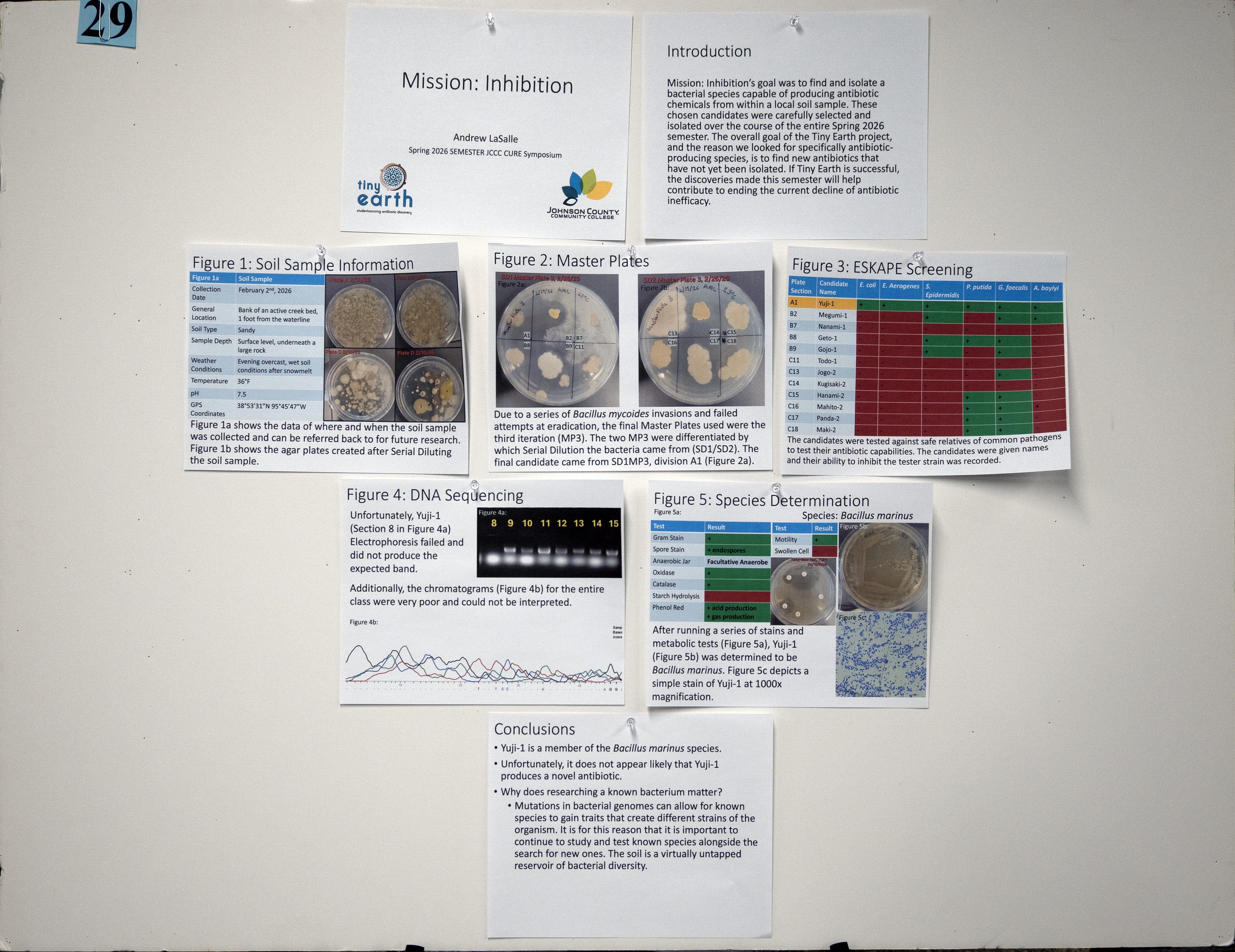
This project aims to find microorganisms within soil samples that are capable of inhibiting other microorganisms with chemical secretions (a.k.a. antibiotics); the end goal of Tiny Earth is to find new antibiotics that were previously unknown. I chose a creekbed as the source of my soil sample because water and areas that surround it are a well-known reservoir for microbial life. Over the semester, I found and isolated 12 antimicrobial bacterial colonies before selecting a final candidate. I screened all 12 of those candidates against six well-known bacterial species (tester strains) to test their antibiotic abilities. The tester strains are safe relatives of the ESKAPE pathogens, dangerous pathogens that cause illness in humans. The ESKAPE pathogens are: E. coli, E. aerogenes, S. epidermidis, P. putida, G. faecalis, and A. baylyi. The safe relatives are genetically similar enough that they allow us to see if the ESKAPE pathogens would be inhibited by the selected microbe without putting ourselves at risk for infection. Of the original 12 candidates, only one displayed inhibition against all six tester strains. I then identified and classified my selected candidate through genetic and metabolic means.
Image
Mission: Inhibition
CoLab, COM 372
This project aims to find microorganisms within soil samples that are capable of inhibiting other microorganisms with chemical secretions (a.k.a. antibiotics); the end goal of Tiny Earth is to find new antibiotics that were previously unknown. I chose a creekbed as the source of my soil sample because water and areas that surround it are a well-known reservoir for microbial life. Over the semester, I found and isolated 12 antimicrobial bacterial colonies before selecting a final candidate. I screened all 12 of those candidates against six well-known bacterial species (tester strains) to test their antibiotic abilities. The tester strains are safe relatives of the ESKAPE pathogens, dangerous pathogens that cause illness in humans. The ESKAPE pathogens are: E. coli, E. aerogenes, S. epidermidis, P. putida, G. faecalis, and A. baylyi. The safe relatives are genetically similar enough that they allow us to see if the ESKAPE pathogens would be inhibited by the selected microbe without putting ourselves at risk for infection. Of the original 12 candidates, only one displayed inhibition against all six tester strains. I then identified and classified my selected candidate through genetic and metabolic means.
Comments
The faculty mentor for this project was Heather Seitz.