

The Last Resort for a Hopeful Future
Location
CoLab, COM 360
Start Date
30-4-2026 3:45 PM
Document Type
Poster
Description
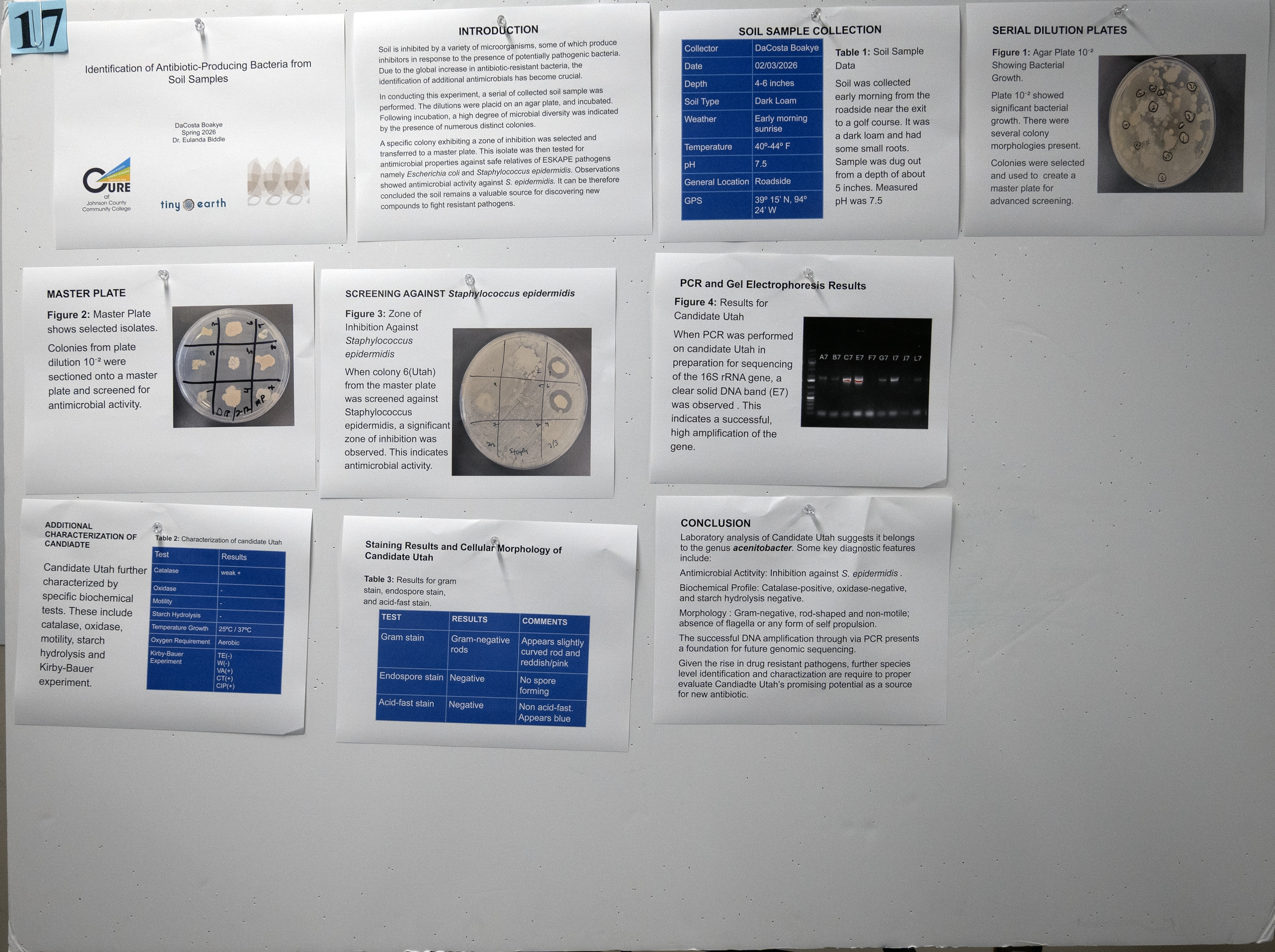
Identification of Antibiotic-Producing Bacteria from Soil Samples in Liberty, Missouri. The rapid rise of multi-drug resistant pathogens has created an urgent need for the discovery of novel antimicrobial compounds. With traditional clinical pipelines exhausting known chemical frameworks, ecological niches such as local soil environments serve as crucial reservoirs for potential antibiotic-producing microbes. In this study, we utilized a serial dilution and screen-plate technique to isolate bacterial colonies from a soil sample collected at coordinates 39⁰15” N 94⁰24”. Using the ESKAPE pathogen screening protocol, we evaluated the inhibitory potential of nine isolates against the safe-relative organism Staphylococcus epidermidis (S. epidermidis). Outstanding isolates were further characterized using Gram staining and biochemical assays to determine metabolic profiles. Our results indicated that the isolated candidate (utah) exhibited a clear zone of inhibition measuring 11 mm against S. epidermidis. Microscopic analysis confirmed this isolate as a Gram-positive bacillus, rod-shaped purple looking bacteria. This isolate demonstrated consistent antimicrobial activity across three experimental replicates. These findings suggest that local soil microbiomes contain viable candidates for secondary metabolite production. By identifying the isolate candidate (utah) as a potential producer of inhibitory compounds, this research provides a new pathway for future drug development and the characterization of novel antibiotics to combat resistant infections.
Image
The Last Resort for a Hopeful Future
CoLab, COM 360
Identification of Antibiotic-Producing Bacteria from Soil Samples in Liberty, Missouri. The rapid rise of multi-drug resistant pathogens has created an urgent need for the discovery of novel antimicrobial compounds. With traditional clinical pipelines exhausting known chemical frameworks, ecological niches such as local soil environments serve as crucial reservoirs for potential antibiotic-producing microbes. In this study, we utilized a serial dilution and screen-plate technique to isolate bacterial colonies from a soil sample collected at coordinates 39⁰15” N 94⁰24”. Using the ESKAPE pathogen screening protocol, we evaluated the inhibitory potential of nine isolates against the safe-relative organism Staphylococcus epidermidis (S. epidermidis). Outstanding isolates were further characterized using Gram staining and biochemical assays to determine metabolic profiles. Our results indicated that the isolated candidate (utah) exhibited a clear zone of inhibition measuring 11 mm against S. epidermidis. Microscopic analysis confirmed this isolate as a Gram-positive bacillus, rod-shaped purple looking bacteria. This isolate demonstrated consistent antimicrobial activity across three experimental replicates. These findings suggest that local soil microbiomes contain viable candidates for secondary metabolite production. By identifying the isolate candidate (utah) as a potential producer of inhibitory compounds, this research provides a new pathway for future drug development and the characterization of novel antibiotics to combat resistant infections.
Comments
The faculty mentor for this project was Eulandria Biddle.