

Deep Roots Clean Water
Location
CoLab, COM 336
Start Date
30-4-2026 2:30 PM
Document Type
Poster
Description
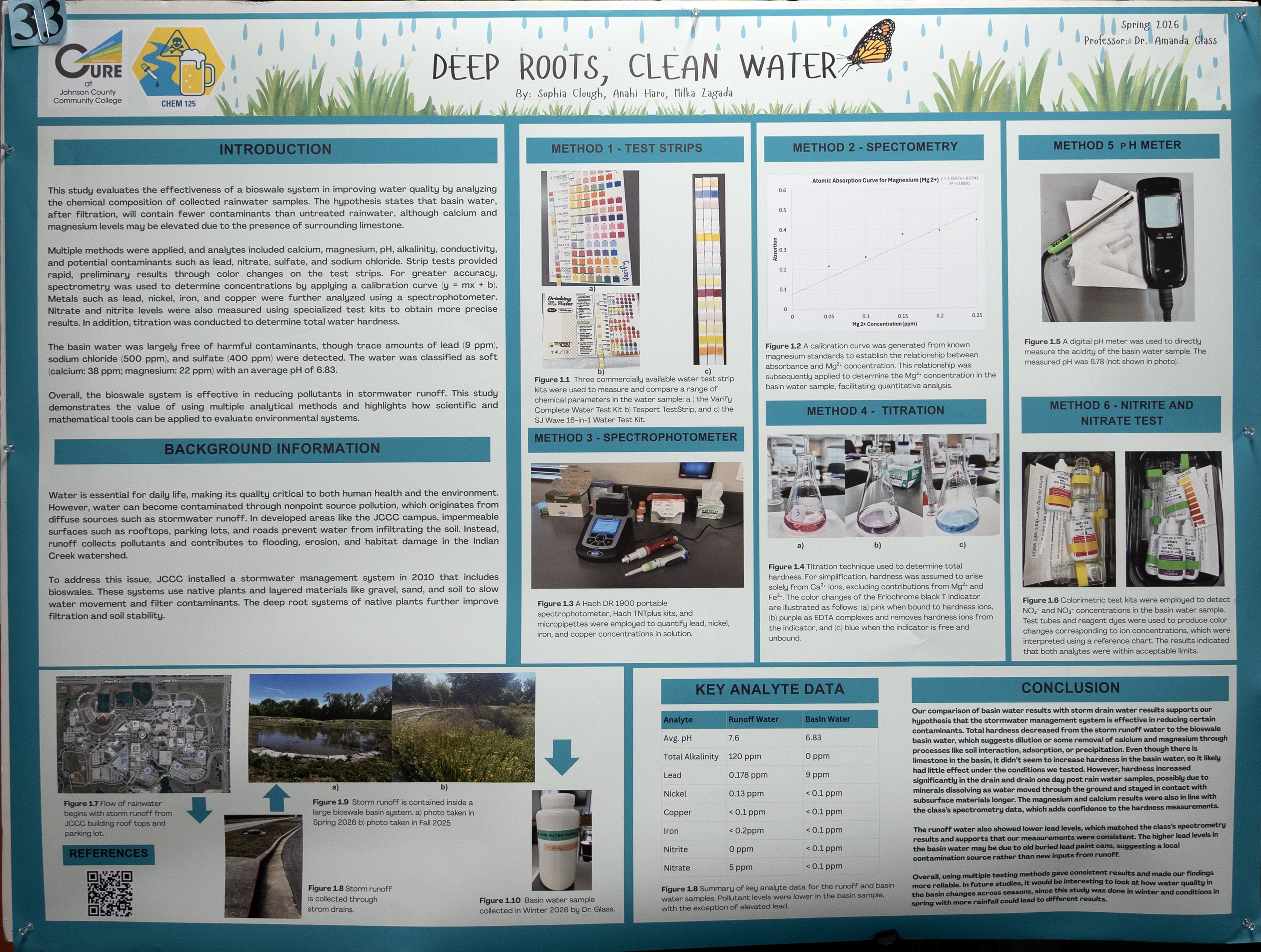
This study evaluates the effectiveness of a bioswale system in improving water quality by analyzing the chemical composition of collected rain water samples. The hypothesis states that basin water, after filtration, will contain fewer contaminants than untreated rainwater, although calcium and magnesium levels may be elevated due to the presence of surrounding limestone. Multiple methods were applied and analytes included calcium, magnesium, pH, alkalinity, conductivity, and potential contaminants such as lead, nitrate, sulfate, and sodium chloride. Strip tests provided rapid, preliminary results through color changes on the test strips. For greater accuracy, spectrometry was used to determine concentrations by applying a calibration curve (y = mx + b). Metals such as lead, nickel, iron, and copper were further analyzed using a spectrophotometer. Nitrate and nitrite levels were also measured using specialized test kits to obtain more precise results. In addition, titration was conducted to determine total water hardness. The basin water was largely free of harmful contaminants, though trace amounts of lead (9 ppm), sodium chloride (500 ppm), and sulfate (400 ppm) were detected. The water was classified as soft (calcium: 38 ppm; magnesium: 22 ppm) with an average pH of 6.83. Overall, the bioswale system is effective in reducing pollutants in stormwater runoff. This study demonstrates the value of using multiple analytical methods and highlights how scientific and mathematical tools can be applied to evaluate environmental systems.
Image
Deep Roots Clean Water
CoLab, COM 336
This study evaluates the effectiveness of a bioswale system in improving water quality by analyzing the chemical composition of collected rain water samples. The hypothesis states that basin water, after filtration, will contain fewer contaminants than untreated rainwater, although calcium and magnesium levels may be elevated due to the presence of surrounding limestone. Multiple methods were applied and analytes included calcium, magnesium, pH, alkalinity, conductivity, and potential contaminants such as lead, nitrate, sulfate, and sodium chloride. Strip tests provided rapid, preliminary results through color changes on the test strips. For greater accuracy, spectrometry was used to determine concentrations by applying a calibration curve (y = mx + b). Metals such as lead, nickel, iron, and copper were further analyzed using a spectrophotometer. Nitrate and nitrite levels were also measured using specialized test kits to obtain more precise results. In addition, titration was conducted to determine total water hardness. The basin water was largely free of harmful contaminants, though trace amounts of lead (9 ppm), sodium chloride (500 ppm), and sulfate (400 ppm) were detected. The water was classified as soft (calcium: 38 ppm; magnesium: 22 ppm) with an average pH of 6.83. Overall, the bioswale system is effective in reducing pollutants in stormwater runoff. This study demonstrates the value of using multiple analytical methods and highlights how scientific and mathematical tools can be applied to evaluate environmental systems.
Comments
The faculty mentor for this project was Amanda Glass.