

Screening Soil Microorganisms in Search for a New Antibiotic
Location
CoLab, COM 322
Start Date
30-4-2026 2:30 PM
Document Type
Poster
Description
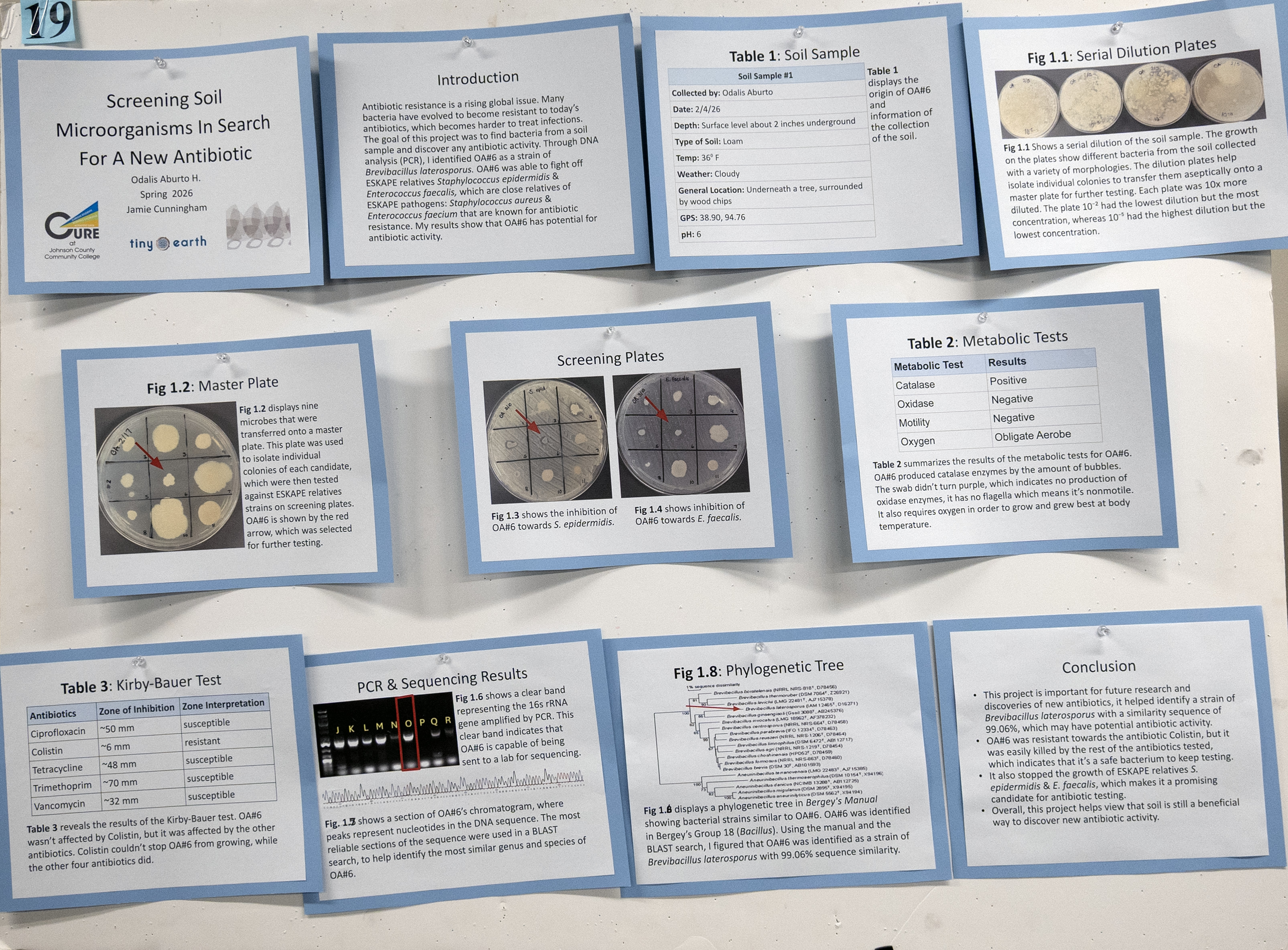
Antibiotics are medicines that have been able to treat bacterial infection throughout the years. However, bacteria have evolved to prevent drugs from killing them, this is known as antibiotic resistance. This is a major issue happening today and the importance of finding new antibiotics has been a challenge to many healthcare professionals and scientists to treat and reduce the infections happening around the world. A source of finding new antibiotics is through soil. In this project, a soil sample was collected from a local area in Kansas. The soil was diluted in order to find individual bacterial colonies, which were chosen, grown, and tested for the ability to inhibit against the ESKAPE relatives (Enterococcus faecalis, Staphylococcus epidermidis, Escherichia coli, Acinetobacter baylyi, Pseudomonas putida, and Enterobacter aerogenes). I found that there was a certain colony that inhibited the growth of three ESKAPE relatives, when being tested against each strain. There was a large inhibition zone of E. faecalis. Through further testing of this microbe, there may be a possibility that it could be making a new antibiotic. This project is important because the microbe has the potential of helping scientists develop a new antibiotic to reduce antibiotic resistance in the future.
Image
Screening Soil Microorganisms in Search for a New Antibiotic
CoLab, COM 322
Antibiotics are medicines that have been able to treat bacterial infection throughout the years. However, bacteria have evolved to prevent drugs from killing them, this is known as antibiotic resistance. This is a major issue happening today and the importance of finding new antibiotics has been a challenge to many healthcare professionals and scientists to treat and reduce the infections happening around the world. A source of finding new antibiotics is through soil. In this project, a soil sample was collected from a local area in Kansas. The soil was diluted in order to find individual bacterial colonies, which were chosen, grown, and tested for the ability to inhibit against the ESKAPE relatives (Enterococcus faecalis, Staphylococcus epidermidis, Escherichia coli, Acinetobacter baylyi, Pseudomonas putida, and Enterobacter aerogenes). I found that there was a certain colony that inhibited the growth of three ESKAPE relatives, when being tested against each strain. There was a large inhibition zone of E. faecalis. Through further testing of this microbe, there may be a possibility that it could be making a new antibiotic. This project is important because the microbe has the potential of helping scientists develop a new antibiotic to reduce antibiotic resistance in the future.
Comments
The faculty mentor for this project was Jamie Cunningham.