

Antibiotic Resistant Bacteria Isolated from Environmental Soil
Location
CoLab, COM 319
Start Date
30-4-2026 2:30 PM
Document Type
Poster
Description
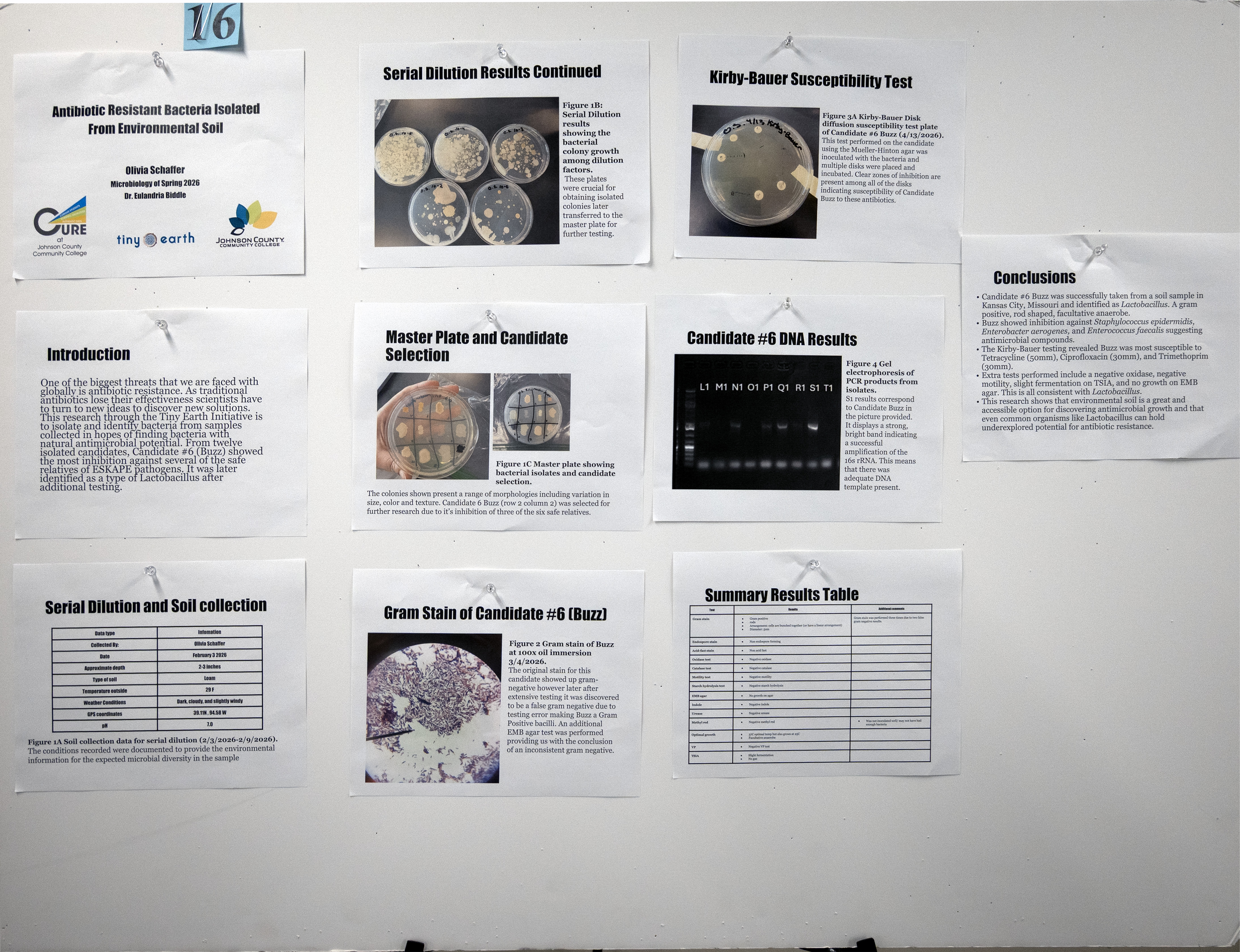
Antibiotic resistance is a rising concern within global healthcare. The purpose of this research was to isolate and identify bacteria from a soil sample collected to analyze its characteristics that may create resistant activity against other bacteria. The soil was taken through a series of serial dilutions before being plated onto a master plate where 12 individual bacteria were grown to continue studies. Candidate isolate #6 also named “Buzz” was the bacteria chosen off of the master plate for continued research after its results of inhibiting several of the safe relatives of ESKAPE pathogens. Candidate Buzz showed signs of small inhibition zones against Staphylococcus epidermidis, Enterobacter aerogenes, and a larger zone of inhibition against Enterococcus faecalis. These findings suggest that Buzz could present with antibiotic resistance among several bacteria with both gram-positive and gram-negative bacteria. Candidate Buzz after several staining processes seems to present being gram-negative and bacilli shaped. Using environmental soil samples to find antimicrobial discovery is a significant way being used to address the growing antibiotic resistance concern.
Image
Antibiotic Resistant Bacteria Isolated from Environmental Soil
CoLab, COM 319
Antibiotic resistance is a rising concern within global healthcare. The purpose of this research was to isolate and identify bacteria from a soil sample collected to analyze its characteristics that may create resistant activity against other bacteria. The soil was taken through a series of serial dilutions before being plated onto a master plate where 12 individual bacteria were grown to continue studies. Candidate isolate #6 also named “Buzz” was the bacteria chosen off of the master plate for continued research after its results of inhibiting several of the safe relatives of ESKAPE pathogens. Candidate Buzz showed signs of small inhibition zones against Staphylococcus epidermidis, Enterobacter aerogenes, and a larger zone of inhibition against Enterococcus faecalis. These findings suggest that Buzz could present with antibiotic resistance among several bacteria with both gram-positive and gram-negative bacteria. Candidate Buzz after several staining processes seems to present being gram-negative and bacilli shaped. Using environmental soil samples to find antimicrobial discovery is a significant way being used to address the growing antibiotic resistance concern.
Comments
The faculty mentor for this project was Eulandria Biddle.