

Smart Glasses for Barcode Reading and Data Display
Location
CoLab, COM 305
Start Date
30-4-2026 2:30 PM
Document Type
Poster
Description
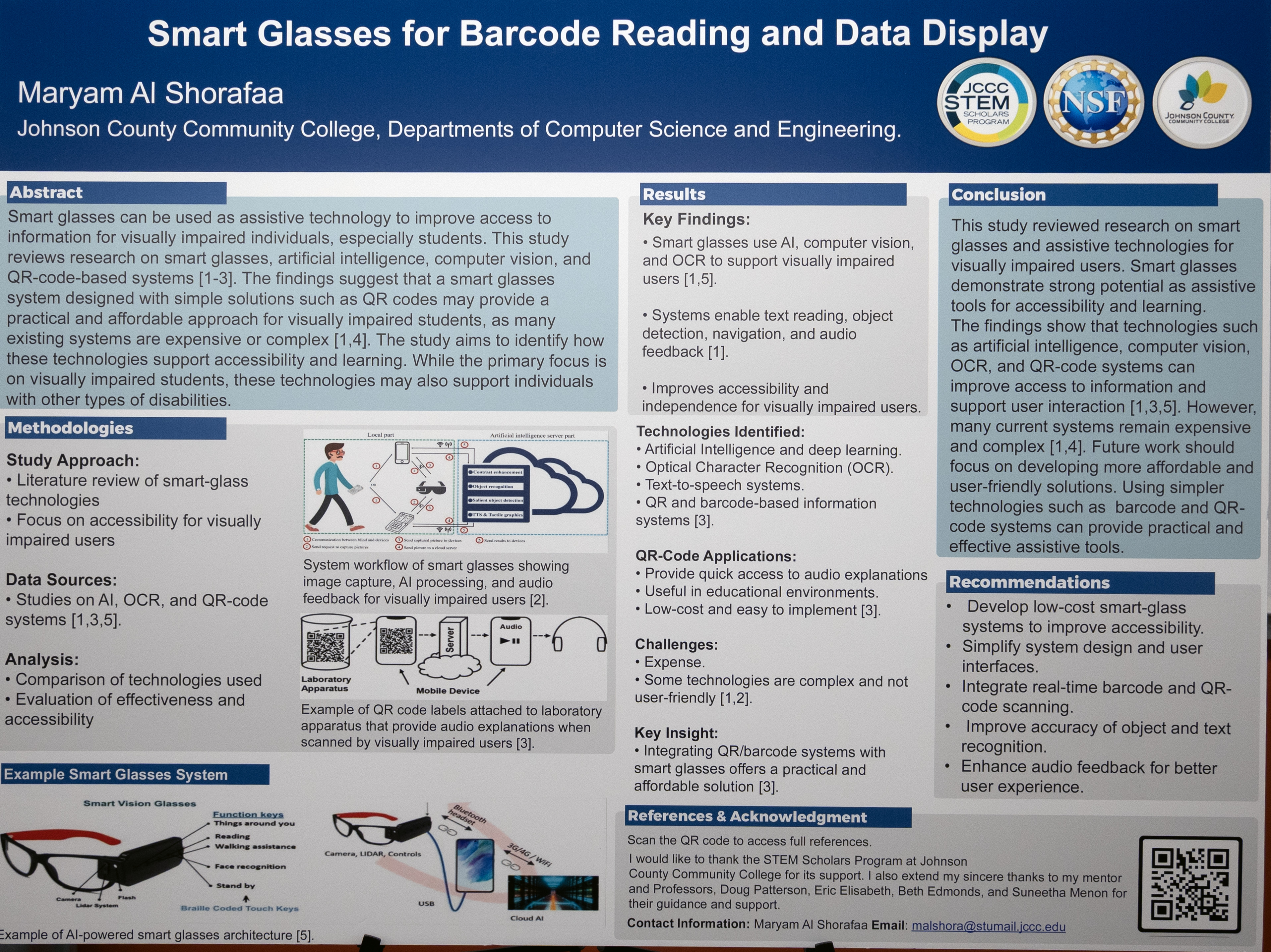
This research explores how smart glasses can be designed as an affordable and accessible tool to support learning and information access for students and people with disabilities. While many existing smart glasses focus on entertainment or commercial applications, they are often expensive and not designed with accessibility or education as a priority. This project investigates how barcode-based systems could offer a simpler and lower-cost alternative. The research is guided by the question: How can smart glasses be designed to scan barcodes and display useful information in a way that is affordable and accessible for students and people with disabilities? To address this question, the project analyzes existing studies on smart glasses, barcode and QR code recognition systems, and assistive technologies. Key challenges such as high cost, complex design, and limited accessibility are identified and examined. Rather than developing a physical prototype, this project focuses on research and conceptual analysis to explore how barcode-based smart glasses could be redesigned to prioritize usability, affordability, and educational value. The findings suggest that barcode-based systems offer a practical and effective way to provide quick access to information while reducing technical and financial barriers. This project highlights the potential of wearable technology to support inclusive learning environments and demonstrates how low-cost, research-driven design ideas can contribute to improved accessibility and information access in education.
Image
Smart Glasses for Barcode Reading and Data Display
CoLab, COM 305
This research explores how smart glasses can be designed as an affordable and accessible tool to support learning and information access for students and people with disabilities. While many existing smart glasses focus on entertainment or commercial applications, they are often expensive and not designed with accessibility or education as a priority. This project investigates how barcode-based systems could offer a simpler and lower-cost alternative. The research is guided by the question: How can smart glasses be designed to scan barcodes and display useful information in a way that is affordable and accessible for students and people with disabilities? To address this question, the project analyzes existing studies on smart glasses, barcode and QR code recognition systems, and assistive technologies. Key challenges such as high cost, complex design, and limited accessibility are identified and examined. Rather than developing a physical prototype, this project focuses on research and conceptual analysis to explore how barcode-based smart glasses could be redesigned to prioritize usability, affordability, and educational value. The findings suggest that barcode-based systems offer a practical and effective way to provide quick access to information while reducing technical and financial barriers. This project highlights the potential of wearable technology to support inclusive learning environments and demonstrates how low-cost, research-driven design ideas can contribute to improved accessibility and information access in education.
Comments
The faculty mentor for this project was Beth Edmonds.