

From Soil to Solution: Discovering Antibiotic-Producing Bacteria Against Resistant Pathogens
Location
CoLab, COM 120
Start Date
30-4-2026 8:15 AM
Document Type
Poster
Description
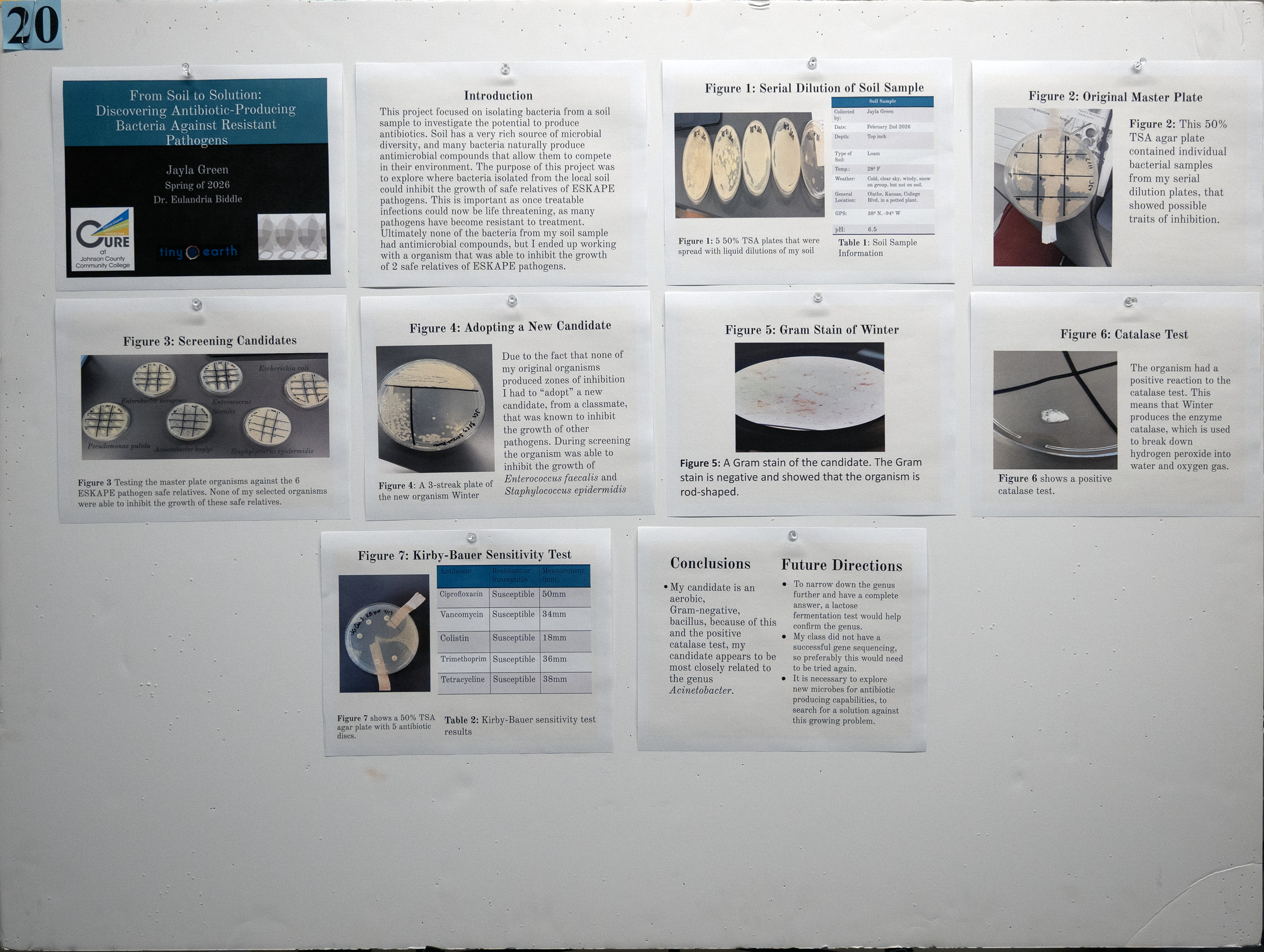
Antibiotic resistance is a growing global health concern that proves to be a threat against treating common bacterial infections, and makes it increasingly difficult to prevent and control complications. This project investigated environmental bacteria as potential sources of antibiotic resistance by isolating soil samples and screening them against safe relatives of the clinically relevant ESKAPE pathogens. The ESKAPE group includes pathogens such as Enterococcus faecium and Staphylococcus aureus; because these organisms can be hazardous to handle, non-pathogenic relatives such as Enterococcus faecalis (a model for Enterococcus faecium) and Staphylococcus epidermidis (a model for Staphylococcus aureus) are commonly used in laboratory settings to safely study similar behaviors. Soil samples were serially diluted and plated to view distinct colonies, that were then selected and purified to obtain individual isolates on a master plate. These isolates were then tested for their ability to inhibit the growth of ESKAPE pathogen safe relatives, simulating how they might act against more harmful resistant pathogens. Notably, one isolate, #1 named Winter, demonstrated clear inhibitory effects against Enterococcus faecalis and Staphylococcus epidermidis, suggesting the production of compounds with antimicrobial properties. These findings highlight the presence of naturally occurring bacteria in the environment that may contribute to the discovery of novel antimicrobial agents. Identifying organisms like Winter that can suppress the growth of other bacteria is important for addressing antibiotic resistance and advancing the development of alternative treatment strategies.
Image
From Soil to Solution: Discovering Antibiotic-Producing Bacteria Against Resistant Pathogens
CoLab, COM 120
Antibiotic resistance is a growing global health concern that proves to be a threat against treating common bacterial infections, and makes it increasingly difficult to prevent and control complications. This project investigated environmental bacteria as potential sources of antibiotic resistance by isolating soil samples and screening them against safe relatives of the clinically relevant ESKAPE pathogens. The ESKAPE group includes pathogens such as Enterococcus faecium and Staphylococcus aureus; because these organisms can be hazardous to handle, non-pathogenic relatives such as Enterococcus faecalis (a model for Enterococcus faecium) and Staphylococcus epidermidis (a model for Staphylococcus aureus) are commonly used in laboratory settings to safely study similar behaviors. Soil samples were serially diluted and plated to view distinct colonies, that were then selected and purified to obtain individual isolates on a master plate. These isolates were then tested for their ability to inhibit the growth of ESKAPE pathogen safe relatives, simulating how they might act against more harmful resistant pathogens. Notably, one isolate, #1 named Winter, demonstrated clear inhibitory effects against Enterococcus faecalis and Staphylococcus epidermidis, suggesting the production of compounds with antimicrobial properties. These findings highlight the presence of naturally occurring bacteria in the environment that may contribute to the discovery of novel antimicrobial agents. Identifying organisms like Winter that can suppress the growth of other bacteria is important for addressing antibiotic resistance and advancing the development of alternative treatment strategies.
Comments
The faculty mentor for this project was Eulandria Biddle.