

What’s in the Water After Rain? A Chemical Analysis of Post-Storm Drain and Runoff Water at JCCC
Location
CoLab, COM 207
Start Date
30-4-2026 10:45 AM
Document Type
Poster
Description
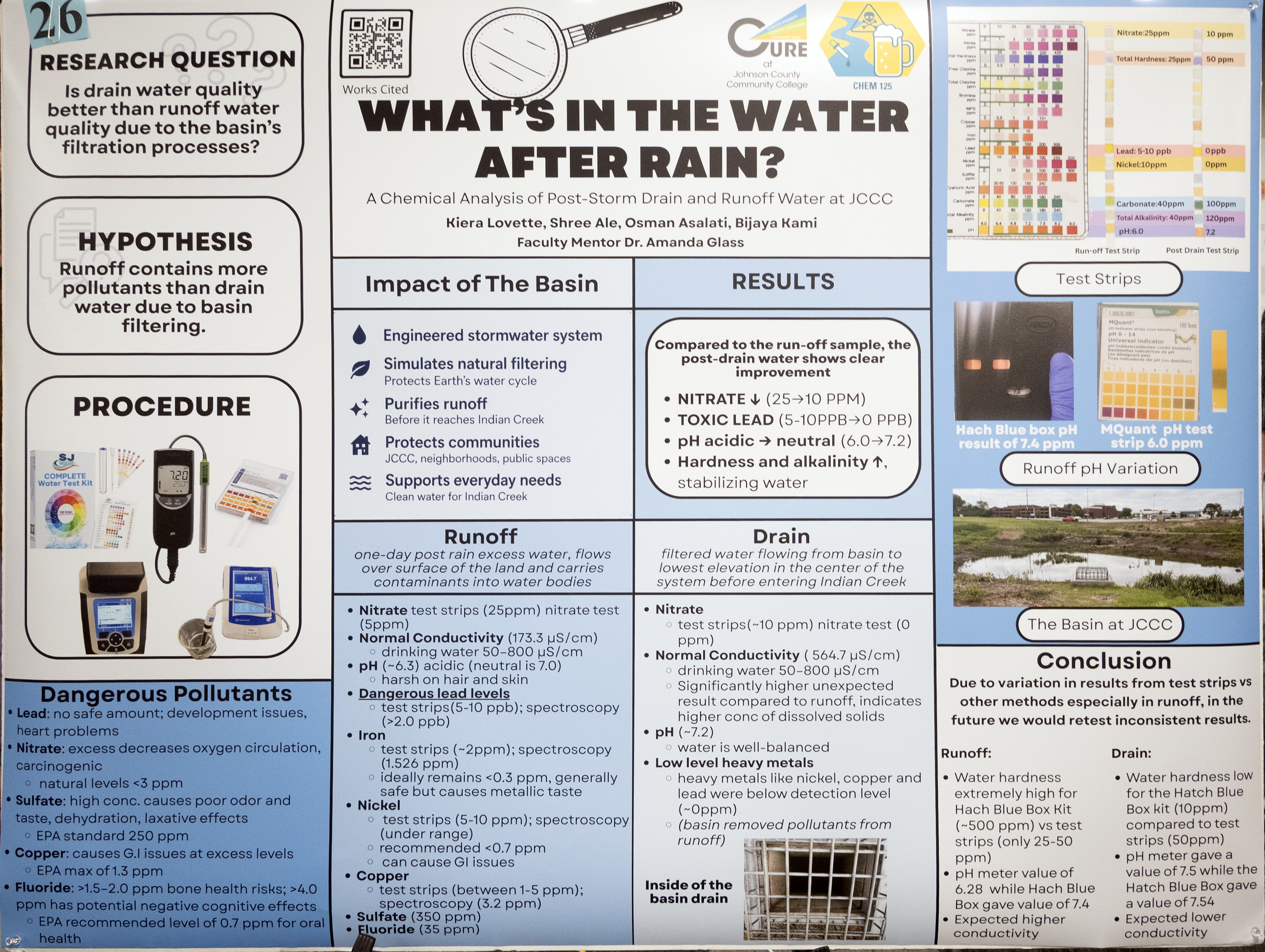
This study examines the quality of a drain water sample one day post rain and run-off sample collected one day after rainfall from the Johnson County Community College (JCCC) campus to evaluate the impact of stormwater runoff on water quality. Rainfall can carry pollutants from surrounding surfaces into drainage systems, making it important to analyze changes in water composition. Multiple tests, including pH measurements, conductivity, test strips, and spectrophotometric analysis, were used to assess chemical properties and detect potential contaminants. The results for both samples showed water had a near neutral pH (6.5–7.5), indicating it was neither strongly acidic nor basic. Nitrite, nitrate, and heavy metals such as lead, nickel, iron, and copper were found to be very low in drain water while run-off had higher concentration of nitrate and some concentration of copper. For rainfall water, conductivity (~568 µS/cm) and elevated sulfate levels (~800 ppm) suggest the presence of dissolved ions, likely introduced through runoff after rainfall. In contrast, run-off water had a conductivity (~173.3 µS/cm) and sulfate levels (~350ppm) suggest a moderate of dissolved ions. Overall, the findings suggest that while the post-rain drain and run-off water is not heavily contaminated with toxic metals, it contains moderate levels of dissolved substances that may influence water quality. This study highlights the role of rainfall and runoff in transporting pollutants into urban drainage systems and emphasizes the importance of monitoring these changes to better manage environmental impacts.
Image
What’s in the Water After Rain? A Chemical Analysis of Post-Storm Drain and Runoff Water at JCCC
CoLab, COM 207
This study examines the quality of a drain water sample one day post rain and run-off sample collected one day after rainfall from the Johnson County Community College (JCCC) campus to evaluate the impact of stormwater runoff on water quality. Rainfall can carry pollutants from surrounding surfaces into drainage systems, making it important to analyze changes in water composition. Multiple tests, including pH measurements, conductivity, test strips, and spectrophotometric analysis, were used to assess chemical properties and detect potential contaminants. The results for both samples showed water had a near neutral pH (6.5–7.5), indicating it was neither strongly acidic nor basic. Nitrite, nitrate, and heavy metals such as lead, nickel, iron, and copper were found to be very low in drain water while run-off had higher concentration of nitrate and some concentration of copper. For rainfall water, conductivity (~568 µS/cm) and elevated sulfate levels (~800 ppm) suggest the presence of dissolved ions, likely introduced through runoff after rainfall. In contrast, run-off water had a conductivity (~173.3 µS/cm) and sulfate levels (~350ppm) suggest a moderate of dissolved ions. Overall, the findings suggest that while the post-rain drain and run-off water is not heavily contaminated with toxic metals, it contains moderate levels of dissolved substances that may influence water quality. This study highlights the role of rainfall and runoff in transporting pollutants into urban drainage systems and emphasizes the importance of monitoring these changes to better manage environmental impacts.
Comments
The faculty mentor for this project was Amanda Glass.