

Bioprospecting Soil Microbes for Novel Antibiotic Activity
Location
CoLab, COM 200
Start Date
30-4-2026 10:45 AM
Document Type
Poster
Description
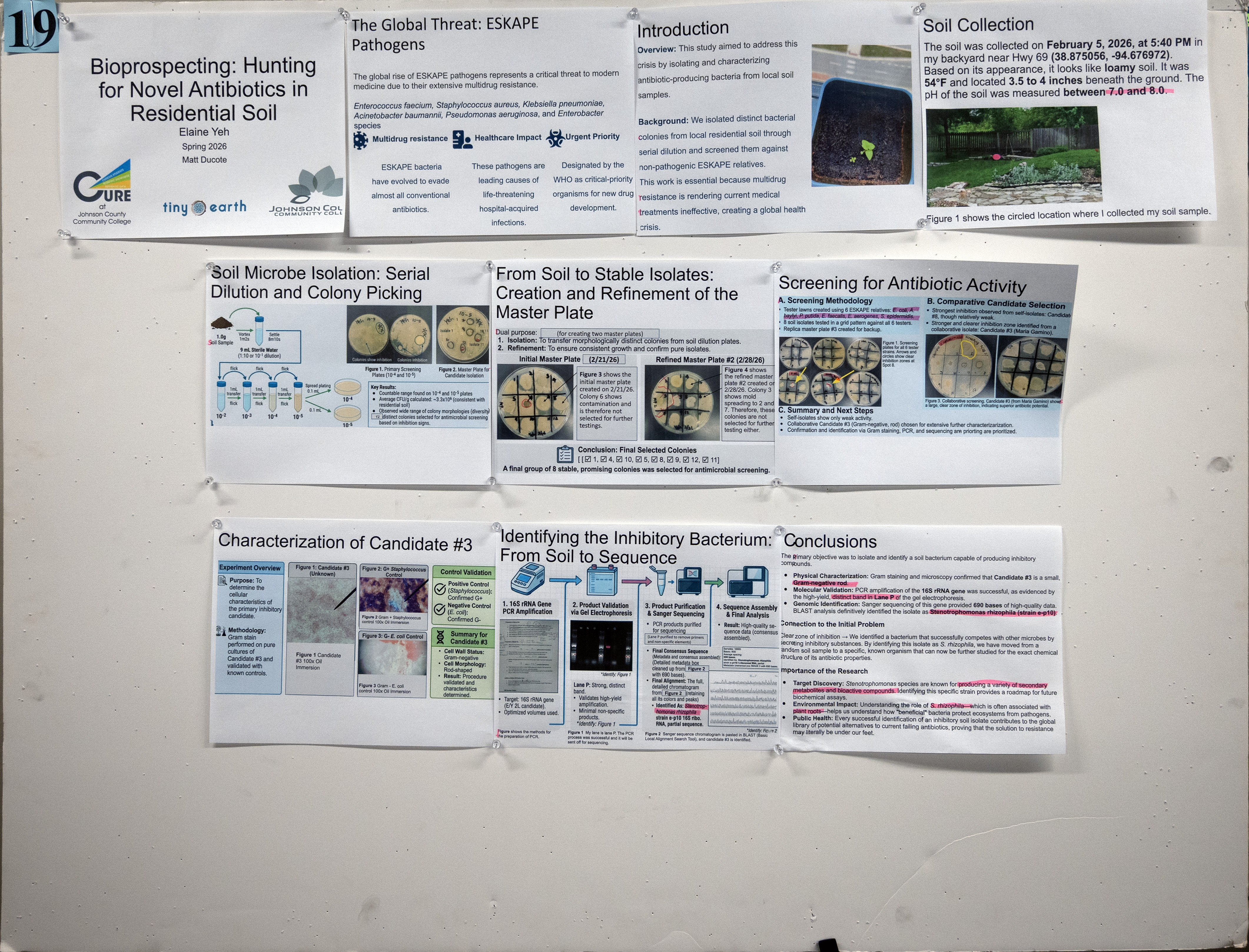
The global rise of ESKAPE pathogens represents a critical threat to modern medicine due to their extensive multidrug resistance. This study aimed to address this crisis by isolating and characterizing antibiotic-producing bacteria from local soil samples. Using a serial dilution method, soil from a residential environment was screened, resulting in the selection of eight morphologically distinct colonies (Isolates 1, 4, 10, 5, 8, 9, 12, and 11) for antibiotic screening. Antimicrobial activity was tested against non-pathogenic ESKAPE relatives, including Escherichia coli, Acinetobacter baylyi, Staphylococcus epidermidis, Enterococcus faecalis, Enterobacter aerogenes, and Pseudomonas putida. While Isolate #8 demonstrated minor inhibitory activity, Candidate #3 (a collaborative isolate) exhibited a significantly clearer zone of inhibition against the tester strains. Following the identification of this inhibitory candidate, Gram staining was performed and validated using Staphylococcus (Gram-positive cocci) and E. coli (Gram-negative rods) controls. Candidate #3 was characterized as a Gram-negative rod, suggesting specific cell wall properties relevant to its antimicrobial profile. Finally, the 16S rRNA gene was amplified via PCR and analyzed through gel electrophoresis to identify the species. This research underscores the importance of environmental bioprospecting in identifying novel Gram-negative microbes that may combat the increasing "escape" of pathogens from current treatments.
Image
Bioprospecting Soil Microbes for Novel Antibiotic Activity
CoLab, COM 200
The global rise of ESKAPE pathogens represents a critical threat to modern medicine due to their extensive multidrug resistance. This study aimed to address this crisis by isolating and characterizing antibiotic-producing bacteria from local soil samples. Using a serial dilution method, soil from a residential environment was screened, resulting in the selection of eight morphologically distinct colonies (Isolates 1, 4, 10, 5, 8, 9, 12, and 11) for antibiotic screening. Antimicrobial activity was tested against non-pathogenic ESKAPE relatives, including Escherichia coli, Acinetobacter baylyi, Staphylococcus epidermidis, Enterococcus faecalis, Enterobacter aerogenes, and Pseudomonas putida. While Isolate #8 demonstrated minor inhibitory activity, Candidate #3 (a collaborative isolate) exhibited a significantly clearer zone of inhibition against the tester strains. Following the identification of this inhibitory candidate, Gram staining was performed and validated using Staphylococcus (Gram-positive cocci) and E. coli (Gram-negative rods) controls. Candidate #3 was characterized as a Gram-negative rod, suggesting specific cell wall properties relevant to its antimicrobial profile. Finally, the 16S rRNA gene was amplified via PCR and analyzed through gel electrophoresis to identify the species. This research underscores the importance of environmental bioprospecting in identifying novel Gram-negative microbes that may combat the increasing "escape" of pathogens from current treatments.
Comments
The faculty mentor for this project was Matt Ducote.