

Location
CoLab, COM 100
Start Date
1-5-2025 9:45 AM
Document Type
Poster
Description
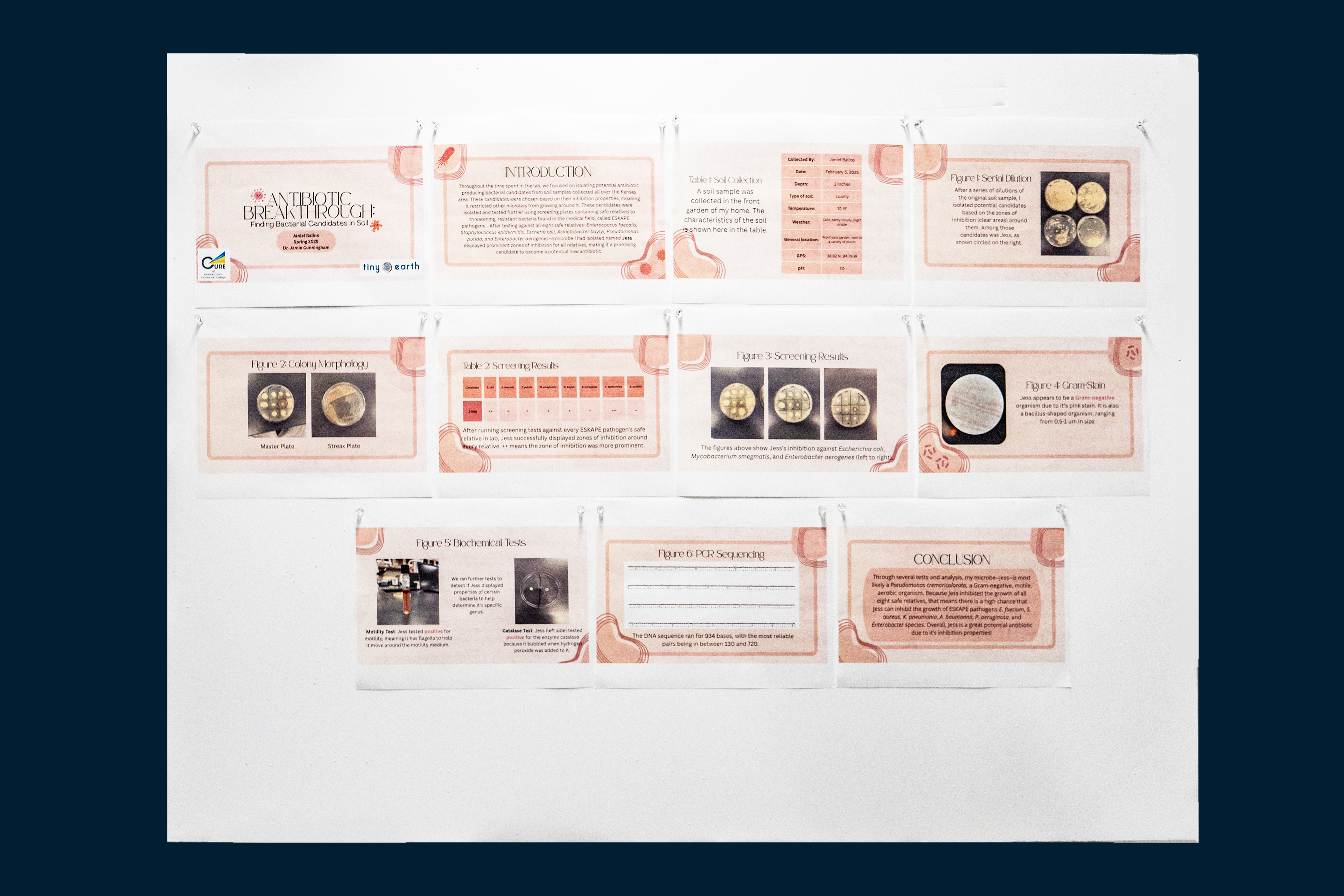
Antibiotic resistance has become an increasing problem in healthcare over the past couple of years. Many bacteria have shown resistant properties against existing antibiotics established in the field today, making certain illnesses harder to cure. It is with this rising concern that we take action. Throughout the time spent in the lab, we focused on isolating potential antibiotic producing bacterial candidates from soil samples collected all over the Kansas area. These candidates were chosen based on their inhibition properties, meaning it restricted other microbes from growing around it. These candidates were isolated and tested further using screening plates containing safe relatives to threatening, resistant bacteria found in the medical field, called ESKAPE pathogens. These pathogens include Enterococcus faecium, Staphylococcus aureus, Klebsiella pneumonia, Acinetobacter baumannii, Pseudomonas aeruginosa, and Enterobacter species. After testing against all eight relatives–Enterococcus faecalis, Staphylococcus epidermidis, Escheria coli, Acinetobacter baylyi, Pseudomonas putida, and Enterobacter aerogenes–a microbe I had isolated named Jess displayed prominent zones of inhibition for all relatives, making it a promising candidate to become a potential new antibiotic. This discovery pushes healthcare a step forward in finding possible antibiotic candidates in attainable and extensive environments such as soil.
Image
Antibiotic Breakthrough: Finding Bacterial Candidates in Soil
CoLab, COM 100
Antibiotic resistance has become an increasing problem in healthcare over the past couple of years. Many bacteria have shown resistant properties against existing antibiotics established in the field today, making certain illnesses harder to cure. It is with this rising concern that we take action. Throughout the time spent in the lab, we focused on isolating potential antibiotic producing bacterial candidates from soil samples collected all over the Kansas area. These candidates were chosen based on their inhibition properties, meaning it restricted other microbes from growing around it. These candidates were isolated and tested further using screening plates containing safe relatives to threatening, resistant bacteria found in the medical field, called ESKAPE pathogens. These pathogens include Enterococcus faecium, Staphylococcus aureus, Klebsiella pneumonia, Acinetobacter baumannii, Pseudomonas aeruginosa, and Enterobacter species. After testing against all eight relatives–Enterococcus faecalis, Staphylococcus epidermidis, Escheria coli, Acinetobacter baylyi, Pseudomonas putida, and Enterobacter aerogenes–a microbe I had isolated named Jess displayed prominent zones of inhibition for all relatives, making it a promising candidate to become a potential new antibiotic. This discovery pushes healthcare a step forward in finding possible antibiotic candidates in attainable and extensive environments such as soil.
Comments
The faculty mentor for this project was Jamie Cunningham, Biology.